Matrimonial litigation has become a privacy battlefield: call records, hotel bookings, WhatsApp exports, location history, secret recordings. In July 2026 the collision reached the Supreme Court, which declined to disturb a Delhi High Court order in a matter where a wife sought her husband's hotel-stay records to prove adultery, leaving the High Court's approach standing. The same week, the Court held that a conclusive DNA test excluding paternity ends a maintenance claim, science cutting through presumption in the other direction. Together the rulings frame the question every separating spouse eventually asks a lawyer: what am I allowed to collect, and what will collecting it cost me? This guide maps the law: the relaxed evidence regime of Section 14 of the Family Courts Act, the Puttaswamy privacy right that now pushes against it, the rules for each category of proof, and the strategic truth that the route by which evidence was obtained now matters nearly as much as what it shows.
Part of the family and divorce law practice at S Jain & Attorneys, Bangalore.
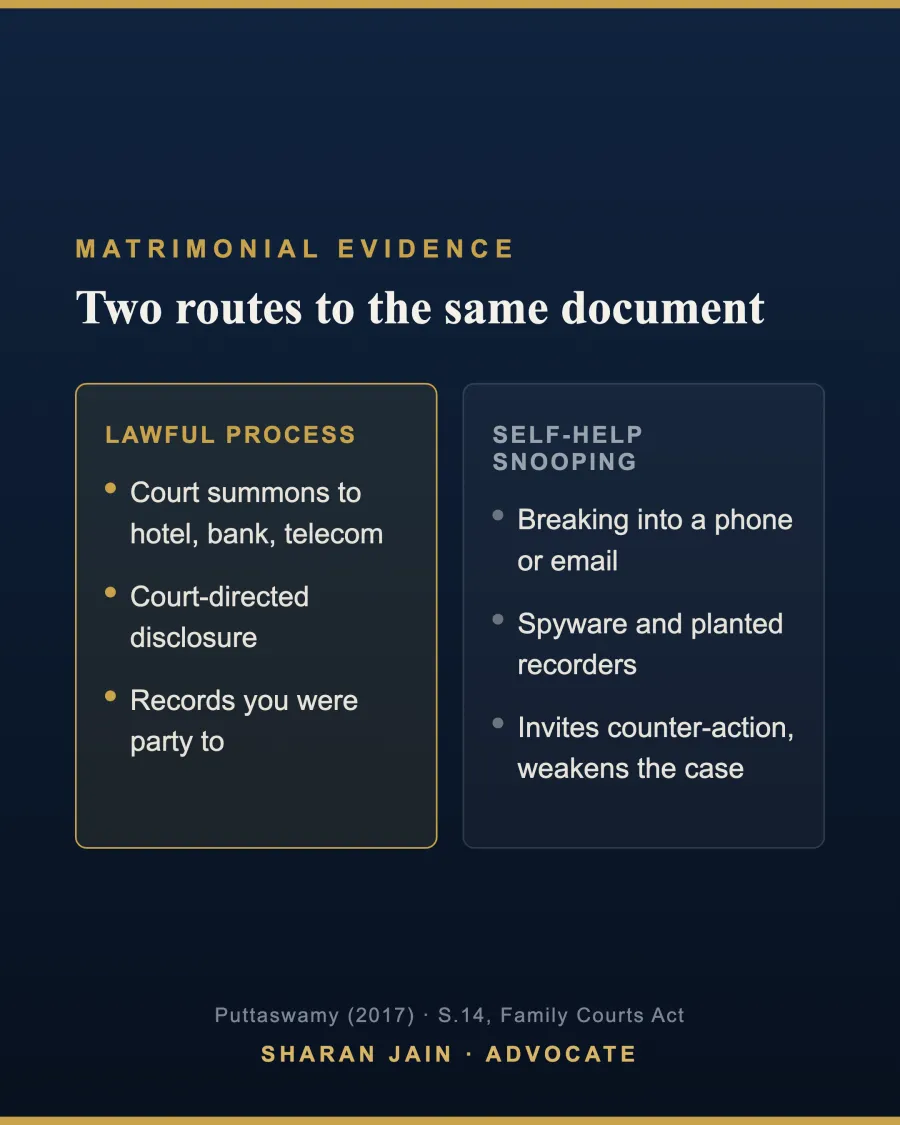
Key takeaway. Ask the court for the document; do not steal it. Evidence summoned through lawful process, hotel registers, call detail records, bank statements, arrives clean and lands with full force. Evidence extracted by breaking into a phone or planting a recorder arrives contaminated: its admissibility becomes a fight, its collection can breed counter-cases, and it tells the judge something about you.
The two rights in tension
Since Justice K.S. Puttaswamy v. Union of India, (2017) 10 SCC 1, decided on 24 August 2017, privacy is a fundamental right, and marriage does not extinguish it: spouses do not acquire a general licence to surveil each other. At the same time, matrimonial wrongs happen behind closed doors by their nature, and Parliament long ago recognised that strict evidence rules would make matrimonial proof impossible. Section 14 of the Family Courts Act, 1984 therefore provides that a family court may receive as evidence any report, statement, document, information or matter that in its opinion assists it to deal effectually with the dispute, whether or not it would be otherwise relevant or admissible under the evidence law. Section 20 of the same Act gives its provisions effect notwithstanding anything inconsistent in any other law, which is why Section 14 is not read down by ordinary evidentiary objections.
Those two provisions pull in opposite directions, and the case law of the last few years, including the July 2026 hotel-records matter, is the judiciary drawing the line case by case. The pattern that has emerged is not about the type of evidence; it is about the route:
| Route | Examples | How courts treat it |
|---|---|---|
| Lawful process | Summons to hotels, airlines, telecoms, banks; court-directed disclosure; interrogatories | Strong footing; relevance and proportionality are the only real battlegrounds |
| Own records | Chats and emails you were party to; joint account statements; photos taken openly | Admissible subject to authentication; the workhorse of most cases |
| Self-help surveillance | Breaking into a phone, spyware, planted recorders, impersonation to extract records | Contested admissibility, adverse judicial impression, and exposure to counter-proceedings |
The hotel-records matter: what it does and does not decide
The July 2026 proceedings arose from a wife's attempt to obtain her husband's hotel-stay details to prove adultery; the Supreme Court declined to interfere with the Delhi High Court's order on the point. Without wading into the parties' facts, the structural significance is this: the fight was about court-ordered production, records summoned from a third party through judicial process, not about self-help. That is exactly where the battle line now runs. Courts weigh the relevance of the records sought against the privacy intrusion, and third-party records with direct probative value on a pleaded ground sit on the strong side of that balance. What no recent decision blesses is the spouse who bypasses the court and extracts the records themselves.
The evidence law has been renumbered
One practical trap deserves flagging before the categories. The Indian Evidence Act, 1872 was replaced by the Bharatiya Sakshya Adhiniyam, 2023 with effect from 1 July 2024, and the sections everyone in matrimonial practice quotes have moved. Older articles, older pleadings and older judgments use the old numbers, so keep both in mind.
| What it governs | Old provision | Current provision | Why it matters in a divorce file |
|---|---|---|---|
| Admissibility of electronic records and the accompanying certificate | Section 65B, Indian Evidence Act, 1872 | Section 63, Bharatiya Sakshya Adhiniyam, 2023 | Every chat export, screenshot, call recording and CCTV clip needs it |
| Communications between spouses during marriage | Section 122, Indian Evidence Act, 1872 | Section 128, Bharatiya Sakshya Adhiniyam, 2023 | The privilege expressly does not apply in suits between the married persons themselves |
| Legitimacy of a child born during a valid marriage | Section 112, Indian Evidence Act, 1872 | Section 116, Bharatiya Sakshya Adhiniyam, 2023 | The conclusive presumption that gates every paternity and DNA application |
| Expert opinion | Section 45, Indian Evidence Act, 1872 | Section 39, Bharatiya Sakshya Adhiniyam, 2023 | Handwriting, forensic examination of devices, medical opinion |
Category by category: the practical rules
- WhatsApp chats and emails you were party to: usable, and the most common proof in modern matrimonial files. The friction is authentication: electronic records need the certificate under Section 63 of the Bharatiya Sakshya Adhiniyam, 2023 (the successor to the old Section 65B), covering the device and the process of extraction. Export chats properly, preserve the device, and do not edit anything.
- Chats obtained from the spouse's phone without consent: contested territory. Some courts have received such material under Section 14's width; others have rebuked the intrusion, and the collection itself can found complaints. If the material matters, the cleaner route is to plead its existence and seek discovery or seizure through the court.
- Call detail records (CDRs): obtainable only through court summons to the telecom provider; private procurement of another person's CDRs is unlawful, full stop. Courts do summon them where relevance is pleaded, they show contact patterns, not content.
- Hotel, travel and financial records: the July matter's territory. Summons to the third party, with a pleaded case making the records relevant, is the route; courts calibrate the window and scope of what is produced.
- Secret audio recordings of the spouse: the most litigated category, and the one where the law moved decisively in 2025. In Vibhor Garg v. Neha, 2025 INSC 829 (Supreme Court, 14 July 2025) a husband produced a compact disc of telephone conversations with his wife, recorded without her knowledge, in his divorce petition. The Family Court at Bathinda allowed it in; the Punjab and Haryana High Court set that order aside, holding that admitting it would infringe the wife's right to privacy. The Supreme Court set aside the High Court's order and restored the Family Court's, reading Section 122 of the Evidence Act, now Section 128 of the Bharatiya Sakshya Adhiniyam, together with Section 14 of the Family Courts Act, and holding there is no bar on a spouse producing such a recording in proceedings between the married parties themselves. Note the boundary: this is about conversations you were a party to. Planted-device interception of conversations you were not part of sits somewhere else entirely, legally and tactically. And quality, tampering allegations and context still consume trials, so treat recordings as corroboration, not as the case.
- Photographs, detectives and social media: public-domain material and openly taken photographs are fair game; trespass, hacking and impersonation are not, whoever performs them. Instruct any investigator in writing within those limits, because their methods become your methods in the courtroom.
- Financial disclosure: in maintenance and alimony, the heavy lifting is done not by surveillance but by the compulsory affidavits of assets and liabilities the Supreme Court mandated in Rajnesh v. Neha (Supreme Court, 4 November 2020), backed by the court's power to summon bank, tax and employment records. Most spouses who imagine they need spyware actually need a well-drafted disclosure application.
Common mistake. Building the case first and asking legal questions later. By the time a spouse arrives with a phone full of extracted chats and a drawer of recordings, they have often converted a strong maintenance or cruelty case into a two-front war, their proof contested, their conduct counter-alleged. The consultation should come before the collection, not after.
How to get third-party records the lawful way
The mechanics are unglamorous and they work. This is the sequence in a family court proceeding.
- Plead the fact first. A court will not summon hotel or telecom records to see whether something happened. Plead the specific allegation, with dates and places, so the records sought are relevant to an issue already on the record.
- Identify the custodian precisely. Name the hotel and its operating company, the telecom circle, the bank and branch, or the employer, with an address that will accept service. Vague applications are refused or die in service.
- File an application for production or a witness summons. Ask the court to summon the custodian to produce specified documents for a specified window. Narrow windows are granted; fishing expeditions are not.
- Justify proportionality expressly. Say why the record is necessary, why a narrower alternative will not do, and how the privacy intrusion is limited. This is the paragraph the other side will attack, so write it as if you were the judge.
- Ask for the custodian's certificate along with the record. For anything electronic, the Section 63 certificate must come from the person producing the output. Getting it later is far harder.
- Use interrogatories and a disclosure affidavit in parallel. In maintenance and alimony, the Rajnesh v. Neha affidavit of assets and liabilities often produces more than any summons, and non-disclosure in it carries its own consequences.
- Prove the document at trial. Formal evidence can go in by affidavit under Section 16 of the Family Courts Act, but keep the custodian available; a record nobody proves is a record the court can ignore.
DNA, paternity and the limits of scientific proof
The same week's other ruling completes the picture. The Supreme Court held that a maintenance claim cannot survive against a man whom a conclusive DNA test excludes as the father. But the gateway remains narrow. Section 112 of the Indian Evidence Act, now Section 116 of the Bharatiya Sakshya Adhiniyam, 2023, makes the fact that a person was born during a valid marriage, or within 280 days of its dissolution with the mother remaining unmarried, conclusive proof of legitimacy, unless it is shown that the parties had no access to each other when the child could have been begotten. Courts therefore order DNA tests sparingly.
The standard has been consistent for three decades. In Goutam Kundu v. State of West Bengal (Supreme Court, 14 May 1993) the Court held that Indian law leans towards legitimacy and that a blood test is not to be ordered as a matter of course. In Sharda v. Dharmpal (Supreme Court, 28 March 2003) the Court confirmed that a matrimonial court has the power to direct a medical examination, exercised with circumspection. And in Aparna Ajinkya Firodia v. Ajinkya Arun Firodia (Supreme Court, 20 February 2023) the Court held that a DNA test of a child should be directed only in exceptional and deserving cases, where it is eminently needed and the controversy cannot be resolved without it, and that the court must weigh the consequences for the child, including stigma and inheritance. The two-step structure, reluctance to order tests but fidelity to their conclusive results once lawfully obtained, is the same balance the hotel-records line draws: process first, and science or records second. The wider strategic landscape of ending a marriage, mutual consent, contested grounds and the Article 142 route, is mapped in our guide to divorce when consent is impossible.
Four things gate a DNA direction in a matrimonial case.
Section 116 presumption
Birth during a valid marriage, or within 280 days of its dissolution with the mother remaining unmarried, is conclusive proof of legitimacy unless non-access is shown.
Goutam Kundu, 1993
Indian law leans towards legitimacy, and a blood test is not to be ordered as a matter of course.
Sharda v. Dharmpal, 2003
A matrimonial court does have the power to direct a medical examination, but that power is to be exercised with circumspection.
Aparna Ajinkya Firodia, 2023
A DNA test of a child is for exceptional and deserving cases only, where the controversy cannot be resolved without it and after weighing stigma and inheritance.
Deadline warning. Electronic evidence degrades on a schedule you do not control. Telecom call detail records are retained for a limited period, hotel and airline systems purge older bookings, and cloud chat backups roll over. If records more than a few months old matter to your case, the application to summon them is urgent, and so is a written request to the custodian to preserve them pending the court's order. Do not factory-reset or replace the phone that holds your own evidence; the device itself is part of the proof under Section 63.
What a family court can and cannot be asked to do
Three features of the Family Courts Act shape how all of this plays out, and clients are usually unaware of them.
- Proceedings can be held in camera. Under Section 11, the court may hold proceedings in camera if it wishes and shall do so if either party asks. Where the evidence is intimate, ask.
- Representation is not a right. Section 13 says no party is entitled as of right to be represented by a legal practitioner, though courts routinely permit it and may appoint a legal expert as amicus curiae. Practice varies; do not assume.
- Appeals are short. Section 19 gives an appeal to the High Court on facts and on law from every judgment or order that is not interlocutory, and it must generally be preferred within thirty days.
How judges actually read evidence files
A practice observation that changes how clients collect: family judges read evidence twice, once for what it proves about the spouse, and once for what it reveals about the collector. A file of lawfully summoned records reads as a wronged party seeking the truth. A file of extracted phone data and hours of ambient recordings reads as obsession, and it invites the court to discount genuine grievances. The strongest matrimonial files I have seen share three features: they are thin (a dozen probative documents, not five hundred), they are clean (every item has a lawful provenance the client can state in one sentence), and they are corroborated (each private allegation is anchored to something a third party or a court process produced). Collect like the file will be cross-examined, because it will be. The place these cases most often come apart is not admissibility at all; it is that the client produced four hundred pages and could not, under cross-examination, say where any particular page came from.
Frequently Asked Questions
Can WhatsApp chats be used as evidence in divorce cases?
Yes, particularly conversations you were party to, subject to the electronic-records certificate under Section 63 of the Bharatiya Sakshya Adhiniyam. Chats extracted from a spouse's device without consent are contested territory; seek discovery through the court instead.
How do I get hotel records or call records for a divorce case?
Through a court summons to the hotel or telecom provider, with a pleaded case showing relevance, the route at issue in the July 2026 matter the Supreme Court left undisturbed. Private procurement of another person's records is unlawful.
Is secretly recording my spouse legal?
In Vibhor Garg v. Neha, 2025 INSC 829, decided on 14 July 2025, the Supreme Court restored a family court order admitting a husband's covert recording of telephone conversations with his wife, holding that the spousal-communication privilege does not bar it in proceedings between the spouses themselves. That covers conversations you took part in. Planted-device interception of conversations you were not part of sits in the danger zone legally and tactically, and court-directed evidence is always the safer route.
Do strict evidence rules apply in family court?
No. Section 14 of the Family Courts Act lets the court receive any material that assists it, whether or not otherwise admissible, and Section 20 gives the Act overriding effect. That shifts the real fight to how the material was obtained and what it is worth.
Can a court order a DNA test in a matrimonial case?
Only sparingly, on a strong prima facie case, because of the conclusive legitimacy presumption in Section 116 of the Bharatiya Sakshya Adhiniyam (formerly Section 112 of the Evidence Act) and the child's privacy. Goutam Kundu and Aparna Ajinkya Firodia set the threshold. Once a lawfully ordered test is conclusive, courts follow it, as the July 2026 maintenance ruling shows.
Will illegally obtained evidence be rejected outright?
Not automatically; Indian law has no absolute exclusionary rule and Section 14 is wide. But admissibility fights, tampering allegations, counter-proceedings and judicial distaste are real costs, which is why provenance discipline wins cases.
How is a spouse's real income proved for maintenance?
Through the mandatory asset-and-liability affidavits under Rajnesh v. Neha, plus court-summoned bank, tax and employment records, far more effective than surveillance, and entirely lawful.
Can my spouse use my own social media posts against me?
Yes. Public posts are fair game for both sides, and deleted posts often survive in screenshots. Assume everything public will be read aloud in court.
Can I ask for the hearing to be held privately?
Yes. Under Section 11 of the Family Courts Act the court may hold proceedings in camera on its own view and must do so if either party desires it, which matters when intimate recordings, medical records or financial affairs are going on the record.
This article is for general informational purposes only and does not constitute legal advice. Specific situations need specific counsel.