
Yes, an apartment association can generate its own power, and the Electricity Act, 2003 has said so since the day it was passed. Section 2(8) defines a captive generating plant to include a plant set up by a co-operative society or an association of persons to generate electricity primarily for the use of its members, and Section 9(1) allows any person to construct, maintain or operate a captive generating plant without a licence. Bengaluru's gated communities received striking news in July 2026: reports that apartment complexes can now set up their own power stations to supply residents. The timing is loaded, because the same season has KERC proposing steep cuts to rooftop solar export tariffs for 2026-29, draft regulations that would mandate battery storage for rooftop systems above 10 kW, and the loudest fight over electricity distribution Karnataka has seen in decades.
Part of the RERA and homebuyer disputes practice at S Jain & Attorneys, Bangalore.
Community energy is genuinely promising for a power hungry city of dense high rises. But an apartment association is a consumer collective, not a utility, until the day it signs papers that make it one, and most RWA energy disasters are contract disasters signed in enthusiasm at an AGM. This guide gives managing committees the full legal picture: the statutory hooks that make community generation lawful, the ownership models and their radically different risk profiles, the metering and tariff conditions that decide project economics, the association-law formalities that make the decision valid, and the questions to force onto the table before any vendor's presentation ends in a signature.
Key takeaway. The first question is never the technology; it is who owns the asset. An association that owns a power plant owns its warranties, its maintenance, its failures and its liabilities for twenty years. An association that buys output under an opex model owns a contract, and everything then depends on what that contract says about exit, performance and failure. Decide the model first; everything else follows from it.
The legal foundations: what lets a community generate at all
Three legal layers stack up behind the headline:
- The Electricity Act, 2003. Section 2(8) defines a captive generating plant to include one set up by a co-operative society or an association of persons to generate electricity primarily for the use of its members, which is the statutory hook a residents' association actually stands on. Section 9(1) permits captive generation without a licence, and Section 9(2) gives a captive generator the right to open access to carry electricity from the plant to the destination of its use, subject to transmission availability. Section 43 keeps the distribution licensee's duty to supply on request intact, and Section 42 governs open access. Distribution to third parties remains licensed territory; supplying your own members within a defined premises is the space community projects occupy, and the July 2026 reports mark Karnataka operationalising exactly that space for gated communities.
- The captive test in the Electricity Rules, 2005. Rule 3 sets the qualifying conditions for a captive generating plant: the captive users must together hold not less than 26 percent of the ownership and consume not less than 51 percent of the electricity generated, determined on an annual basis, with consumption in proportion to ownership. For a rooftop plant owned by the association itself and consumed inside the complex the test is usually easy. It becomes a live issue the moment a special purpose vehicle, a developer stake or an outside investor enters the ownership chart, and it is a question to answer before the shareholding is fixed, not after.
- KERC's regulations decide the economics: net metering and banking rules, export tariffs, connection charges, and the pending DSPV (distributed solar) framework. These are being redrawn right now, which is the single most important fact for any committee evaluating a vendor's payback spreadsheet.
- Association law. Under the Karnataka Apartment Ownership Act, 1972 and the societies/KOFA framework, common-area decisions of this magnitude need the association's bye-laws followed to the letter: general-body resolutions with the prescribed majority, transparent procurement, and committee authority properly recorded. Section 3 of the 1972 Act defines common areas and facilities to include the roofs of the building and the installations of central services such as power and light, so the roof a vendor wants is not the committee's to give away. An energy contract signed on a committee's enthusiasm without general-body sanction is a dispute waiting for its first outage.
The two models: own the plant, or buy the power
| Association owns (capex) | Vendor owns (opex / PPA) | |
|---|---|---|
| Upfront cost | Full system cost from association funds/corpus | Nil or minimal; vendor finances |
| Ongoing obligations | EPC contract, warranties, O&M vendor, insurance, replacement reserves | Per-unit tariff under a long-term power purchase agreement |
| Risk of underperformance | Association's, mitigated only by warranty drafting | Vendor's, if the PPA has real performance guarantees |
| Exit | Sell/scrap the asset | Termination and buy-out clauses decide everything |
| Legal character | Association as plant owner-operator | Association as bulk purchaser; vendor edges toward regulated supply territory |
| Who holds the manufacturer warranties | Can be assigned directly to the association if the EPC contract says so | The vendor, unless the PPA provides for assignment on termination |
| What happens on vendor insolvency | The asset is the association's; the loss is the unexpired workmanship warranty | The asset may be a lender's security sitting on your roof |
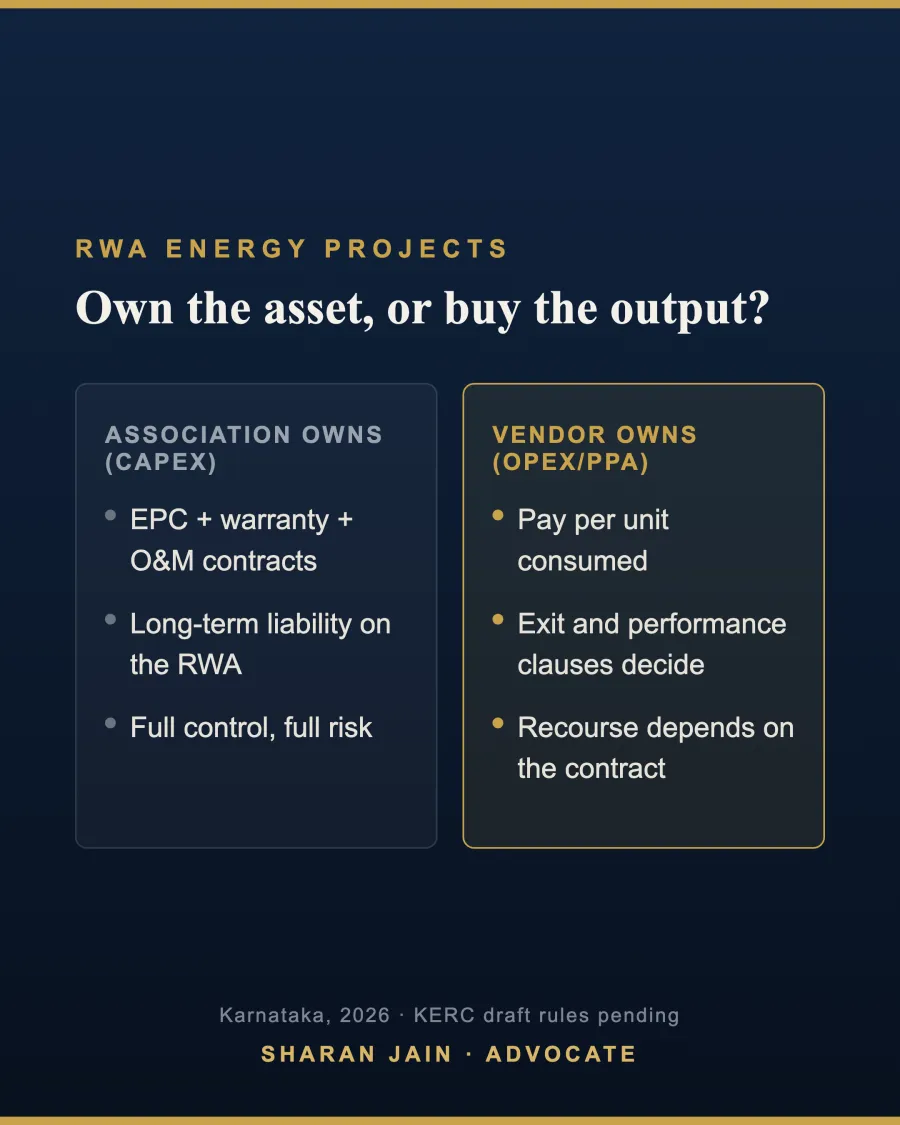
Neither model is wrong; they allocate the same risks to different balance sheets. The recurring failure is hybrid confusion: an association that paid capex prices but signed opex-grade contracts, ending up with the liabilities of an owner and the control of a customer.
The regulatory boundary: where project economics are actually decided
Committees evaluate solar proposals on the vendor's payback slide. The variables that actually decide payback live at the grid boundary, in the central rules and in KERC's rulebook:
- Export tariffs are falling. KERC's 2026-29 proposals cut what surplus units earn. A project financed on today's export price can be underwater on next year's, which is why self-consumption-heavy designs (sized to the community's daytime common-area and pumping loads) are structurally safer than export-dependent ones.
- Storage mandates are coming. Draft DSPV regulations would require batteries with systems above 10 kW, changing capex, replacement cycles and O&M obligations. Contracts signed before the final regulations should price the contingency explicitly.
- Metering architecture matters: net metering versus gross metering, single-point supply for the community versus individual connections, and how common-area versus apartment consumption is measured. Each choice changes both the economics and who bears billing disputes with the ESCOM. Residents' individual billing rights, including the new 15-clear-day payment window, are covered in our guide to electricity consumer rights in Karnataka.
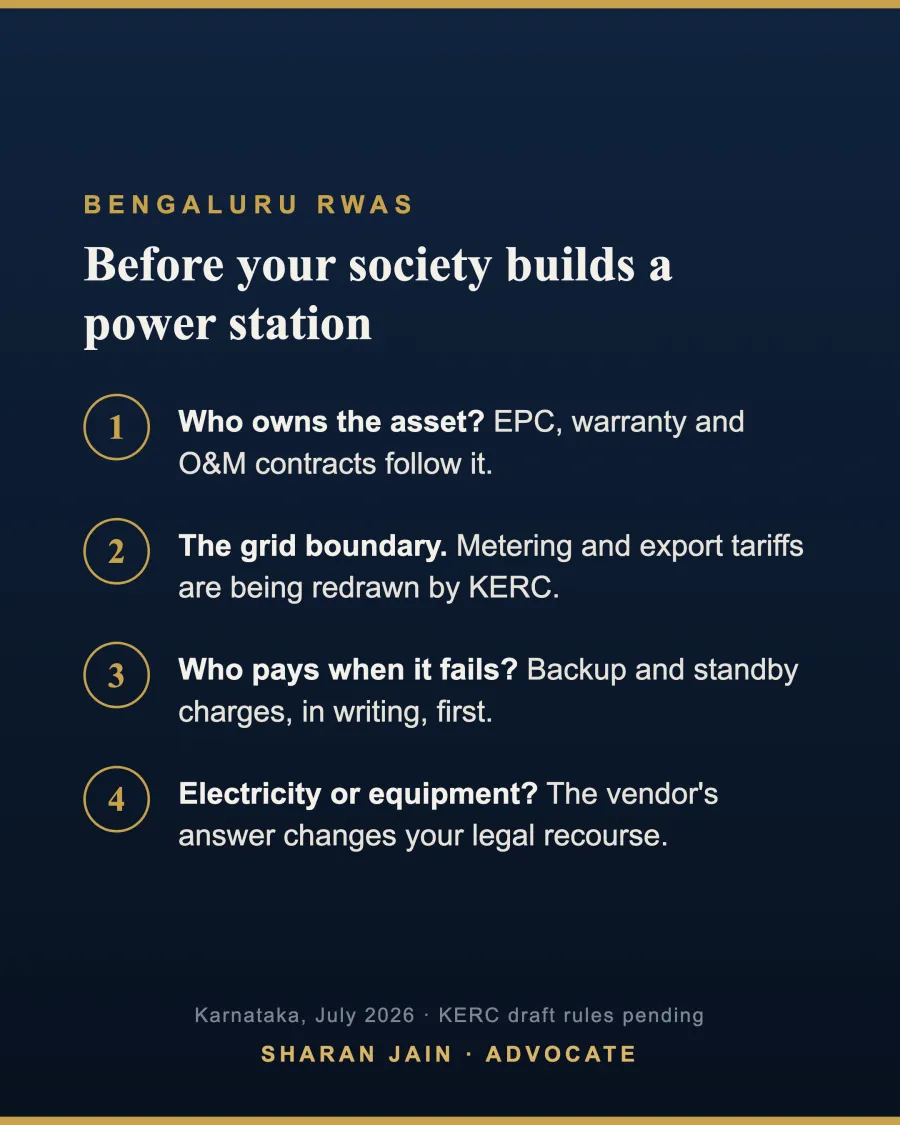
- Backup and standby: the ESCOM connection does not disappear. Section 43 of the Electricity Act keeps the licensee's duty to supply alive, but standby charges and the terms of grid backup during plant failure must be written down before the first outage, not negotiated during it.
The national floor for metering sits in the Electricity (Rights of Consumers) Rules, 2020, which recognise a consumer who installs a rooftop solar unit as a prosumer with the rights of an ordinary consumer plus the right to generate. The Electricity (Rights of Consumers) Amendment Rules, 2021, notified on 29 June 2021, provide that where the state regulations do not already provide otherwise, the Commission may allow net metering for loads up to 500 kW or up to the sanctioned load, whichever is lower, with net billing or net feed-in for larger loads, the detailed arrangements being as specified by the State Commission. For a large Bengaluru complex, whose sanctioned load can run well past that figure, which side of the line the project falls on is not a technical footnote. It is the whole revenue model.
| Metering arrangement | How the units are counted | What it suits | The risk it carries |
|---|---|---|---|
| Behind-the-meter self consumption | Generation is consumed inside the complex and never crosses the ESCOM meter | Common-area lighting, lifts, water pumping, STP and clubhouse loads that run in daylight | Almost none on tariff, but the system must be sized honestly to the daytime load or the surplus is wasted |
| Net metering | Export is set off against import in units, and only the net is billed or carried forward | Systems within the capacity threshold the State Commission allows | Threshold and banking rules can change; unused credits may lapse at the settlement date |
| Net billing or net feed-in | Export is paid at a separate rate rather than set off unit for unit | Larger systems above the net metering threshold | Directly exposed to any cut in the export tariff, which is exactly what the 2026-29 proposals contemplate |
| Gross metering | All generation is sold to the licensee and all consumption is bought back separately | Projects designed as a revenue asset rather than a bill-reduction measure | The most tariff-dependent structure of all |
The contract clauses that decide the next twenty years
Whether capex or opex, the papers should answer these before signature:
- Performance guarantees with remedies: a guaranteed generation figure (units per kWp per year), measured how, with liquidated damages or tariff rebates when missed, not aspirational "estimated generation" language.
- Warranty architecture: module performance warranties (typically 25 years, degradation-stepped), inverter warranties (5 to 10 years), workmanship warranties, and, critically, who enforces them: an association facing a defunct EPC vendor discovers that manufacturer warranties it never held directly are hard to invoke.
- O&M scope and response times: cleaning cycles, monitoring, breakdown response hours, spares, with termination rights for chronic failure.
- Exit and buy-out (opex): the schedule at which the association can buy the system, what happens on vendor insolvency, and asset ownership at term-end. On vendor insolvency the panels on your roof may be a lender's security; take undertakings and check charges.
- Insurance and liability: fire, structural load, third-party injury on common-area installations, and who indemnifies whom. Roof waterproofing warranties, easily voided by penetrative mounting, deserve their own clause.
- Regulatory change: a clause that says what happens to price and scope if the final DSPV regulations mandate storage, if the export tariff is revised, or if the metering category changes. Without it, the association absorbs every regulatory movement and the vendor absorbs none.
- Roof licence, not roof lease: the document that lets the vendor onto the roof should be a revocable licence for a defined area and a defined purpose, with reinstatement obligations, not anything that reads like a transfer of an interest in common property.
- Dispute resolution: a sensibly seated arbitration clause for the vendor contracts, remembering the map of what can and cannot be arbitrated, covered in our guide to non-arbitrable disputes in India.
Common mistake. Letting the vendor's draft govern. Solar EPC and PPA templates are written by vendors' counsel for vendors, and the default drafts routinely omit generation guarantees, cap liability at trivial figures, and make exit practically impossible. The association's leverage exists on exactly one day: the day before signature. Spend it.
Governance: making the decision stick inside the association
Half the disputes in community energy are internal. The committee that signs without general-body sanction, the treasurer who committed corpus funds to capex, the tower that objects to roof allocation, the member who challenges the procurement. The discipline that prevents all of it: a general-body resolution on the model and budget with the bye-law majority, a documented comparison of at least three proposals, minutes recording the delegation of signing authority, and transparent circulation of the final contract before execution. Under the apartment-ownership framework the roof is common area belonging to all owners; treating it as the committee's to allocate is the fastest route to a civil suit that outlives the panels' warranty.
The decision sequence a managing committee should actually follow
- Measure the load before you shop. Pull twelve months of ESCOM bills for the common-area connection and, where they exist, the bulk supply meters. Separate the daytime load (lifts, pumps, STP, lighting, clubhouse) from the night load. This single sheet decides the honest system size, and it is the number vendors will otherwise choose for you.
- Get the roof surveyed independently. Structural load capacity, remaining life of the waterproofing, shading from water tanks and lift rooms, and access for cleaning. An engineer's report before tendering costs a fraction of a roof leak after installation.
- Choose the model in principle, at the committee, in writing. Capex or opex, and the reasoning, minuted. Do not let the model be decided by whichever vendor presents most persuasively.
- Take the mandate to the general body. Circulate the agenda with the notice period the bye-laws require, present both models with indicative numbers, and pass a resolution that authorises the model, the budget ceiling, the funding source and the persons who may sign.
- Tender properly. A written scope, at least three comparable proposals on the same specification, and a comparison sheet that puts guaranteed generation, warranty terms and O&M obligations side by side with price. Price-only comparison is how associations buy the cheapest inverter in Karnataka.
- Fix the grid interface before you fix the price. Confirm with the ESCOM which metering category the sanctioned load puts you in, what the connection and standby charges will be, and what approvals the feasibility and net metering application require. A payback model built before this step is fiction.
- Have the contract reviewed and rewritten, not merely read. Insert the generation guarantee, the remedy for shortfall, the O&M response times, the regulatory-change clause, the roof licence terms, the insurance obligations and the exit or buy-out schedule.
- Circulate the final draft to members before signature and record the objections and the answers in the minutes. This is what converts a contested decision into a defensible one.
- Execute, and build the file the same week. Signed contract, warranty certificates in the association's own name where possible, approvals, the metering agreement, insurance policy, commissioning report and the monitoring login credentials, all in one place with a copy off site.
- Handover discipline at every committee change. The energy file, the O&M calendar, the generation log and the warranty expiry dates should pass to the incoming committee as a documented handover, not as folklore.
Deadline warning. KERC's 2026-29 tariff proposals and the draft DSPV regulations are, at the time of writing, still in the consultation stage. Associations have two windows and both close. The first is the public consultation, where an association or a federation of associations can actually file objections; once a regulation is notified, the practical options narrow to compliance or a constitutional challenge. The second is the signature window on the vendor contract. Sign before the regulations are final without a regulatory-change clause, and the association has silently agreed to absorb whatever the final notification does to the economics.
A practice note on how these projects actually fail
The community energy disputes that reach lawyers almost never involve the technology failing outright. They involve a generation shortfall nobody can enforce because the guarantee was "indicative"; an O&M vendor who stopped answering in year three; a committee changeover where the new committee finds no file, no warranties in the association's name, and no exit clause; and a tariff regime that moved while the payback model stood still. What I tell committees is that the two documents nobody reads are the two that decide everything: the annexure with the guaranteed generation table, and the termination clause. Every one of those failures is preventable with an afternoon of drafting and a properly minuted general body. Karnataka is genuinely opening the door to community power, and for large complexes the economics can be excellent. Walk through the door with the file built, and the project is an asset; walk through on a vendor's slide deck, and the association has bought itself a decade of committee-meeting agenda items.
Frequently Asked Questions
Can a Bengaluru apartment complex legally generate its own electricity?
Yes. Section 2(8) of the Electricity Act, 2003 expressly includes a plant set up by a co-operative society or association of persons for the use of its members within the definition of a captive generating plant, and Section 9 permits captive generation without a licence. Rooftop solar under KERC's framework is established, and July 2026 reports confirm gated communities may set up their own power stations for residents. The enabling conditions and contracts decide whether a specific project is lawful and sensible.
Will rooftop solar still pay for itself under KERC's new tariffs?
Projects premised on selling surplus power need re-modelling against the proposed 2026-29 export tariff cuts; designs sized for self-consumption of common-area and pumping loads are far less exposed.
Is battery storage now mandatory for rooftop solar in Karnataka?
KERC's draft DSPV regulations propose storage requirements for systems above 10 kW. Track the final regulations, and price the contingency in any contract signed meanwhile.
Should the association own the system or sign a PPA?
Capex ownership suits associations with strong reserves and governance continuity; opex/PPA models suit those who want the vendor to carry performance risk. The fatal option is hybrid confusion, paying like an owner while contracting like a customer.
What approvals are needed inside the association?
A general-body resolution with the majority the bye-laws prescribe, documented procurement, and minuted signing authority. Section 3 of the Karnataka Apartment Ownership Act, 1972 puts roofs and central service installations in the common areas, so committee-only decisions invite member challenges.
Who is liable if the community power station fails?
Whatever the contracts say, which is why performance guarantees, O&M response obligations, backup arrangements and standby charges must be negotiated before signature rather than after the first outage.
Can the association sell surplus power to outsiders?
Supplying third parties beyond the community crosses toward licensed distribution territory. Export to the grid happens under KERC's metering and tariff framework; selling to neighbours does not.
What happens if the solar vendor goes bankrupt?
On a capex project, warranties held directly in the association's name survive better than promises routed through the EPC. On an opex project, the PPA's insolvency, step-in and buy-out clauses decide whether the panels keep running or become a lender's security sitting on your roof.
Does the association lose its ESCOM connection once it generates its own power?
No. Section 43 of the Electricity Act, 2003 keeps the distribution licensee's duty to supply on request intact, and in practice the grid connection stays as backup. What changes is the commercial arrangement around it, including standby charges and the metering category, which is why both belong in writing before commissioning.
Does the 26 percent ownership and 51 percent consumption captive rule apply to an apartment association?
Rule 3 of the Electricity Rules, 2005 sets those qualifying conditions for a captive generating plant, tested annually and in proportion to ownership. For a plant owned by the association and consumed within the complex, they are usually satisfied comfortably. They become a live risk where a developer, an investor or a special purpose vehicle holds part of the ownership, so settle the shareholding chart against Rule 3 before, not after, the money moves.
This article is for general informational purposes only and does not constitute legal advice. Specific situations need specific counsel.