Electricity consumers in Karnataka gained a concrete new right in 2026: fifteen clear days to pay every bill, counted from the date the bill is actually generated, with the issuing date printed on the bill so you can verify it. That direction from the Karnataka Electricity Regulatory Commission (KERC) sits on top of a stack of statutory protections most consumers have never been told about: the two-year bar on recovering old arrears under Section 56(2) of the Electricity Act, 2003, strict preconditions for disconnection, a free two-tier grievance machinery, and compensation standards when the ESCOM fails you. This guide walks through every layer, with the exact provisions, the forums, and the practical playbook for billing disputes, in a summer when Karnataka's power sector is being publicly fought over.
Part of the consumer protection practice at S Jain & Attorneys, Bangalore.
Key takeaway: an electricity bill is not a demand you can only obey. It is a statutory document with rights attached: a minimum payment window, a limitation period on old dues, notice requirements before disconnection, and a regulator-built complaint ladder that costs you nothing to climb.
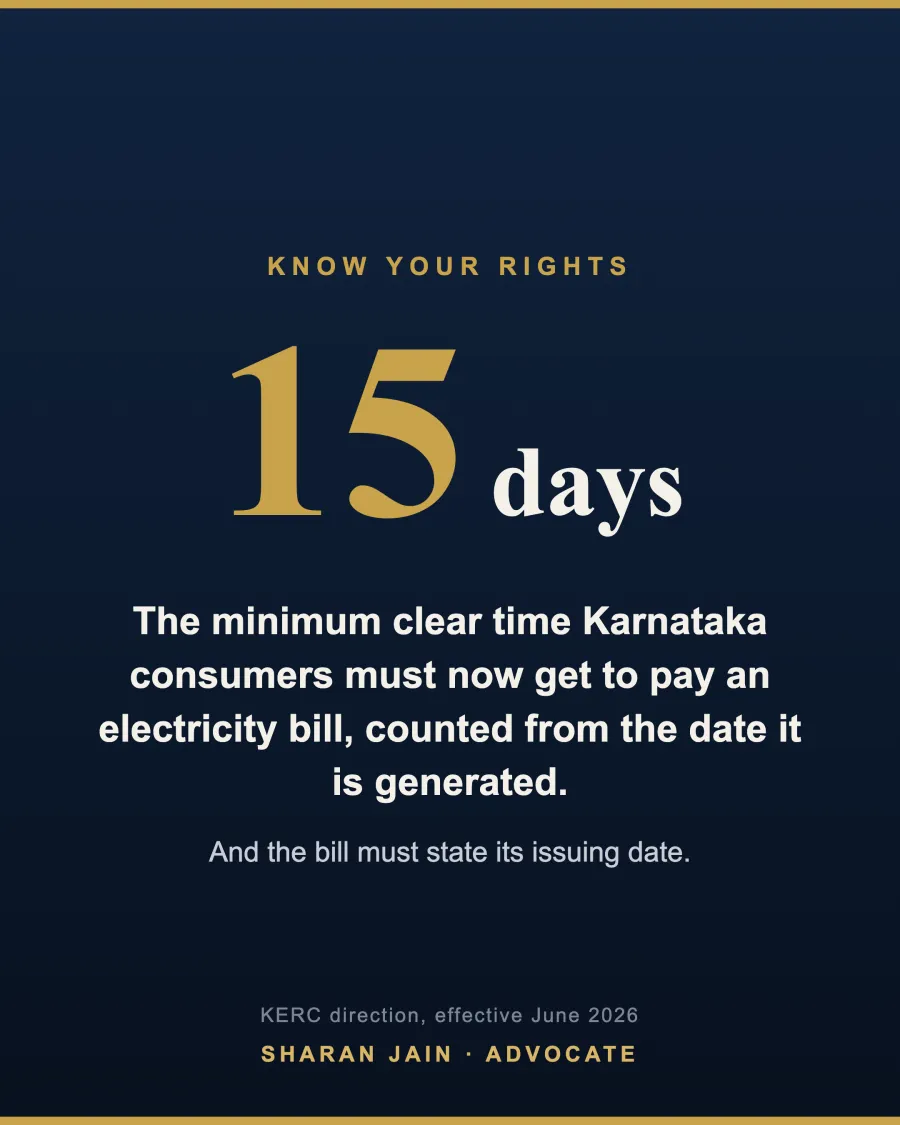
The 2026 change: fifteen clear days, from bill generation
From June 2026, KERC has directed all Karnataka ESCOMs (BESCOM, MESCOM, CESC, HESCOM and GESCOM) to give consumers fifteen clear days from the date of bill generation to make payment, and to print the issuing date on the bill itself. The mischief this cures is familiar to anyone in Bengaluru: bills that arrive on the 10th with a due date of the 14th, followed by late-payment interest the consumer never fairly incurred.
Three practical consequences:
- If your bill's due date falls less than fifteen clear days after its printed issuing date, the bill violates the direction. Pay under protest if needed, and complain in writing citing the KERC direction.
- Late payment interest computed from a short due date is contestable, and small amounts matter because they recur every billing cycle across lakhs of consumers.
- The printed issuing date is now your evidence. Keep bills; screenshots of the ESCOM app showing generation dates work too.
The statutory framework: which section does what
Almost every domestic electricity dispute in Karnataka is decided by a handful of provisions of the Electricity Act, 2003, read with regulations the State Commission makes under Section 181 and the supply code it specifies under Section 50. It is worth knowing which section carries your point, because a complaint that names the provision is treated differently from one that only expresses annoyance.
| Provision | What it gives you | The number that matters |
|---|---|---|
| Section 42(5) to (8) | A grievance forum in every distribution licensee, an Ombudsman above it, and an express saving of all your other rights | Two free tiers, and Section 42(8) preserves other remedies |
| Section 43 | Duty to supply on request to the owner or occupier of any premises | Supply within one month of a complete application; penalty up to Rs 1,000 for each day of default |
| Section 47 | Limits the licensee's power to demand security, and requires notice before calling for more | Thirty days' notice to furnish additional security |
| Section 55 | Supply only through a correct meter installed as per Central Electricity Authority regulations | No correct meter, no lawful metered billing |
| Section 56(1) | Notice before disconnection, and a deposit-under-protest route that keeps supply on | Fifteen clear days' written notice |
| Section 56(2) | Bar on recovery of stale dues and on disconnection for them | Two years from when the sum first became due |
| Section 57 | Standards of performance, and compensation when the licensee misses them | Compensation payable within ninety days of determination |
| Sections 126 and 127 | Assessment for unauthorised use of electricity, and the appeal against it | Appeal within thirty days, on deposit of half the assessed amount |
Section 56(2): the two-year wall against surprise backbilling
The single most valuable provision most consumers have never heard of is Section 56(2) of the Electricity Act, 2003: no sum due from a consumer "shall be recoverable after the period of two years from the date when such sum became first due unless such sum has been shown continuously as recoverable as arrear of charges", and the supplier cannot cut supply for such stale dues.
This is the answer to the classic "audit shock" demand: a letter claiming underbilling from three, five or eight years ago, discovered during a meter change or tariff reclassification. In Assistant Engineer (D1), Ajmer Vidyut Vitran Nigam Ltd. v. Rahamatullah Khan, (2020) 4 SCC 650, the Supreme Court set out the position precisely, and the detail is worth getting right because consumers routinely overstate it:
- The right to disconnect under Section 56(1) is subject to the two-year limitation in Section 56(2), running from the date the charge first became due.
- Where the licensee billed wrongly by bona fide mistake, it is not barred from raising a supplementary or additional demand even after two years, and it may sue to recover it. What it cannot do is use the coercive weapon of disconnection.
- Where the dues were continuously shown as arrears in your bills, the two-year wall does not apply at all.
- Cases of established theft or meter tampering stand on a different footing from honest billing errors; the protection is for consumers, not for meddled meters.
So the correct reading is narrower and sharper than the popular one. Section 56(2) is not an amnesty on old money. It is a bar on switching off your house to collect it. In practice that distinction decides the case, because the ESCOM's leverage is almost entirely the threat of disconnection, and once that threat is unlawful the demand usually gets negotiated or dropped rather than litigated in a civil suit.
Deadline warning: when a backbilling demand arrives, do not simply pay it into silence and do not simply ignore it into disconnection. Reply in writing within the demand's own deadline, dispute it citing Section 56(2), ask when the amount first became due and where it appeared in past bills, and pay under protest only if disconnection is threatened. Every one of those steps preserves rights; silence surrenders them.
Disconnection is a procedure, not a mood
Under Section 56(1), supply can be cut for non-payment only after fifteen clear days' notice in writing, and the section gives the consumer a powerful safety valve. Supply shall not be cut off if the consumer deposits, under protest, whichever is lower of (a) an amount equal to the sum claimed, or (b) the monthly charges worked out on the average of what was paid over the preceding six months, pending disposal of the dispute. Read that twice: the statute itself contemplates that you may be in dispute and still keep the lights on. In practice:
- No valid prior notice, no valid disconnection. Reconnection plus compensation claims follow wrongful disconnection.
- Paying the lower of the two figures under protest keeps supply running without conceding the disputed amount. Write the words "under protest, without prejudice, pending dispute dated [date]" on the payment reference or the covering email.
- Disconnection for dues barred by Section 56(2) is itself unlawful, whatever the demand notice says.
- Section 56(1) is about non-payment. It is not authority to disconnect as a punishment for arguing, for refusing an unmetered estimate, or for a dispute the ESCOM has not yet decided.
Section 126 assessments and theft allegations: a different track
Some notices are not bills at all. If an inspecting officer concludes that you are indulging in unauthorised use of electricity, for example running a commercial activity on a domestic tariff, extending supply to a premises that was never sanctioned, or using a tampered meter, the ESCOM proceeds under Section 126, not under the ordinary billing provisions. The machinery is tight and time-bound:
- Provisional assessment order. The assessing officer assesses to the best of his judgment and serves the order on the person in occupation of the premises.
- Objections and hearing. You are entitled to file objections. The assessing officer must give a reasonable opportunity of hearing and pass a final order within thirty days of service of the provisional order.
- Accept and close, if you are wrong. A person served with the provisional order may accept it and deposit the assessed amount within seven days.
- Check the period and the rate. Assessment covers the entire period of unauthorised use; where that period cannot be ascertained, it is capped at twelve months immediately preceding the inspection, and it is charged at twice the tariff for the relevant category.
- Appeal under Section 127. Thirty days from the final order, to the prescribed appellate authority, and no appeal is entertained unless half the assessed amount is deposited in cash or by bank draft with proof enclosed. Default in paying the assessed amount attracts interest at sixteen per cent per annum, compounded every six months.
Two traps here catch people constantly. The first is the twelve-month cap: assessments routinely reach back further on assumptions the record does not support, and the moment the ESCOM cannot prove the start date of the unauthorised use, the period is limited by statute. The second is forum. In U.P. Power Corporation Ltd. v. Anis Ahmad, (2013) 8 SCC 491, the Supreme Court held that a complaint against an assessment under Section 126, or against action taken for offences under Sections 135 to 140 (theft and allied offences), is not maintainable before a consumer forum. Section 145 separately bars civil courts on matters an assessing officer or appellate authority is empowered to decide. File in the wrong place and you lose months.
Common mistake. Treating a Section 126 assessment as an ordinary billing complaint. It is not. It carries its own thirty-day objection and appeal clocks, its own pre-deposit condition, and its own forum, and the consumer commission will send you away. Read the heading of the notice before you decide where to fight.
Your complaint ladder: CGRF, Ombudsman, and beyond
The Electricity Act built a dedicated, free grievance machinery under Section 42(5) to (7), and Karnataka's version is fully operational:
| Forum | What it does | Time and cost |
|---|---|---|
| 1. ESCOM sub-division / customer care | First written complaint; most billing errors die here | Free; keep the acknowledgment |
| 2. Consumer Grievance Redressal Forum (CGRF) | Statutory forum in each ESCOM for unresolved grievances | Free; decides within the period fixed by KERC regulations |
| 3. Electricity Ombudsman (KERC) | Appeals against CGRF orders or non-decision | Free; independent of the ESCOM |
| 4. Consumer commission (CPA 2019) | Deficiency-in-service claims with compensation; the Supreme Court has confirmed electricity consumers can invoke the CPA | Nil fee up to Rs 5 lakh claims; 2-year limitation |
The CGRF and Ombudsman route is purpose-built and fast for billing, metering, connection and disconnection grievances. The consumer commission route matters where you have suffered real loss (spoiled inventory, a wrongful disconnection before an exam season, appliance damage from voltage issues) and want compensation, not just correction. Note the boundary Anis Ahmad draws: deficiency in service is squarely within the consumer commission's reach, while a Section 126 assessment or a Section 135 theft case is not.
How to fight a wrong bill, step by step
The sequence below is the one that works, in the order that works. Skipping a step does not save time; it costs you the record you will need two forums later.
- Freeze the evidence, the same week. Photograph the meter with the reading and the date visible, download the bill PDF, and screenshot the ESCOM app page showing the generation date and the due date. If the bill is on a three-month average rather than an actual reading, note that on the face of your record.
- Complain in writing to the sub-division, not by phone. Use the ESCOM's online portal so the system issues a ticket number, or deliver a letter and take an acknowledgment. State the account or RR number, the disputed amount, the exact ground (short payment window, backbilling barred by Section 56(2), faulty meter under Section 55, wrong tariff category) and the relief sought.
- Protect supply if disconnection is threatened. Deposit the lower of the sum claimed or the six-month average under the proviso to Section 56(1), expressly under protest, and say in writing that the deposit is made under that proviso pending the dispute.
- Ask for a meter test if the quantum is the issue. Section 55 requires supply through a correct meter. A written request for testing, on payment of the prescribed fee, puts the accuracy question on record; billing for the faulty period is then reworked on the prescribed norms rather than on the ESCOM's estimate.
- Escalate to the CGRF if nothing moves. There is no court fee and no advocate is strictly needed. Attach the bills, the complaint, the ticket number, the ESCOM's reply or the proof that it never replied, and the payment made under protest.
- Appeal to the Electricity Ombudsman. If the CGRF rejects your grievance or fails to decide it, the Ombudsman appointed under KERC's framework is the next rung. Check the appeal period printed on the CGRF order and file within it.
- Go to the consumer commission for money. Where you want damages for a wrongful disconnection or a service failure, file under the Consumer Protection Act, 2019. Limitation is two years from the cause of action; complaints can be filed online.
Costs and timelines, realistically
Indicative ranges, not promises, because every ESCOM and every forum runs at its own pace:
- Written complaint to the sub-division: free. Expect a response in roughly one to four weeks; many billing errors are corrected in the next cycle without anything further.
- Meter testing: a prescribed fee, typically a few hundred rupees for a domestic installation, refundable or adjusted where the meter is found defective. Testing and rebilling commonly take a few weeks.
- CGRF: no fee. Filing to order is often in the region of one to three months, depending on how quickly the ESCOM files its reply.
- Electricity Ombudsman: no fee. Budget a further two to four months.
- Consumer commission: nil fee for claims up to Rs 5 lakh. The statute contemplates disposal in a few months, but a contested matter realistically runs one to three years, which is exactly why the free electricity-specific ladder should be exhausted first.
- Section 127 appeal: the real cost is the pre-deposit of half the assessed amount, plus the fee specified by the State Commission. Interest at sixteen per cent compounded half-yearly runs on unpaid assessed amounts, so delay is expensive.
- Professional fees: most domestic billing grievances do not need an advocate up to the CGRF stage. Where a matter involves a large Section 126 assessment, a commercial connection or an Ombudsman appeal, professional fees in Bengaluru vary widely with complexity and are worth agreeing in writing at the outset.
Metering, new connections and this July's average bills
A few adjacent rights worth knowing in 2026:
- Faulty meters: Section 55 requires the licensee to supply only through a correct meter installed in accordance with the Central Electricity Authority's metering regulations, and testing is governed by those regulations read with KERC's supply code and conditions of supply. You can demand a meter test on payment of the prescribed fee, and billing for the faulty period is reworked on prescribed norms, not the ESCOM's guess.
- New connections: KERC has made Aadhaar e-KYC authentication mandatory for new connections in BESCOM's jurisdiction from June 2026, and Karnataka opened a window (with an August 15 deadline reported) for regularising connections without occupancy certificates. Section 43 obliges the licensee to supply within one month of a complete application, and Section 43(3) makes a defaulting licensee liable to a penalty which may extend to Rs 1,000 for each day of default. That penalty is rarely invoked, but citing it in writing concentrates minds.
- Security deposits: under Section 47 the licensee may require reasonable security as determined by regulations, and must give thirty days' notice before requiring additional security. A sudden demand for a large top-up, without notice and without a stated basis, is challengeable.
- July 2026 average billing: many Bengaluru bills this July were raised on a three-month average because of a billing-system transition, with corrections to follow against actual meter readings. Averages are provisional by nature: preserve these bills, because reconciliation disputes are decided on the paper trail.
The bigger board: why your supplier may change soon
These consumer rights are being sharpened at the very moment Karnataka's distribution market is contested. In May 2026 Tata Power applied for a parallel distribution licence covering a large part of the state, relying on Section 14 of the Electricity Act, which has permitted a second licensee in the same area since 2003. ESCOMs objected, unions threatened strikes, BESCOM filed formal objections before KERC, and by 4 July Tata Power had withdrawn, with a fresh private applicant reported within days. The government has floated using Section 108 policy directions; licence applications, however, are decided by KERC acting quasi-judicially, not by press release.
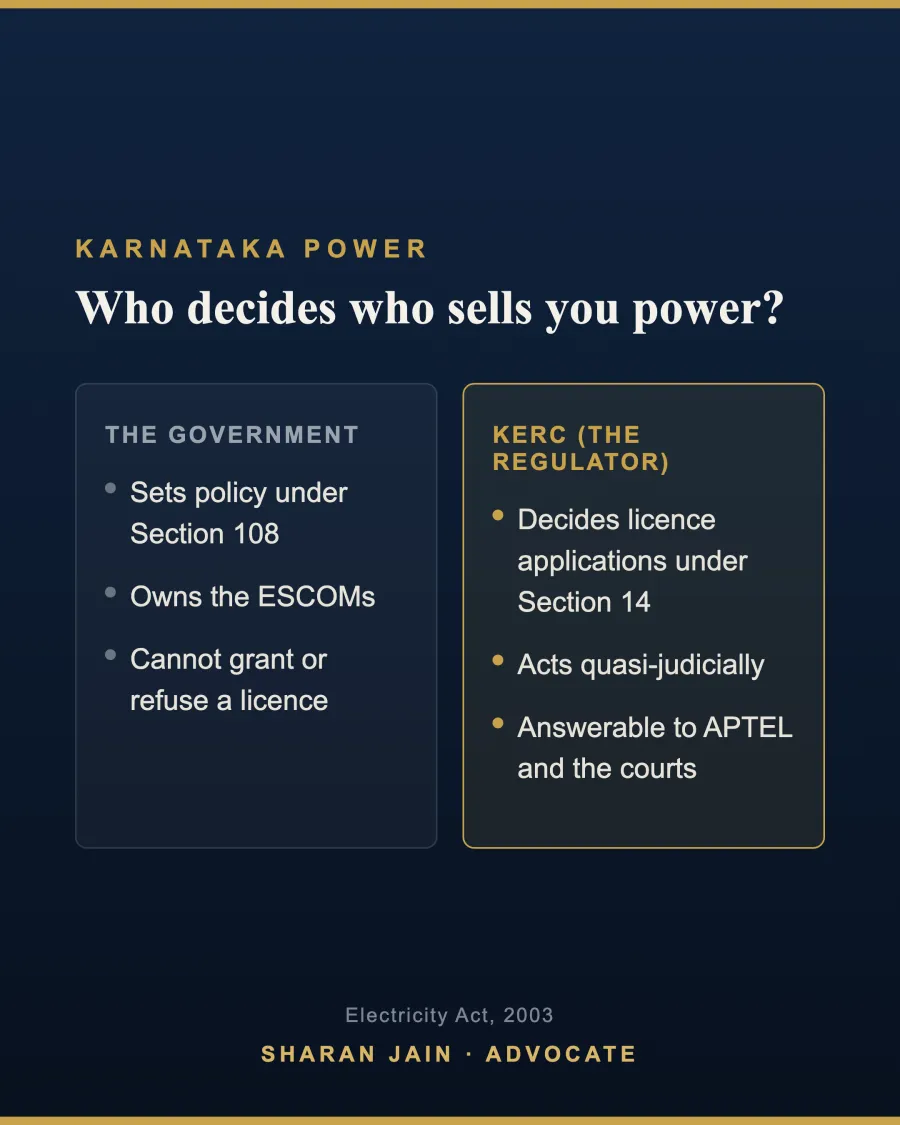
For consumers, two takeaways: competition, if it arrives, changes service standards faster than any complaint ever will; and in the meantime the same regulator that decides those licences also writes your billing protections, which is exactly why citing KERC's own directions in complaints works. Industrial and commercial users tracking the deeper regulatory shifts should read our analysis of the Karnataka High Court's ruling on KERC's captive power verification, and apartment residents weighing self-generation should start with our guide to community power stations for Bengaluru RWAs.
The mistakes that lose these cases
Most electricity disputes I see are lost in the first thirty days, not in any forum. The consumer calls the helpline, is reassured verbally, pays "to be safe", and throws away the bill. Six months later there is no complaint on record, no protest annotation on the payment, and no documents. The recurring errors are these:
- Complaining by phone. A helpline conversation leaves no record. Use the portal so a ticket number is generated, or write and take an acknowledgment.
- Paying without the words "under protest". An unqualified payment is treated as acceptance of the demand. Two words on the covering email keep the dispute alive.
- Letting the notice period run out. Fifteen clear days is short. A reply on day sixteen is a reply after the disconnection has already been authorised.
- Confusing a Section 126 assessment with a bill. Different clocks, different forum, a pre-deposit condition, and no consumer commission jurisdiction.
- Discarding old bills. Keep every bill for at least two years, the exact length of the Section 56(2) window, because the question "was this amount shown continuously as an arrear" is answered only by the bills themselves.
- Arguing the tariff rather than the service. Tariff determination is the State Commission's job under the Act, and a consumer commission will not redetermine it. Frame your complaint as a service failure, a billing error, or a limitation bar, which are the grounds the forums can actually act on.
- Not asking for compensation. Section 57 obliges a licensee that misses specified standards of performance to compensate the affected person, payable within ninety days of determination. Ask for it in terms; nobody volunteers it.
The winning pattern is boring: complain in writing, pay disputed amounts under protest and say so, and keep the paper. Paper wins these cases; indignation does not.
Frequently Asked Questions
How many days do I get to pay an electricity bill in Karnataka?
Fifteen clear days from the date the bill is generated, under KERC's 2026 direction to all ESCOMs, and the bill must state its issuing date so the window can be verified.
Can BESCOM recover arrears from several years ago?
It cannot disconnect your supply to recover them. Section 56(2) of the Electricity Act bars recovery of sums by disconnection after two years from when they first became due, unless they were continuously shown as arrears in your bills. In Rahamatullah Khan the Supreme Court clarified that a licensee may still raise a supplementary demand for a bona fide billing mistake and sue on it, but cannot cut off supply. Theft and tampering cases are treated differently.
Can my electricity connection be disconnected without notice?
No. Section 56(1) requires fifteen clear days' prior written notice, and depositing, under protest, whichever is lower of the sum claimed or the average of the preceding six months' charges prevents disconnection while a genuine dispute is decided.
Where do I complain against an ESCOM in Karnataka?
Start with a written complaint to the sub-division, escalate to the ESCOM's Consumer Grievance Redressal Forum, then to the Electricity Ombudsman appointed under KERC's framework. All three are free. Compensation claims can also go to the consumer commission.
I received a Section 126 assessment notice. What do I do first?
Do not ignore it and do not pay it reflexively. File written objections before the assessing officer, who must hear you and pass a final order within thirty days of the provisional order. Check whether the assessed period exceeds the twelve-month statutory cap that applies where the period of unauthorised use cannot be ascertained. An appeal lies under Section 127 within thirty days, on deposit of half the assessed amount.
Can I take a Section 126 assessment to the consumer commission?
No. In U.P. Power Corporation Ltd. v. Anis Ahmad, (2013) 8 SCC 491, the Supreme Court held that complaints against Section 126 assessments and against action under Sections 135 to 140 are not maintainable before a consumer forum. The route is the Section 127 appeal, and thereafter the High Court.
Is my July 2026 average bill final?
No. Bills raised on a three-month average during the billing transition are provisional and are to be reconciled against actual readings. Keep the bills; corrections are claimed against them.
How long does the ESCOM have to give me a new connection?
Section 43(1) requires supply within one month of a complete application, subject to extension where distribution mains must be extended or a new sub-station commissioned. Section 43(3) makes a defaulting licensee liable to a penalty which may extend to Rs 1,000 for each day of default.
Can I claim compensation for wrongful disconnection?
Yes. Wrongful disconnection is a deficiency in service; consumer commissions have awarded compensation for it, and Section 57 of the Electricity Act requires a licensee that fails to meet specified standards of performance to pay compensation, within ninety days of the amount being determined.
Who decides whether a private company can supply electricity in my area?
KERC, the state electricity regulator, acting quasi-judicially on a licence application under Section 14 of the Electricity Act. Government policy directions under Section 108 guide policy but do not decide applications.
Does the Consumer Protection Act apply to electricity bills?
Yes, for deficiency in service. The Supreme Court has confirmed that electricity consumers can pursue deficiency-in-service claims under the CPA alongside the Electricity Act's own machinery, provided the claim is about service deficiency rather than tariff fixation or a Section 126 assessment.
This article is for general informational purposes only and does not constitute legal advice. Specific situations need specific counsel.