You divorced abroad, and now you need one answer: is that foreign divorce decree valid in India? The short answer: a foreign decree does not dissolve an Indian marriage automatically. It is recognised only if it passes the tests in Section 13 of the Code of Civil Procedure, 1908 (CPC), read with the Supreme Court's rule in Y. Narasimha Rao v. Y. Venkata Lakshmi (1991). A decree that fails those tests leaves you legally married in India, whatever the foreign order says, with real consequences for remarriage, maintenance, property and even criminal liability.
Part of the family and divorce law practice at S Jain & Attorneys, Bangalore.
This question comes up constantly in NRI families: a couple marries in India under the Hindu Marriage Act, 1955 (HMA), moves to the US, UK, Canada, Australia or Singapore, and one or both later obtain a divorce there. Whether India respects that divorce decides everything downstream, from a second marriage to how an NRI divorce should be run in the first place. Our family and divorce law practice deals with both sides of it: spouses who want the foreign decree upheld, and spouses who want it ignored.
When Is a Foreign Divorce Decree Valid in India?
The governing principle, laid down in Y. Narasimha Rao v. Y. Venkata Lakshmi, (1991) 3 SCC 451, is that both the foreign court's jurisdiction and the ground on which it granted divorce must be in accordance with the matrimonial law under which the parties married. For a couple married under the HMA, that means the foreign forum must be one the HMA framework can accept, and the ground (cruelty, desertion, adultery and so on) must be a ground the HMA itself recognises. A decree that satisfies both is treated as conclusive under Section 13 CPC. A decree that satisfies neither is, in the eyes of Indian law, no divorce at all.
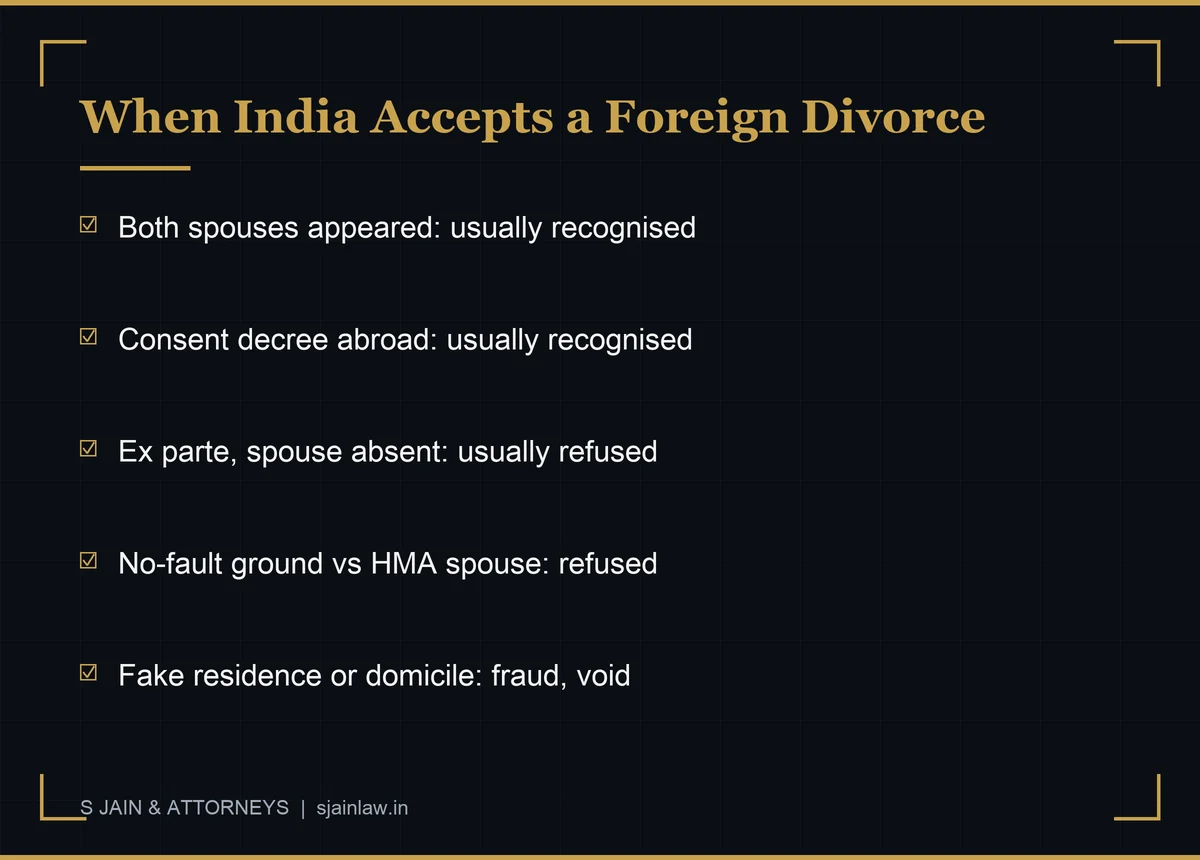
Because recognition is rule-plus-exceptions, the safest way to think about it is: contested or consented decrees where both spouses genuinely participated are usually recognised; ex parte decrees on foreign no-fault grounds usually are not.
Section 13 CPC: The Six Tests Every Foreign Judgment Must Pass
Section 13 CPC says a foreign judgment is conclusive between the parties except in six situations. Each one has a specific matrimonial meaning:
- (a) Court of competent jurisdiction. Competence is judged by the matrimonial law of the parties, not by the foreign country's own rules. A court in Missouri or Ontario is not competent over an HMA marriage merely because one spouse flew there and completed a residency period designed for divorce.
- (b) Not given on the merits. A default or ex parte decree, passed because the respondent never appeared, is not a decision on the merits. Recognition requires a real contest or a genuine consent.
- (c) Founded on an incorrect view of international law, or a refusal to recognise Indian law. This is where most NRI decrees fail: the foreign court applies its own ground, typically "irretrievable breakdown" or no-fault divorce, which is not a ground under the HMA. Applying the wrong law to an HMA marriage triggers this clause.
- (d) Opposed to natural justice. The respondent spouse must have had proper notice and a real opportunity to be heard, not a summons served at an address she left years ago, for a hearing on another continent she could never afford to attend.
- (e) Obtained by fraud. Fraud includes lying about jurisdictional facts. The classic example is Satya v. Teja Singh, discussed below, where the husband invented a Nevada domicile.
- (f) Founded on a breach of Indian law. A decree resting on a claim that Indian law prohibits, or granted in disregard of the law that governs the marriage, falls here.
Section 14 CPC: The Presumption That Works in Your Favour
Section 14 CPC gives you a head start: when a certified copy of a foreign judgment is produced, the Indian court presumes that the foreign court was competent, unless the contrary appears from the record or is proved. The presumption is rebuttable, and in matrimonial cases it is rebutted exactly the way Narasimha Rao and Satya describe: by showing the forum or the ground did not match the matrimonial law. But it matters procedurally, because the spouse attacking the decree carries the burden of displacing it.
The Narasimha Rao Rule and Its Three Exceptions
In Y. Narasimha Rao v. Y. Venkata Lakshmi, a husband who had married at Tirupati under the HMA obtained an ex parte divorce from a Missouri court on the ground that the marriage had irretrievably broken down. The Supreme Court refused recognition and laid down the working rule: the jurisdiction of the foreign court and the ground of divorce must accord with the law under which the parties married. The Court then carved out three exceptions where a foreign decree will be recognised:
- The matrimonial action was filed in the forum where the respondent is domiciled or habitually and permanently resides, and the relief was granted on a ground available under the matrimonial law of the parties.
- The respondent voluntarily and effectively submitted to the foreign court's jurisdiction and contested the claim on a ground available under the matrimonial law.
- The respondent consented to the grant of relief, even though the foreign forum was not one recognised by the matrimonial law.
The Court was explicit that "residence" means genuine, settled residence, not a temporary stay engineered to obtain a divorce. It also clarified that merely filing a reply under protest, or appearing only to contest jurisdiction, is not voluntary submission.
Key takeaway: India does not ask whether the foreign divorce was valid where it was granted. It asks whether the forum and the ground line up with the law your marriage was performed under, or whether the spouse on the receiving end genuinely submitted or consented. Everything else is detail.
Ex Parte Foreign Divorces: The Riskiest Category
The ex parte decree, granted when the spouse in India never appeared, is the category Indian courts refuse most often. It usually fails three tests at once: the forum was chosen by the petitioner alone (clause (a)), there was no decision on the merits (clause (b)), and the ground was a no-fault ground unknown to the HMA (clause (c)).
The Supreme Court's decision in Satya v. Teja Singh, AIR 1975 SC 105, remains the sharpest warning. The husband obtained a divorce from a Nevada court by swearing he was a bona fide resident of and domiciled in Nevada, when he was there only long enough to get the decree. When the wife claimed maintenance in India, he waved the Nevada decree. The Supreme Court held the decree was obtained by fraud on the jurisdictional facts and refused to recognise it: no rule of private international law compels a wife to submit to a decree procured by trickery. The wife remained his lawful wife in India, and her maintenance claim survived.
Two practical corollaries follow. First, a spouse in India served with foreign divorce papers should take advice before deciding whether and how to appear, because full participation can convert a refusable decree into a recognisable one. Second, an NRI petitioner who wants a decree that holds up in India must build genuine jurisdiction and, ideally, the other side's participation or consent into the case.
Mutual Consent Divorce Abroad: Usually Recognised
At the other end of the spectrum sits the foreign mutual consent divorce. Where both spouses approach the foreign court together, or the respondent appears and consents to the decree, the case falls squarely within the second and third Narasimha Rao exceptions. Indian courts routinely treat such decrees as binding, even when the foreign statute's label for the ground differs from Section 13B HMA. Consent cures the forum problem; participation cures the merits problem. This is why well-advised NRI couples who agree on separation almost always end the marriage by consent, either abroad with both appearing, or in India through the mutual consent route, rather than racing each other to courthouses on two continents.
Recognised or Not? Common NRI Scenarios Compared
| Scenario | Recognised in India? | Why |
|---|---|---|
| Both spouses jointly obtain a divorce abroad (mutual consent, both appear) | Generally yes | Consent and submission satisfy the Narasimha Rao exceptions |
| Contested foreign divorce; respondent fully participated; ground exists under the HMA (cruelty, desertion, adultery) | Generally yes | Voluntary submission plus a matching ground |
| Respondent genuinely domiciled or habitually resident in the foreign country; HMA-recognised ground | Generally yes | First Narasimha Rao exception |
| Ex parte decree; spouse in India never appeared | Generally no | No competent forum, no decision on merits, often no valid ground |
| No-fault or irretrievable-breakdown decree against a non-consenting spouse married under the HMA | Generally no | Ground not available under the matrimonial law (clause (c)) |
| Decree based on a false claim of residence or domicile | No | Fraud on jurisdiction; Satya v. Teja Singh |
The Bigamy Trap: Remarrying on an Invalid Foreign Decree
This is where the stakes turn criminal. If your foreign decree is not recognised in India, your Indian marriage still subsists. Remarry, and the second marriage is void, and you are exposed to a bigamy prosecution under Section 82 of the Bharatiya Nyaya Sanhita, 2023 (BNS), the provision that replaced the old Section 494 of the Indian Penal Code, carrying imprisonment of up to seven years.
An unrecognised decree also does not shut out the other spouse's remedies in India. She (or he) can still file a divorce or judicial separation petition here, claim maintenance under Section 144 of the Bharatiya Nagarik Suraksha Sanhita, 2023 (BNSS), the successor to Section 125 CrPC, and pursue interim and permanent alimony under Sections 24 and 25 HMA, exactly as if the foreign decree did not exist. That is precisely what happened in Satya: the maintenance claim succeeded because the Nevada decree was a nullity in India.
Common mistake: treating the foreign decree as the end of the matter and remarrying on its strength. If the first spouse never submitted to the foreign court, that decree can be attacked in India years later, and the second marriage becomes the evidence against you. Get the recognition question answered before the wedding, not after.
How to Use a Valid Foreign Decree in India
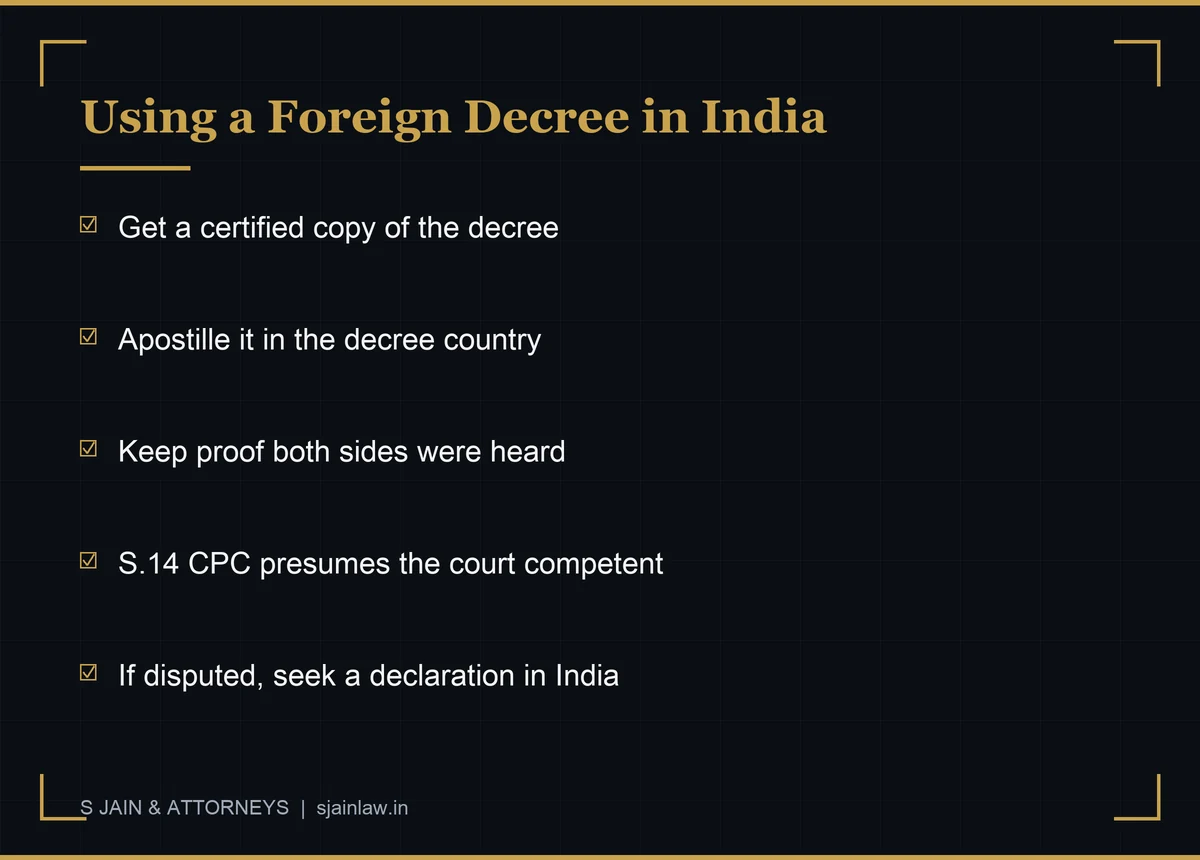
India has no registry where a foreign divorce is "deposited" or stamped as valid. A decree is simply produced and relied on when it matters: before a passport office, a marriage officer, a family court or a succession forum. To make that as smooth as possible:
- Obtain a certified copy of the decree (and the judgment or findings, if separate) from the foreign court, showing it has taken effect and any appeal period has passed.
- Get the copy apostilled in the country of the decree under the Hague Apostille Convention, 1961, to which India is a party; documents from non-Convention countries need consular attestation instead.
- Preserve the record showing both sides participated or consented: appearance memos, settlement agreements, joint petitions. This is what an Indian authority or court will look for.
- Rely on the Section 14 CPC presumption: a certified copy raises a presumption of competence that the objecting party must displace.
- If you anticipate a dispute, or an authority refuses to act on the decree, seek a declaration from an Indian family court on marital status before taking any irreversible step such as remarriage.
Expect practical checkpoints. Passport authorities commonly ask for the divorce decree when updating marital status; a marriage officer processing a remarriage under the Special Marriage Act, 1954 may ask for proof that the earlier marriage stands dissolved. An apostilled, participation-backed decree usually sails through; an ex parte decree invites questions.
Transfer Petitions and the Anti-Suit Angle
Foreign proceedings rarely travel alone. The spouse in India often files her own petition here, and parallel litigation begins. Indian family courts can and do proceed with an Indian matrimonial case despite a pending foreign one, and in appropriate cases Indian courts have granted anti-suit injunctions restraining a party from pursuing oppressive foreign matrimonial proceedings, though this is an exceptional remedy. Within India, the Supreme Court regularly allows transfer petitions, moving a matrimonial case to the city where the wife resides. For NRIs this means the battlefield can shift: a husband litigating in New Jersey may simultaneously face a maintenance case in Bengaluru and a transfer petition in Delhi. The cross-border rules for all of this sit within private international law, and custody adds its own layer, covered in our guide on custody for NRI parents.
What I Tell NRI Clients in Practice
What I tell NRI clients is blunt: the recognition question is decided by how the foreign case is run, not by anything you do afterwards. If you are the petitioner abroad, get the other side to appear or consent, on the record, and keep every page proving it. If you are the spouse in India served with foreign papers, do not ignore them and do not casually appear; either choice, made without advice, can cost you the case. Where these matters actually go wrong is the gap years, when someone remarries or buys property on the strength of a decree nobody ever tested, and the challenge arrives at the worst possible moment, inside a succession fight or a bigamy complaint. A two-week legal review of the decree costs a fraction of that. Our NRI legal services desk does exactly this review, remotely, for clients across time zones.
Related guides and where to get help
- Second Marriage After Divorce in India: Rules & Timing
- NRI Divorce in India: Jurisdiction, Foreign Decrees and Your Options
- Prenuptial Agreements in India: Are They Valid and Enforceable?
Frequently Asked Questions
Is a foreign divorce decree automatically valid in India?
No. It is recognised only if it clears Section 13 CPC as interpreted in Y. Narasimha Rao v. Y. Venkata Lakshmi (1991): the foreign court's jurisdiction and the ground of divorce must accord with the law under which you married, unless the respondent submitted to or consented before the foreign court.
Is an ex parte foreign divorce valid in India?
Usually not, if the spouse in India never appeared. Such decrees typically fail the competent-jurisdiction, merits and recognised-ground tests together. Each case turns on its facts, especially on whether service and the opportunity to be heard were real.
Is a mutual consent divorce obtained abroad valid in India?
Generally yes. Where both spouses appeared or the respondent consented to the decree, the case falls within the exceptions recognised by the Supreme Court, and Indian courts routinely act on such decrees.
Do I need to register my foreign divorce in India?
There is no registration system for foreign divorces in India. You rely on a certified, apostilled copy of the decree when needed. If a dispute is likely, a declaratory proceeding before an Indian family court settles the status question.
Can I remarry in India on the basis of a foreign divorce decree?
Only if the decree would be recognised here. If it is not, the first marriage subsists, the second marriage is void, and Section 82 of the Bharatiya Nyaya Sanhita, 2023 (the old Section 494 IPC) makes the remarriage a bigamy offence punishable with up to seven years.
Can my spouse still claim maintenance in India after a foreign divorce?
If the decree is not recognised, yes. The marriage continues in the eyes of Indian law, and maintenance can be claimed under Section 144 BNSS (the old Section 125 CrPC) and under the matrimonial statute, as Satya v. Teja Singh confirms.
What is Section 14 CPC and how does it help?
It creates a presumption, on production of a certified copy of the foreign judgment, that the foreign court had jurisdiction. The party attacking the decree must displace that presumption with evidence.
Does a foreign divorce decree cover child custody and property in India?
Not reliably. Custody orders are tested separately against the child's welfare, and Indian immovable property disputes are decided by Indian courts. Treat the divorce, custody and property strands as three separate recognition questions.
This article is general legal information, not legal advice, and does not create a lawyer-client relationship. Recognition of foreign decrees is intensely fact-specific. For advice on your situation, consult a qualified advocate.