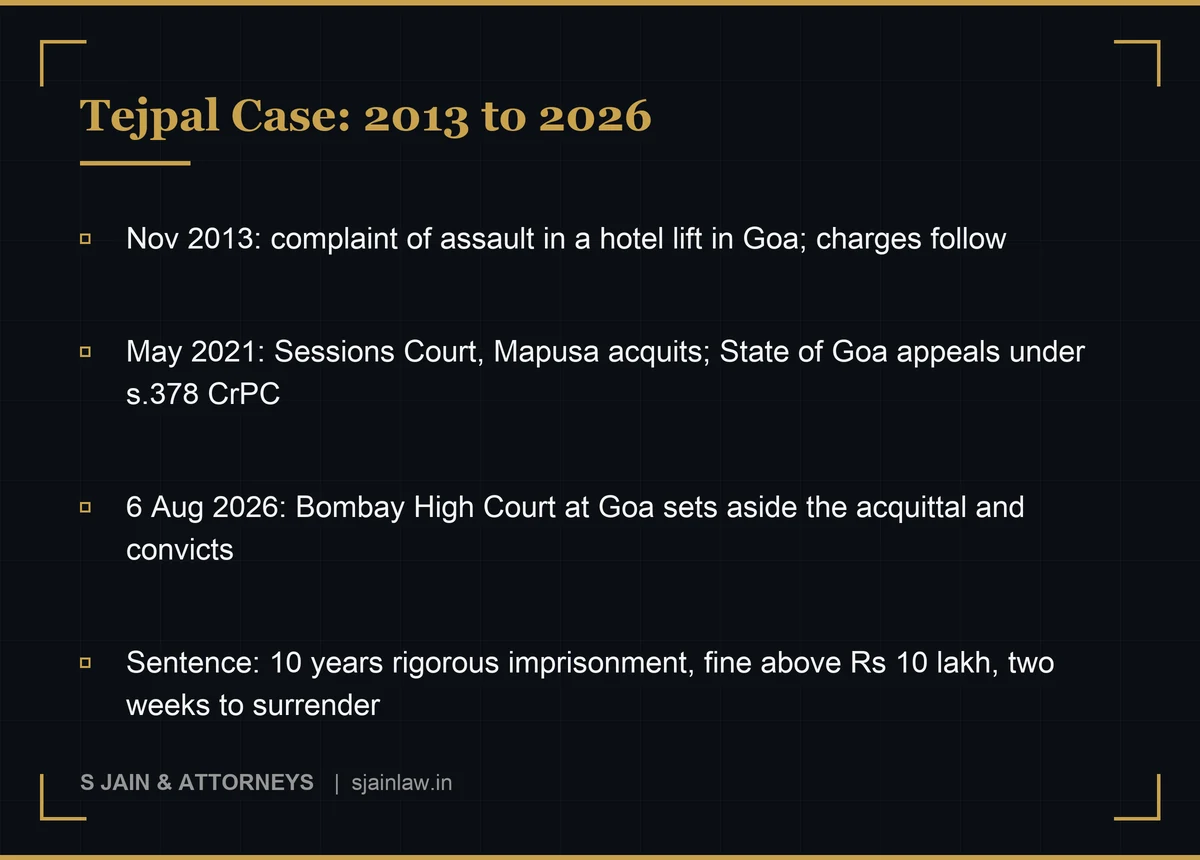
On 6 August 2026, a division bench of the Bombay High Court at Goa, comprising Justice Neela Gokhale and Justice Amit Jamsandekar, set aside the judgment of the Sessions Court at Mapusa which had in May 2021 acquitted the former editor-in-chief of Tehelka, Tarun Tejpal, and convicted him instead.
Part of the criminal defence practice at S Jain & Attorneys, Bangalore.
The Court sentenced him to ten years of rigorous imprisonment on the rape charges under Sections 376(2)(f) and 376(2)(k) of the Indian Penal Code, with sentences on the two counts running concurrently, together with sentences under Sections 354A and 354B and a fine exceeding ten lakh rupees. He was given two weeks to surrender.
The case has been in the public eye since 2013 and most of the commentary since Thursday has been about the personalities. The part that will actually matter to lawyers, and to anyone who ever sits on either side of a criminal appeal, is narrower and more interesting: an appellate court in India reversing an acquittal is genuinely difficult, and the law imposes a standard the State rarely clears. This is what that standard is, and how it was met here.
Bombay High Court, Goa Bench, judgment dated 6 August 2026, as reported by Live Law. The certified copy can be pulled from the eCourts judgment portal or the Bombay High Court website once it is uploaded. As at the date of this post the full text is not yet available on Indian Kanoon.
The complainant is not named anywhere in this article and no detail that could identify her appears in it. Publishing anything that discloses the identity of a survivor of a sexual offence is itself an offence under Section 228A of the Indian Penal Code, now carried forward as Section 72 of the Bharatiya Nyaya Sanhita, 2023. The High Court itself directed redaction of identifying material at the earlier stage of these proceedings. This applies to social media posts as much as to news reports.
What actually happened procedurally
The allegation concerned an incident in a hotel lift in Goa on 7 and 8 November 2013, during an event organised by the magazine, involving a junior colleague. Charges followed. In May 2021 the Additional Sessions Judge at Mapusa acquitted the accused. The State of Goa appealed.
That appeal is the whole story. What reached the High Court was not a fresh trial and not a routine appeal by a convicted person. It was an appeal against an acquittal, brought by the State, and Indian law treats that as a category of its own.
Why an appeal against acquittal is different
When a convicted person appeals, they are asking the appellate court to find a reasonable doubt. When the State appeals an acquittal, it is asking the appellate court to take away something the accused already holds. The accused arrives at the appellate court with what is often described as a double presumption of innocence: the presumption every accused begins with, reinforced by a trial court's finding in their favour.
That is why appellate courts say repeatedly that they will not interfere with an acquittal merely because they would have decided the case differently.
The statutory route, and which code applied
The State's right to appeal an acquittal came from Section 378 of the Code of Criminal Procedure, 1973. That provision has now been replaced by Section 419 of the Bharatiya Nagarik Suraksha Sanhita, 2023, which preserves the same essential structure while strengthening victim participation.
Two points of detail are worth getting right, because they come up constantly in practice right now:
- The offence dates from November 2013, so the Indian Penal Code governs it, not the Bharatiya Nyaya Sanhita. New codes do not reach back to conduct that predates them.
- The appeal was filed in 2021, well before the BNSS came into force on 1 July 2024. Under the savings provision in Section 531 of the BNSS, proceedings pending at commencement continue under the old Code. So this was a Section 378 CrPC appeal, decided in 2026.
The Chandrappa principles
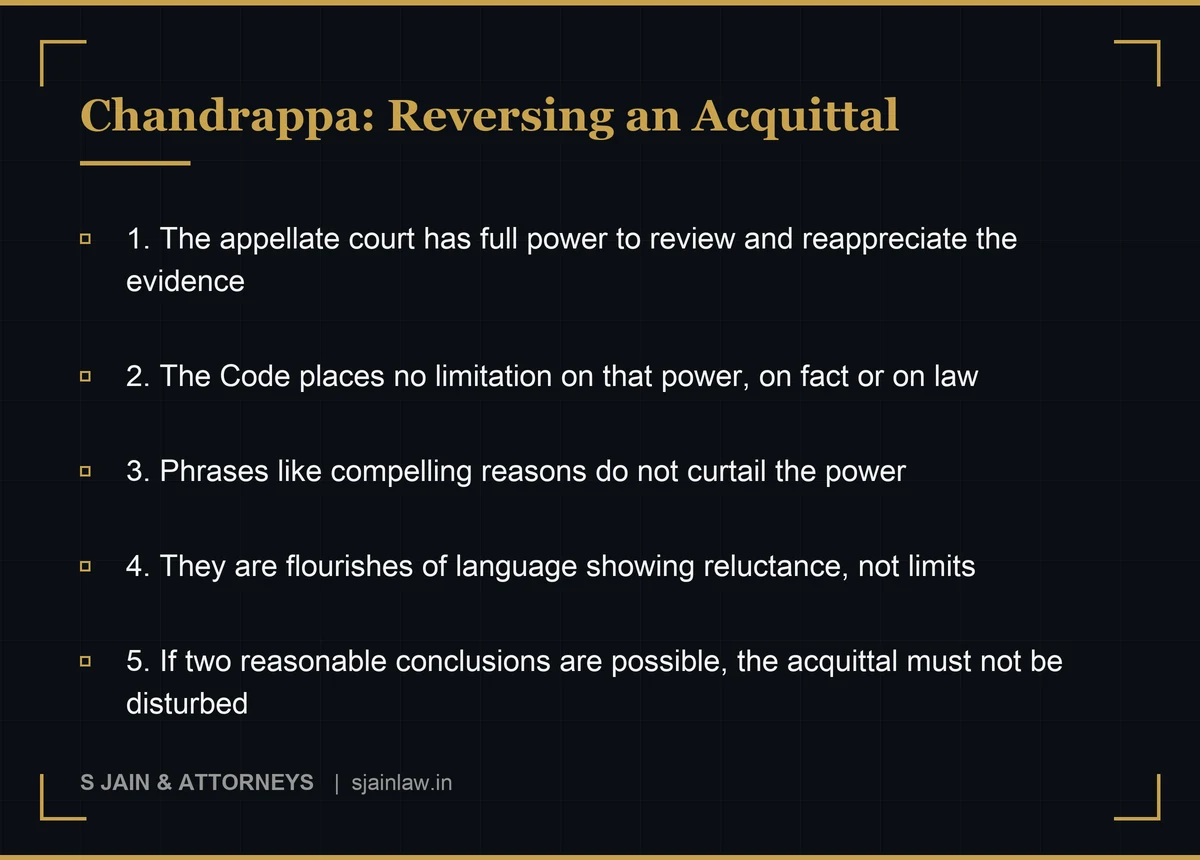
The governing authority on how an appellate court should approach an acquittal is Chandrappa v State of Karnataka, (2007) 4 SCC 415. The Supreme Court set out five propositions that are cited in effectively every appeal against acquittal argued in India.
| # | The principle |
|---|---|
| 1 | An appellate court has full power to review, reappreciate and reconsider the evidence on which the order of acquittal is founded. |
| 2 | The Code puts no limitation, restriction or condition on the exercise of that power, and the appellate court may reach its own conclusion on questions of both fact and law. |
| 3 | Expressions such as substantial and compelling reasons, good and sufficient grounds, very strong circumstances, distorted conclusions and glaring mistakes are not intended to curtail that extensive power. |
| 4 | Those phrases are flourishes of language, emphasising the appellate court's reluctance to interfere with an acquittal rather than limiting its power to do so. |
| 5 | If two reasonable conclusions are possible on the evidence, the appellate court should not disturb the acquittal. |
Principle five is the one that decides most appeals against acquittal, and it is why the State usually loses. It is not enough for the State to show that a conviction was available on the evidence. It has to show that acquittal was not reasonably available.
Key takeaway: the question on an appeal against acquittal is never "was the trial court wrong?". It is "was the trial court's view one that a reasonable court could hold on this evidence?". If yes, the acquittal stands even if the appellate court disagrees with it.
The word that unlocks reversal: perverse
Given principle five, how does any appeal against acquittal ever succeed? Through the recognised exception. Where the trial court's conclusion is not merely one of two possible views but is perverse, meaning it rests on a misreading of the evidence, on ignoring material evidence altogether, or on reasoning no reasonable court could adopt, it falls outside the protection of principle five. A perverse finding is not a second reasonable view. It is not a reasonable view at all.
That is the door the State walked through here. The High Court held that interference was warranted because the judgment under appeal involved a misreading or omission of material evidence, and described the Sessions Court's reasoning as not merely unreasonable but perverse. Once a court reaches that characterisation, the double presumption of innocence no longer shields the acquittal.
Common mistake: State appeals against acquittal are routinely drafted as a rerun of the trial, inviting the High Court to prefer the prosecution version. That framing loses, because it concedes that the trial court held one of two possible views. The appeal has to be pleaded as an attack on the reasoning, identifying the specific evidence misread or left out.
In practice this is the hardest thing to get counsel to accept. An appeal against acquittal feels like it should be about the facts, and every instinct pulls towards retelling the case from the beginning. The appeals that succeed do something narrower and less satisfying. They take three or four findings, put the actual evidence next to what the trial court said about it, and show the gap. Where a witness said one thing and the judgment records another, that is a misreading. Where an exhibit was on the record and the judgment never mentions it, that is an omission. Two or three of those, clearly demonstrated, do more than two hundred pages of reappreciation.
The evidentiary findings
Three strands of the High Court's reasoning are worth setting out, because each has application well beyond this case.
The sole testimony of the prosecutrix
The High Court rejected the trial court's insistence on corroboration, holding that the testimony of the survivor was reliable, inspired confidence, and could sustain a conviction on its own. It noted the obvious practical reality that in sexual offences direct evidence from anyone other than the victim is very rarely available.
This is settled law, not innovation. The Court relied on State of Maharashtra v Chandraprakash Kewalchand Jain, (1990) 1 SCC 550, and State of Punjab v Gurmit Singh, (1996) 2 SCC 384, both of which establish that the evidence of a prosecutrix in a sexual offence stands on a footing at least equal to that of an injured witness and does not require corroboration as a matter of law. Corroboration may be looked for where the testimony itself does not inspire confidence. It is not a precondition.
The perfect victim
The Court expressly rejected what it called the perfect victim construct, describing it as a myth and an unspoken cultural archetype. The State's case had been that the trial court measured the survivor's conduct after the incident against a stereotype of how a victim is expected to behave, and treated departures from that stereotype as reasons to disbelieve her.
The High Court held that credibility must be assessed against the circumstances of the assault itself, and not against whether a survivor fits a narrow cultural mould of total passivity or absolute vulnerability. In substance, using a stereotype as a yardstick for credibility is itself a legal error, and one capable of rendering a finding perverse.
Discrepancies, and what they are worth
The State argued that the trial court had attached excessive weight to minor discrepancies instead of asking the right question, which is whether the central allegation remained consistent throughout. That distinction between peripheral inconsistency and core consistency is orthodox and it is what the High Court applied. The Court also treated the apology emails as clear admissions of misconduct, reasoning that no person of ordinary prudence apologises falsely for an incident of this kind, and found that the CCTV material supported rather than undermined the prosecution account.
What happens next
A conviction by a High Court in an appeal against acquittal is not the end of the road. The route from here is a special leave petition to the Supreme Court under Article 136 of the Constitution, together with an application for suspension of sentence and bail pending that petition. The two-week window before surrender exists precisely so that such an application can be moved.
Because a further challenge is realistically in prospect, this article deliberately confines itself to what the High Court held and to the settled law it applied. It does not comment on the merits of any appeal that may follow.
Why this matters beyond the headlines
| If you are | What to take from this |
|---|---|
| A complainant whose case ended in acquittal | An acquittal is not automatically final. But an appeal succeeds on demonstrable misreading or omission of evidence, not on dissatisfaction with the outcome. |
| Defending a criminal appeal | Principle five in Chandrappa is your strongest argument. Frame the trial court's view as one reasonable view among two, and resist any characterisation of it as perverse. |
| Prosecuting an appeal against acquittal | Do not argue that conviction was available. Identify the specific evidence misread or omitted, and show that no reasonable court could have reached the acquittal. |
| An employer or internal committee | Stereotyped expectations about how a complainant should behave are not a safe basis for disbelieving one. The same reasoning that made the trial court's approach unsustainable applies to an internal inquiry under the POSH Act. |
Related guides and where to get help
- FIR Quashing in India: What a Reasoned High Court Order Means
- De-Indexing Search Results After Acquittal: Your Rights
- Acquittal for Contradictions in Prosecution Evidence
Frequently Asked Questions
Can a High Court convict someone who was acquitted by a trial court?
Yes. On an appeal against acquittal the High Court has full power to review and reappreciate the evidence and to reach its own conclusion, including a conviction. The power was exercised under Section 378 of the CrPC, now Section 419 of the BNSS.
Is it not harder to reverse an acquittal than to uphold a conviction?
In practice, yes. The accused enjoys a double presumption of innocence, and under Chandrappa v State of Karnataka an appellate court must leave an acquittal undisturbed if two reasonable conclusions are possible on the evidence. Reversal generally requires the trial court's view to be perverse.
What does perverse mean in this context?
A finding that rests on a misreading of the evidence, on ignoring material evidence, or on reasoning that no reasonable court could adopt. It is not simply a view the appellate court disagrees with.
Can a conviction for rape rest on the survivor's testimony alone?
Yes, where that testimony inspires confidence. Chandraprakash Kewalchand Jain and Gurmit Singh establish that corroboration is not required as a matter of law. It may be sought where the testimony itself is not found reliable.
Why was the Indian Penal Code applied when the BNS is now in force?
Because the offence took place in 2013. The substantive law that applies to an offence is the law in force when it was committed. The new sanhitas do not operate retrospectively.
What remedy remains after a High Court conviction?
A special leave petition to the Supreme Court under Article 136 of the Constitution, usually accompanied by an application for suspension of sentence and bail.
Can I name or discuss the complainant on social media?
No. Disclosing the identity of a survivor of a sexual offence is a criminal offence under Section 228A of the IPC, now Section 72 of the BNS, and that applies to individuals posting online just as it does to publishers.
This article reports and analyses a judgment already delivered and available on the public record, and is for general informational purposes only. It does not constitute legal advice and expresses no view on any further appeal. Please consult a qualified advocate about your own matter.