Losing a job is bad enough; losing it illegally is something the law lets you fight. Wrongful termination in India is not a single offence but a family of violations: termination without notice, retrenchment without the statutory compensation, dismissal for misconduct without an inquiry, or a firing that is really punishment for raising a complaint. This guide maps the whole field for private-sector employees: what makes a termination wrongful, the critical question of whether you are a worker, the exact money Section 70 of the Industrial Relations Code requires, Karnataka's own protection for shop and establishment employees, and the remedies ladder from a demand letter to a claim before the industrial tribunal.
Part of the employment and labour law practice at S Jain & Attorneys, Bangalore.
India's four labour codes were brought into force on 21 November 2025, with the central rules following on 30 December 2025. The Industrial Disputes Act, 1947 is gone: it stands repealed, along with the Trade Unions Act, 1926 and the Industrial Employment (Standing Orders) Act, 1946, by Section 104 of the Industrial Relations Code, 2020. The Payment of Gratuity Act, 1972 has gone into the Code on Social Security, 2020; the Factories Act, 1948 into the Occupational Safety, Health and Working Conditions Code, 2020; the Payment of Wages Act, 1936 into the Code on Wages, 2019. The substance of most of what follows survived the move, but the section numbers and the vocabulary did not, and a notice that cites Section 25F today cites a repealed provision.
What counts as wrongful termination in India
A termination is wrongful when the employer breaks the contract, the statute, or both. The recurring patterns are:
- Termination without notice or pay in lieu, where the appointment letter or the statute requires it.
- Retrenchment without compensation: a worker let go for redundancy without the money and notice Section 70 of the Industrial Relations Code, 2020 mandates, the provision that replaced Section 25F of the Industrial Disputes Act, 1947.
- Misconduct dismissal without a domestic inquiry, or after an inquiry that ignored natural justice.
- Victimisation: dressing up punishment as redundancy because the employee raised a grievance, joined a union, or filed a complaint (for example, retaliation after a POSH complaint).
- Discriminatory termination, including termination for pregnancy, which separate statutes expressly prohibit.
Illegal termination and wrongful termination are often used interchangeably, but the remedies differ sharply depending on which statute was broken and who you are, so the vocabulary is worth keeping precise:
| Label | What it means | Typical consequence |
|---|---|---|
| Wrongful | Breach of the employment contract: no notice, no cause where cause is required | Notice pay and damages; appeal under shops law |
| Illegal | Violation of a mandatory statute, e.g. retrenchment without Section 70 compliance | Termination can be declared void; reinstatement possible for workers |
| Unfair | Unfair labour practice, e.g. dismissal by way of victimisation (Second Schedule to the Industrial Relations Code, prohibited by Section 84) | Tribunal relief, including reinstatement and back wages |
Are you a worker? The definition still decides everything
The single most important legal question after any termination has not changed, but its vocabulary has. Until 21 November 2025 the question was whether you were a "workman" within Section 2(s) of the Industrial Disputes Act. That Act is repealed. The question now is whether you are a worker within the definition in the Industrial Relations Code, 2020. Readers still search on the old word, and the case law decided on it is still the guide to how the new one is read, so both terms appear in this guide deliberately.
The Code defines a worker as a person employed in any industry to do manual, unskilled, skilled, technical, operational, clerical or supervisory work for hire or reward. It excludes those employed mainly in a managerial or administrative capacity, and those employed in a supervisory capacity drawing wages exceeding Rs 18,000 a month, or such other amount as the Central Government notifies. Two things are worth noticing. The managerial exclusion, which is what most termination fights turn on, survived the transition intact. The supervisory threshold did not: it was Rs 10,000 under the old Act and is Rs 18,000 under the Code, so a band of supervisors who were outside the old definition are inside the new one.
Workers get the strongest remedies: statutory retrenchment compensation, adjudication before the industrial tribunal, and the possibility of reinstatement with back wages. Those outside the definition, meaning genuine managers, are left largely to contract law.
Employers know this, which is why designations are inflated. The Supreme Court shut that door in S.K. Maini v. Carona Sahu Co. Ltd., (1994) 3 SCC 510: the designation is not decisive; what matters is the main and substantial nature of the duties actually performed. An employee mainly doing technical or clerical work remains a worker even if some supervisory work is done incidentally, and the reverse is equally true. That case was decided under the 1947 Act, but the Code carries forward the same list of duties and the same managerial exclusion, so the duties test it lays down remains the practical guide.
Retrenchment: the Section 70 checklist
Where a worker with at least one year of continuous service is retrenched, Section 70 of the Industrial Relations Code, 2020 imposes three conditions precedent, meaning they must be satisfied before the termination takes effect. They are the old Section 25F conditions, carried across almost word for word:
- One month's written notice stating the reasons, or wages in lieu of that notice.
- Retrenchment compensation equal to 15 days' average pay for every completed year of continuous service, or any part of a year exceeding six months. The Code allows the appropriate Government to notify a different number of days, so check whether anything has been notified for your State before you fix the figure.
- Notice to the appropriate Government, or to the authority it specifies, in the prescribed manner.
Key takeaway: non-compliance with Section 70 is not a technicality. Courts consistently held a retrenchment carried out without the notice and compensation under the identical old provision to be void, which is what opens the door to reinstatement with back wages.
Two companion provisions matter in layoffs. Section 71, the old Section 25G, imposes the "last come, first go" rule: within each category of workers, the employer must ordinarily retrench the last person hired first, and a departure needs recorded reasons. Section 72, the old Section 25H, gives retrenched workers a right of re-employment: where the employer proposes to take anyone into employment within one year of the retrenchment, the retrenched workers must be given the opportunity to offer themselves and have preference over other candidates. In mass layoffs these two sections are violated more often than Section 70 itself, because employers select by cost or appraisal ranking without recording why juniors were retained.
Continuous service is defined by Section 66 of the Code, and the familiar arithmetic survived: a worker who has actually worked 240 days in the preceding twelve months is deemed to have been in continuous service for a year, 190 days in the case of underground mine work.
Karnataka Shops and Establishments Act: the Section 39 shield
Employees in Bangalore offices, including most of the IT and services workforce, have a second layer of protection, and it is untouched by the labour codes. The Karnataka Act is State legislation and is not one of the central Acts repealed by the four codes, so what follows is unchanged by the 21 November 2025 commencement. Section 39 of the Karnataka Shops and Commercial Establishments Act, 1961 provides that an employee with six months of continuous service cannot be removed or dismissed except for a reasonable cause, and only after one month's previous notice or pay in lieu. The notice requirement falls away only where misconduct is proved on record at an inquiry.
The enforcement route is unusually direct: the dismissed employee can appeal to the prescribed authority (in practice the jurisdictional Assistant Commissioner of Labour) on the ground that there was no reasonable cause or that the misconduct was not proved, and the authority can order compensation, capped at one month's pay for each year of service. The appeal must be filed within 30 days of the dismissal order being communicated, with a limited power to condone delay.
Deadline warning: two clocks start on the day you are terminated. The Section 39 appeal runs out in 30 days; the industrial dispute must reach conciliation well inside the Code's outer limit, set out below. Most employees discover the first deadline only after it is gone.
Misconduct dismissals: the domestic inquiry and natural justice
An employer who dismisses for misconduct must be able to show a fair domestic inquiry: a specific written charge sheet, a reasonable chance to respond, an unbiased inquiry officer, evidence taken in the employee's presence with an opportunity to cross-examine, a reasoned finding, and a punishment proportionate to the charge. Skipping the inquiry, treating it as a formality with a pre-decided outcome, or dismissing for something never put in the charge sheet, all render the dismissal vulnerable before the tribunal and the Section 39 appellate authority alike.
The remedies ladder: from demand letter to the industrial tribunal
The forum changed on 21 November 2025 along with everything else. The Industrial Relations Code does away with the separate tier of Labour Courts and provides for Industrial Tribunals, and matters that were pending before a Labour Court or Tribunal under the 1947 Act stand transferred to the tribunal with corresponding jurisdiction under the Code. If your papers say "Labour Court", that is where the file now sits, not a different case.
- Secure your documents (see the checklist below) and put your protest on record in writing; silence reads as acceptance.
- Demand letter or legal notice setting out the illegality and the money due. A well-drafted notice settles a surprising share of these disputes.
- Conciliation: the Code's definition of an industrial dispute expressly takes in a dispute between an individual worker and an employer arising out of discharge, dismissal, retrenchment or termination, so a lone employee still does not need a union behind them. The conciliation officer holds proceedings under Section 53.
- The failure report: where no settlement is reached, Section 53(5) requires the conciliation officer to send the report to the parties and the appropriate Government within 45 days of the conciliation proceedings commencing, unless the parties agree in writing to extend it with the officer's approval.
- Application to the tribunal: Section 53(6) allows any concerned party to apply to the Industrial Tribunal in the prescribed form for matters not settled in conciliation, within 90 days from the date the failure report is received. No government reference is needed.
- Adjudication: the tribunal can set aside the termination and order reinstatement with full or partial back wages, or award compensation in lieu where reinstatement is impractical.
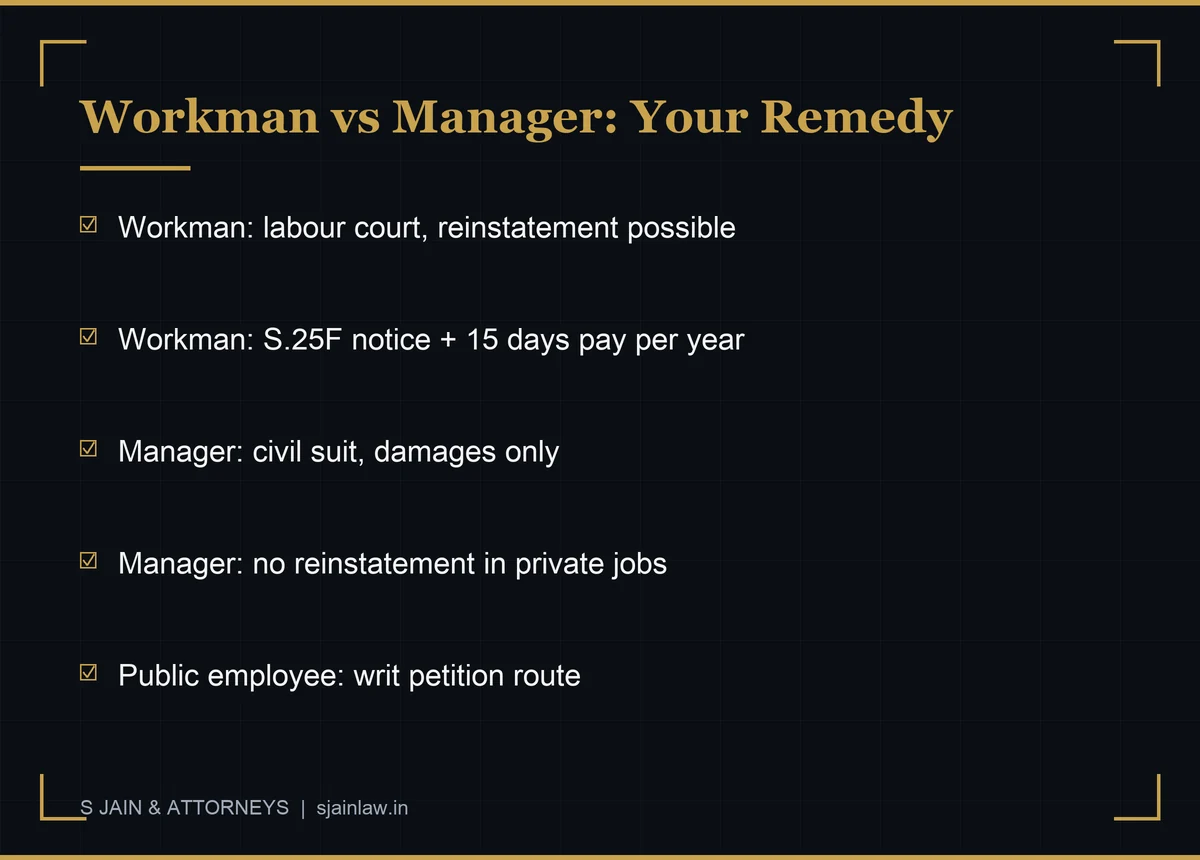
Managers and senior staff stand on different ground. A private employment contract is a contract of personal service, and the settled rule, laid down in Executive Committee of Vaish Degree College v. Lakshmi Narain, (1976) 2 SCC 58, is that a contract of personal service cannot ordinarily be specifically enforced. A civil court will not force a private employer to keep you; the recognised exceptions are public servants protected by Article 311, workers under industrial law, and statutory bodies acting in breach of statute. A manager's civil suit therefore yields damages only, typically the notice pay and other contractual dues, not reinstatement. Public-sector employees have a further route: a writ petition where the state employer acted arbitrarily or in breach of service rules.
Limitation: the window closed, and most readers do not know it
This is the correction that matters most to anyone who was terminated recently. Under the old Section 2A(3) of the Industrial Disputes Act, an employee had three years from the termination to apply to the labour court. That provision is repealed and the Code is stricter in two separate ways.
First, the proviso to Section 53(1) bars the conciliation officer from holding conciliation proceedings on an industrial dispute after two years from the date on which the dispute arose. Second, once the failure report comes, Section 53(6) gives only 90 days from its receipt to move the tribunal. The old comfortable three-year runway is gone, and a claim that would have been in time in 2024 may not be in time on the same facts today.
Key takeaway: do not measure your deadline from the tribunal application backwards. Measure it from the day the dispute arose, and get into conciliation early. Delay also costs money independently of limitation, because back wages shrink as time passes and tribunals view stale claims sceptically.
Severance math: what a retrenched worker is owed
Take a worker in a Bangalore establishment earning monthly wages (basic plus dearness allowance) of Rs 40,000, retrenched after 6 years and 8 months of continuous service. Because a part of a year exceeding six months counts as a completed year, the service counts as 7 years:
| Head | Rule | Amount |
|---|---|---|
| Notice pay | One month's wages in lieu of notice, Section 70(a), IR Code | Rs 40,000 |
| Retrenchment compensation | 15 days' average pay x 7 years (Rs 20,000 x 7), Section 70(b), IR Code | Rs 1,40,000 |
| Gratuity | 15/26 x Rs 40,000 x 7 years, Section 53, Code on Social Security, 2020 | About Rs 1,61,538 |
| Leave encashment | Unavailed earned leave under the Karnataka Shops and Commercial Establishments Act | As per leave balance |
| Statutory minimum | About Rs 3,41,538 + leave encashment |
Gratuity is a separate entitlement, payable after five years of continuous service, and it cannot be traded away against retrenchment compensation. Anything the employer offers as a "severance package" should be measured against this floor before you sign. One change worth checking against your own payslip: the codes use a single definition of "wages", and it provides that where the excluded allowances exceed one-half of total remuneration, the excess is added back into wages. A salary structure built on a small basic and a large allowance component no longer automatically produces a small severance figure.
IT layoffs: are software engineers workers?
Every layoff season revives the same question, and the answer is the settled duties test, not the industry. A software engineer writing code, testing, or doing other technical work is doing exactly what the Code's worker definition describes, and the designation on the offer letter does not change that; the Tamil Nadu labour department had said in terms that IT employees were covered by the Industrial Disputes Act, and nothing in the Industrial Relations Code narrows the description of technical work. The line is crossed when the role becomes genuinely managerial: the Karnataka High Court has set aside a labour court order reinstating an IT project lead, holding that such a role cannot be implied to be clerical, manual or technical work, so the labour court had no jurisdiction. That was decided under the old Act, and the reasoning still applies, but note that the Code expressly includes supervisory work in the definition and only excludes supervisors whose wages exceed the Rs 18,000 threshold, so a supervisory argument that succeeded for an employer under the 1947 Act will not always succeed now. Each case still turns on what the person actually did all day: appraisal writing, hiring decisions and genuine managerial authority point away from worker status; sprint tickets, code commits and delivery work point towards it.
One more nuance, and it survived the transition. The prior-permission regime, now Chapter X of the Industrial Relations Code, applies only to factories, mines and plantations, because Section 77 defines "industrial establishment" for that Chapter in those terms alone. It does not reach software offices. The threshold also moved: it is now 300 workers on an average per working day in the preceding twelve months, or such higher number as the appropriate Government notifies, against 100 under the old Chapter V-B. For IT workers the battle is therefore almost always compliance with Sections 70, 71 and 72.
What to collect before you resign or are terminated
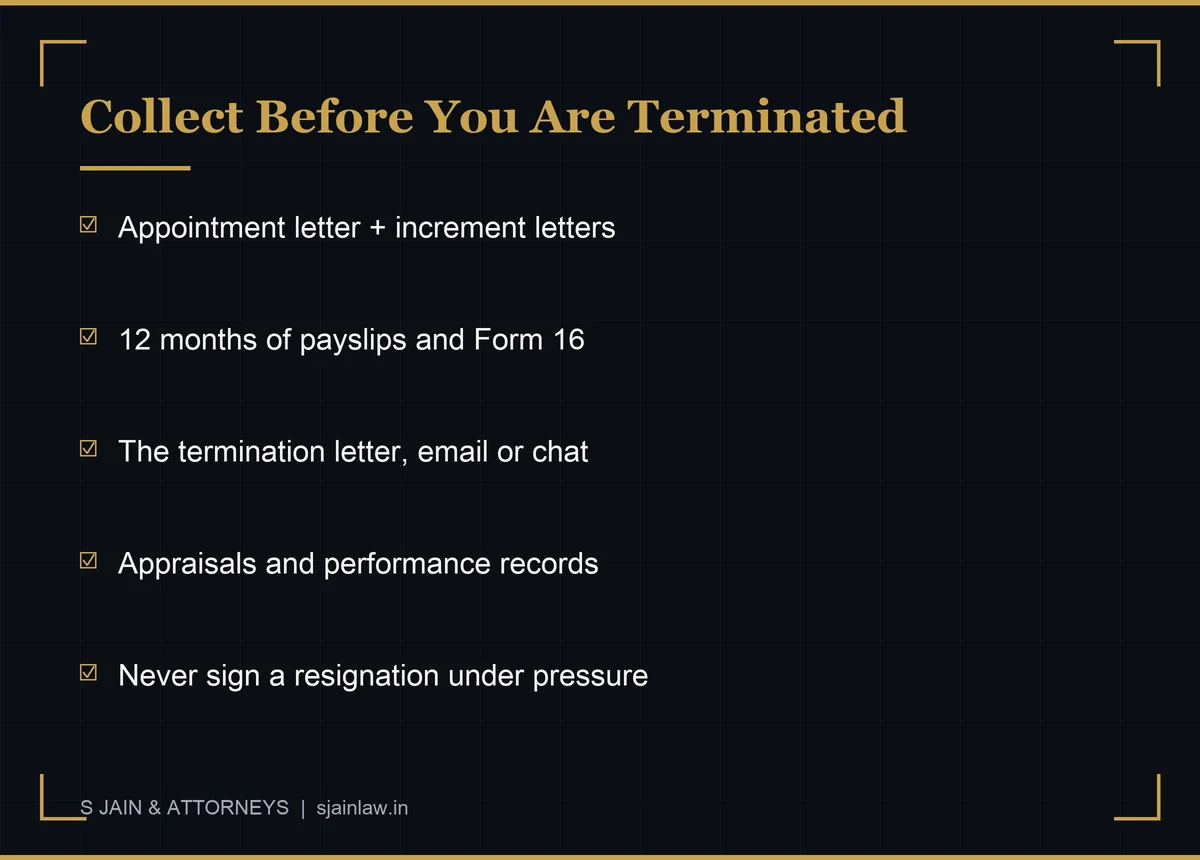
- Appointment letter, increment and promotion letters, and any employment agreement or service agreement you signed.
- Payslips for at least 12 months, Form 16, and PF statements, which prove your wage for severance math.
- The termination communication itself: letter, email, or a contemporaneous written record if it was only verbal.
- Appraisals, targets and performance records, especially if the stated reason is performance.
- Emails, chats and minutes showing the real sequence of events, forwarded to a personal account before access is cut, restricted to your own employment records and never confidential business data.
- Do not sign a resignation, settlement or release under pressure. A forced resignation can amount to termination in law, but proving coercion after you signed is an uphill fight.
In my practice, the pattern in Bangalore is depressingly uniform: the employee is called into a short meeting, told the role is redundant, and handed a resignation letter with a same-day deadline and a modest cheque. Almost every legal advantage the employee has, the 240 days of continuous service, the Section 70 floor, the Section 39 appeal, the victimisation angle, depends on documents and on not signing that letter in the room. The clients who walk out saying "I will revert after taking advice" keep their options; the ones who sign lose most of them in one signature. If you are facing this, our employment and labour law team can assess within a day whether you are a worker and what your floor figure actually is.
Cases and terminations from before 21 November 2025
Nothing you had before commencement day disappeared. Section 104 of the Industrial Relations Code repeals the 1947 Act but provides that anything done or any action taken under the repealed enactments is deemed to have been done under the corresponding provisions of the Code, so far as it is not contrary to the Code, and it expressly applies Section 6 of the General Clauses Act, 1897 to the repeal. That is the ordinary saving machinery: proceedings already begun continue, and rights already accrued are not swept away by the repeal itself. Cases pending before a Labour Court or Tribunal constituted under the old Act stand transferred to the tribunal with corresponding jurisdiction under the Code.
What that does not mean is that you can carry on citing the old sections in a fresh matter. For anything commenced after 21 November 2025 the operative provisions are those of the Code, and where the transition affects a live limitation question, that is exactly the point on which to take advice rather than an assumption.
Related guides and where to get help
- Married Daughter & Compassionate Appointment Rights
- Temporary Status Casual Labourer Pension Rights in India
- Service Agreement Drafting in India: Scope, Payment, Indemnity and Termination
- Your Case Is Pending: Can the Employer Still Transfer or Dismiss You?
- Unfair Labour Practices: The List of Things an Employer Cannot Do
- The Employer Owes You Money and Will Not Pay: Section 59
- Mass Casual Leave Is Now a Strike in Law
Frequently Asked Questions
What is wrongful termination in India?
A termination that breaches the employment contract or a statute: no notice or pay in lieu, retrenchment without the compensation Section 70 of the Industrial Relations Code, 2020 requires, dismissal without a fair inquiry, or termination as victimisation or discrimination.
Is the Industrial Disputes Act still the law?
No. It was repealed by Section 104 of the Industrial Relations Code, 2020 when the four labour codes came into force on 21 November 2025, with central rules following on 30 December 2025. Most of the substance moved across, but the section numbers and the term "workman" did not.
Is a "workman" now a "worker"?
Yes. The Code uses "worker" and defines it as a person employed to do manual, unskilled, skilled, technical, operational, clerical or supervisory work, excluding those employed mainly in a managerial or administrative capacity and supervisors drawing wages above Rs 18,000 a month or such other amount as is notified.
My designation is manager. Does that mean I have no remedy?
Not by itself. Under S.K. Maini v. Carona Sahu (1994), status depends on your main duties, not your title. If you mainly did technical, clerical or operational work, you can still be a worker with the full statutory remedies.
What is retrenchment compensation?
For a worker with one year of continuous service: one month's written notice or pay in lieu, plus 15 days' average pay for every completed year of service (a part exceeding six months counts as a full year), paid at the time of retrenchment under Section 70 of the Industrial Relations Code.
Can I go directly to the tribunal?
Yes, without a government reference. Conciliation comes first under Section 53; where it fails, the conciliation officer's report is due within 45 days of the proceedings commencing, and Section 53(6) allows an application to the Industrial Tribunal within 90 days of that report being received.
What is the time limit for challenging a termination?
Shorter than it used to be. The proviso to Section 53(1) bars conciliation proceedings more than two years after the dispute arose, and the tribunal application must follow within 90 days of the failure report. Separately, the appeal under Section 39 of the Karnataka Shops and Commercial Establishments Act runs out in 30 days.
Can a private-sector manager get reinstatement?
Ordinarily no. A contract of personal service is not specifically enforceable, so a manager's civil suit yields damages such as notice pay, not the job back. Reinstatement is realistic only for workers, public servants and employees of statutory bodies.
Is termination without notice ever legal?
Yes, in narrow cases: proven misconduct after a fair domestic inquiry, or during a genuine probation period on the contract's terms. Otherwise both Section 70 of the Code and Section 39 of the Karnataka Act require notice or pay in lieu.
Do laid-off IT employees get retrenchment compensation?
If their real duties were technical or clerical, they are workers and Section 70 applies in full, along with the last-come-first-go rule in Section 71 and re-employment rights under Section 72. Genuinely managerial staff fall back on their contracts.
What happens to my case that was already in the Labour Court?
It continues. Cases pending under the 1947 Act stand transferred to the tribunal with corresponding jurisdiction under the Code, and Section 104 saves things already done under the repealed Acts.
This article is general legal information, not legal advice, and does not create a lawyer-client relationship. Employment disputes turn on documents, dates and duties, and the right strategy varies case to case. For advice on a specific termination, consult a qualified advocate.