Captive power in Karnataka received its most significant legal reset in years this June: the Karnataka High Court quashed KERC's procedure for verifying the captive status of generating plants and their users, struck down the regulator's "dynamic UQR" mechanism as contrary to the Electricity Rules, 2005 and Supreme Court precedent, and directed KERC to frame a fresh procedure only after consulting the stakeholders it governs. If your company consumes power from a plant it part-owns, whether through a group captive structure, an industrial park arrangement, or your own plant, this ruling touches your tariff economics directly, because captive status is what stands between you and the cross-subsidy surcharge. This guide explains the statutory scheme, the twin 26%/51% tests, what the High Court actually decided and why, the money at stake, and the compliance playbook for the interregnum while the new procedure is written.
Part of the corporate and commercial law practice at S Jain & Attorneys, Bangalore.
Key takeaway: the tests for captive status live in central law, Section 9 of the Electricity Act and Rule 3 of the Electricity Rules, 2005, as interpreted by the Supreme Court. A state regulator administers those tests; it cannot bolt new moving parts onto them. That is the principle the High Court has enforced, and it is the lens through which every pending verification and surcharge demand should now be re-read.
Why captive status is worth crores
A captive generating plant is one set up primarily for one's own use. The Electricity Act, 2003 deliberately privileges it: under Section 9, a person may construct and operate a captive plant without a licence, and under the fourth proviso to Section 42(2), open access for carrying captive power to the destination of use is not subject to the cross-subsidy surcharge (CSS) that other open-access consumers must pay the distribution licensee.
That exemption is the entire financial architecture of the captive market. CSS in Karnataka runs to rupees per unit; across an industrial consumer's annual consumption, captive status routinely decides liabilities in the crores. Group captive structures, where an SPV owns the plant and multiple industrial users hold equity and consume the output, exist precisely to qualify for this exemption. Whoever controls how captive status is verified, and for which year, therefore controls who keeps the exemption. That is why verification procedure, which sounds like paperwork, is fought like tariff litigation: because it is tariff litigation.
The twin tests: 26% ownership, 51% consumption
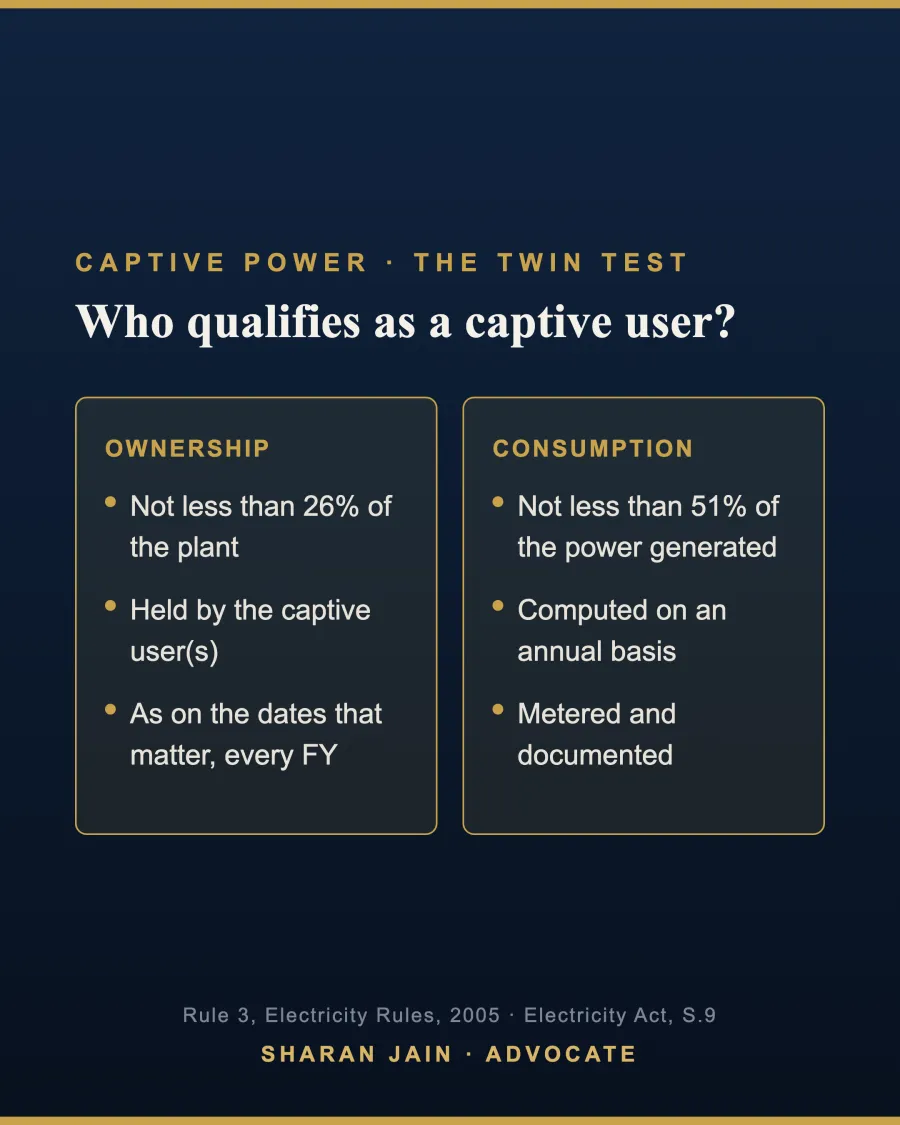
Rule 3 of the Electricity Rules, 2005 fixes the qualifying conditions. A plant qualifies as captive only if, in aggregate:
- the captive user(s) hold not less than 26% of the ownership of the plant (equity with voting rights, in the SPV or the plant), and
- the captive user(s) consume not less than 51% of the aggregate electricity generated, determined on an annual basis.
For group captives, the rule adds a proportionality discipline: each captive user's consumption must track its ownership within the tolerance the rule prescribes, so that a 5% shareholder cannot claim the exemption on half the plant's output. The Supreme Court examined the scheme in detail in Dakshin Gujarat Vij Company Ltd. v. Gayatri Shakti Paper & Board Ltd. (2023), confirming that the twin tests are mandatory, that consumption is computed annually, and how the proportionality requirement operates for group captive users. The verification exercise, in other words, already has a complete rulebook: central rules, authoritatively construed.
What KERC did, and what the High Court struck down
KERC's impugned framework created a state-level verification procedure for captive status and introduced a dynamic "UQR" (unutilised quantum requirement) mechanism, an additional, moving computational layer applied to captive users' consumption profiles. Generators and users challenged it, and in June 2026 the High Court:
- quashed the verification procedure as framed;
- struck down the dynamic UQR mechanism, holding it contrary to the Electricity Rules, 2005 and to Supreme Court precedent, a state instrument cannot rewrite central qualifying tests; and
- directed KERC to frame a fresh procedure after stakeholder consultation, restoring process legitimacy to an exercise that had been imposed rather than consulted.
The reasoning matters more than the result. Verification per se is legitimate; a regulator may check that claimed captive users actually satisfy Rule 3. What it may not do is alter the substance of the tests through the verification design, adding thresholds, timing rules or computational mechanics that Rule 3 does not contain. The line between administering a test and amending it is the whole judgment.
The money consequences: demands, refunds and the appeal clock
Verification outcomes convert directly into money three ways, and each now needs a fresh look:
| Situation | Effect of the ruling | Action |
|---|---|---|
| CSS demands premised on failed verification under the quashed procedure | The foundation is gone; demands are reviewable, not automatically payable | Legal review before payment; protest and challenge where appropriate |
| Amounts already paid under such demands | Restitution arguments arise, subject to limitation and the orders in each case | Inventory payments; evaluate refund claims |
| Pending verification proceedings for past years | Cannot proceed under the quashed framework; await the consulted procedure | Keep records audit-ready; participate in consultation |
Two clocks deserve respect. Appellate challenges to regulatory orders run to APTEL within 45 days under Section 111 of the Act; and restitution claims have their own limitation arithmetic. The ruling opens doors, but the doors are time-stamped, and Karnataka's electricity bar knows how quickly they close. Note also that further proceedings, an appeal by the regulator, or the fresh procedure itself can change the landscape; every position taken now should be built to survive that evolution.
Different instruments are challenged in different forums, and each forum has its own clock.
Writ in the High Court
Regulations are tested in the High Court by writ petition. That is the route that produced the quashing of the verification procedure.
APTEL within 45 days
Orders in individual matters go to the Appellate Tribunal for Electricity within 45 days, under Section 111 of the Electricity Act, 2003.
Supreme Court on law
From the Appellate Tribunal a further appeal lies to the Supreme Court, but only on a question of law arising out of the order.
KERC stakeholder consultation
The fresh procedure will be written in the consultation the High Court has ordered, and absence from that room is acquiescence.
The compliance playbook for captive users and generators
While the fresh procedure is framed, the users who will sail through it are the ones whose files are already complete. The discipline:
- Shareholding proof, audit-ready, for every financial year: share certificates, registers of members, and the dates of every transfer. The 26% must hold in the right instrument (equity with voting rights) on the dates that matter, and group captive SPVs should reconcile the register annually against the consumption roster.
- Consumption documentation against the 51% and proportionality tests: meter data, energy accounting statements, and the annual computation, kept in the format the Supreme Court's reading of Rule 3 contemplates.
- Contract hygiene in group captives: the shareholders' agreements and power supply agreements should tie equity, consumption entitlements and true-up mechanics together, so that the paper structure and the metered reality never diverge. Divergence is what verification exercises exist to find.
- Participate in KERC's consultation. The High Court has ordered exactly the stakeholder process that was missing; the fresh procedure will be written in that room, and absence is acquiescence.
- Re-examine every live demand and pending proceeding against the ruling before paying or conceding anything.
Common mistake: treating captive compliance as a one-time structuring exercise at commissioning. The tests are annual. Shareholding changes mid-year, a user exits, consumption shifts, and a structure that qualified in FY24 quietly fails FY26. The companies that lose verification fights are rarely the ones with bad structures; they are the ones with good structures and three-year-old paperwork.
The wider Karnataka board
This ruling landed in the middle of the most contested season Karnataka's power sector has seen in years: Tata Power's parallel distribution licence application and withdrawal, a fresh private applicant within days, KERC's new consumer billing directions, and draft rules reshaping rooftop solar and open access. The through-line is the same in every fight: the boundary between policy, regulation and statute, and who gets to draw it. Retail consumers can see their side of the board in our guide to electricity consumer rights in Karnataka, and housing societies exploring self-generation should read the companion piece on community power stations for Bengaluru RWAs.
A practice note from the regulatory trenches
Regulatory law moves quietly and then all at once, and captive verification is a textbook case: years of routine filings, then a procedure, a challenge, and suddenly every industrial CFO in the state is asking what the exemption is worth. The honest answer is that the exemption is worth exactly as much as the file that proves it. In these disputes I have watched the same asymmetry repeatedly: the regulator's side arrives with a procedure; the user's side must arrive with years of registers, meter data and agreements that all say the same thing. Build that file annually, before anyone asks, and verification, under the old procedure or the new one, becomes an administrative event rather than an existential one.
Related guides and where to get help
- Share Valuation in NCLT Buy-Out Orders: How Fair Value Is Fixed When a Minority Shareholder Exits
- Moonlighting in India: Is a Second Job Legal, and Can You Be Fired for It?
- Gratuity in India: Who Qualifies, How It Is Calculated, and When It Can Be Forfeited
Frequently Asked Questions
What did the Karnataka High Court decide about KERC's captive verification?
In June 2026 it quashed KERC's captive status verification procedure, struck down the dynamic UQR mechanism as inconsistent with the Electricity Rules, 2005 and Supreme Court precedent, and directed a fresh procedure framed after stakeholder consultation.
What are the requirements for captive power status?
Under Rule 3 of the Electricity Rules, 2005: not less than 26% ownership of the plant held by the captive user(s) and not less than 51% of the aggregate generation consumed by them, computed annually, with proportionality between ownership and consumption for group captive users.
Do captive users pay cross-subsidy surcharge?
No, genuine captive consumption carried on open access is exempt under the fourth proviso to Section 42(2). That exemption is precisely what verification disputes decide.
What happens to surcharge demands raised under the quashed procedure?
They are built on a foundation the High Court removed and deserve legal review rather than automatic payment; amounts already paid may ground restitution claims, subject to limitation and the orders in each matter.
What is a group captive structure?
An arrangement where multiple users hold equity (aggregating at least 26%, with voting rights) in a generating SPV and together consume at least 51% of its output in proportion to shareholding, qualifying each for the captive exemption.
What records should captive users maintain?
Year-wise shareholding proof (certificates, registers, transfer dates), meter and energy-accounting data establishing the 51% and proportionality tests, and the SPV agreements tying equity to consumption entitlements.
Where are KERC's orders challenged?
Regulations are tested in the High Court by writ; orders in individual matters go to the Appellate Tribunal for Electricity (APTEL) within 45 days under Section 111, with a further appeal to the Supreme Court on questions of law.
Does this ruling end verification in Karnataka?
No. Verification legitimately continues once KERC frames the fresh, consulted procedure; what ended is the specific framework, and the principle is that any new one must administer Rule 3, not amend it.
This article is for general informational purposes only and does not constitute legal advice. Specific situations need specific counsel.