When a company's cheque bounces, Section 141 of the Negotiable Instruments Act decides which human beings stand trial alongside it, and complainants routinely read that section as "sue every name on the MCA master data". Courts keep reading it as written: liability attaches to those who, at the time the offence was committed, were in charge of and responsible to the company for the conduct of its business, and to the cheque's signatories, not to every director, and never automatically. Two July 2026 rulings mark both edges of the line: a high court reiterated that a bare designation is not an averment, and the Karnataka High Court quashed proceedings where the cheque post-dated the company's dissolution, leaving no principal offender for vicarious liability to attach to. This guide covers the full Section 141 battlefield: the statutory test, the S.M.S. Pharmaceuticals averment rules, who is presumptively in the net and who keeps escaping it, the resignation defence and its DIR-12 paperwork, the mandatory arraignment of the company after Aneeta Hada, and the complainant-side playbook for pleading these cases so they survive.
Part of the cheque bounce practice at S Jain & Attorneys, Bangalore.
Key takeaway: Section 141 is a role test, not a designation test. The complaint must plead, with particulars, how each accused was responsible for the conduct of the company's business when the cheque bounced. Copy-paste allegations against the whole board invite quashing; precise role-based pleading survives it.
The statutory scheme: two nets, not one
Section 141 casts two distinct nets:
- Sub-section (1): every person who, when the offence was committed, was in charge of, and responsible to the company for, the conduct of its business. This is the operational-control net, and it carries a proviso: no liability if the person proves the offence occurred without their knowledge or despite due diligence.
- Sub-section (2): any director, manager, secretary or other officer with whose consent or connivance, or due to whose neglect, the offence was committed. This is the participation net, and it requires pleading the consent, connivance or neglect specifically.
The company itself is the principal offender, and after Aneeta Hada v. Godfather Travels (2012) 5 SCC 661, its arraignment is ordinarily mandatory: without the company in the array (save narrow exceptions such as legal impossibility), the vicarious prosecution of its officers fails. The Karnataka High Court's July 2026 dissolution ruling is the same logic from the other end: a company that ceased to exist before the cheque was issued cannot offend, so there is nothing for Section 141 to extend.
The averment rules: S.M.S. Pharmaceuticals and its line
The controlling authority is the three-judge decision in S.M.S. Pharmaceuticals v. Neeta Bhalla (2005) 8 SCC 89, refined by cases like National Small Industries Corp. v. Harmeet Singh Paintal (2010) 3 SCC 330 and Pooja Ravinder Devidasani v. State of Maharashtra (2014) 16 SCC 1:
- The complaint must contain a specific averment that the accused was in charge of and responsible for the conduct of the company's business at the relevant time. Reproducing the statutory words helps but is not a magic incantation; where the accused's role is facially implausible, particulars matter.
- Managing directors and joint managing directors are, by the very nature of the office, presumptively within sub-section (1); their designation itself signifies control.
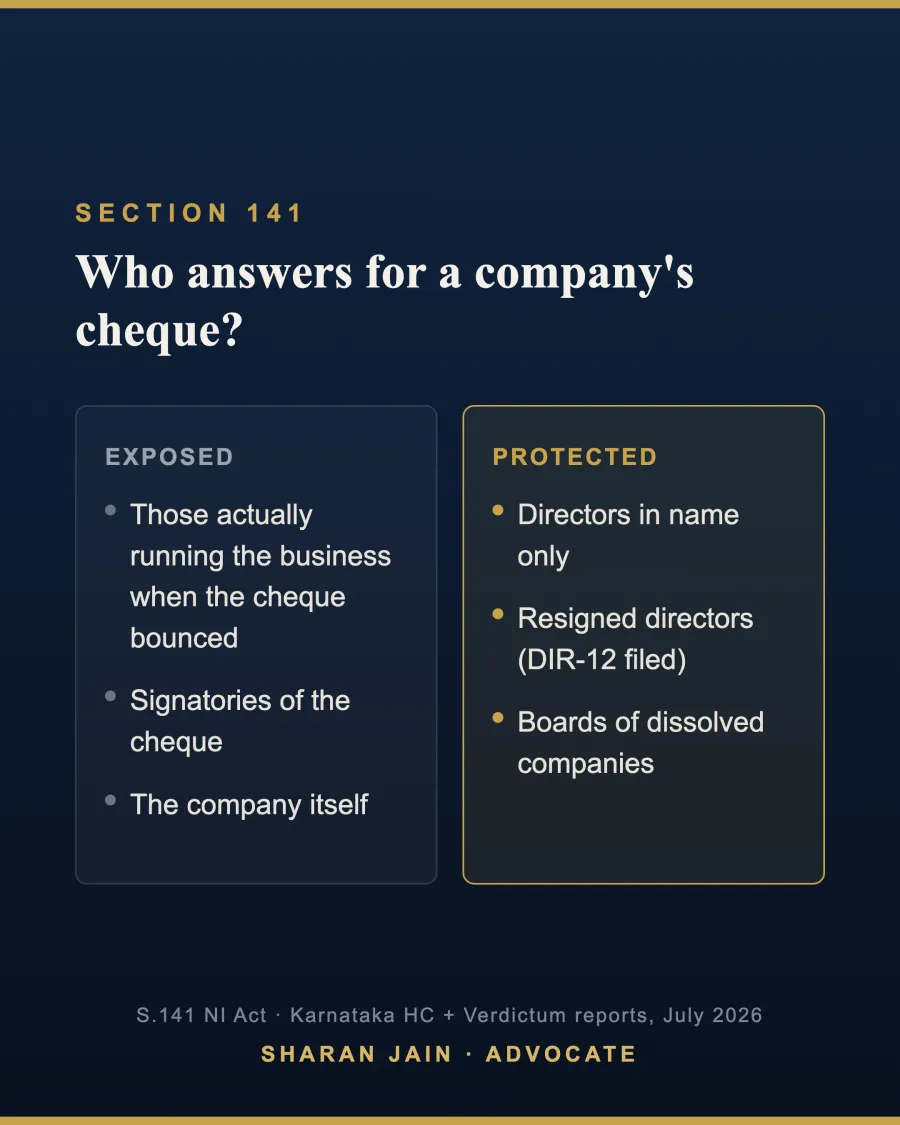
- Signatories of the cheque are directly in the net; signing the instrument is participation.
- Ordinary directors, non-executive directors, and nominees are NOT liable merely for holding office; the complaint must show their operational role or their consent/connivance/neglect.
- A high court reiterated the rule in July 2026: designation is not an averment. The line has not moved in twenty years; complainants keep testing it anyway.
Who keeps winning quashing petitions
The Section 482 CrPC docket, now Section 528 BNSS, in every high court is thick with Section 141 quashings, and the winners form a recognisable gallery:
- The resigned director: resignation effective before the cheque was issued (better still, before the underlying transaction), proved by the board's acceptance and the Form DIR-12 filed with the Registrar. Pooja Devidasani is the leading authority; the MCA filing is the clinching document because it is a public record beyond the parties' dispute.
- The non-executive or independent director with no operational role: boards' minutes, the absence of any executive designation, and the complaint's own silence on particulars do the work.
- The nominee director lent by an investor or lender, protected by the same role logic.
- Relatives on paper: the spouse or parent whose signature completed incorporation formalities; courts have grown openly impatient with complaints that sweep them in.
- Everyone, where the company was dissolved before the cheque, per the Karnataka High Court's July 2026 ruling, or where the company was never arraigned at all, per Aneeta Hada.
Timing matters: these defects are apparent from the complaint and public records, which makes them quashing material before the High Court rather than trial fodder, saving the accused years. The broader map of substantive defences, part-payments, security cheques, the Section 139 rebuttal, is in our companion guide to Section 138 defences that actually work.
Three habits that keep names off complaints
- Resign formally, file immediately. An unfiled resignation is a fact dispute you will litigate for years; a DIR-12 is a record that ends arguments. Check the master data afterward, filings fail silently more often than directors imagine.
- Come off bank signatory lists for accounts you no longer control. Signatories are presumptively in the net regardless of board status, and stale mandates are the classic trap for founders who moved on.
- Keep the minutes honest: board minutes that record who actually manages banking and finance are the contemporaneous evidence that wins the due-diligence proviso if a case ever comes. In a Section 141 fight, paper from the time beats memory from the witness box.
Common mistake (for complainants): the shotgun complaint. Naming all seven directors because the master data was one click away feels thorough and dies procedurally: the untargeted names win quashings, costs follow, and the case against the real operators is delayed by years of satellite litigation. Precision is not generosity to the accused; it is speed for the complainant.
The complainant's playbook: pleading Section 141 so it survives
- Arraign the company first, always, per Aneeta Hada; check its live status on the MCA portal the same day (struck-off and dissolved companies change the whole strategy, as July's Karnataka ruling shows).
- Name the signatories, identified from the returned cheque itself.
- For every other proposed accused, plead the role with particulars: the designation AND the function, the negotiations they conducted, the correspondence they signed, the meetings where the debt was acknowledged. Annex the emails; particulars beat formulas.
- Run the public-record checks before filing: DIR-12 history for resignations, the company's status, and signatory mandates where available. Ten minutes on the MCA portal prevents the quashing petition that costs two years.
- Remember the deadlines: Section 141 precision means nothing if the notice or complaint missed the statutory clocks; the timeline discipline is set out in the standing guide to the cheque bounce case procedure, and if the matter is headed toward compromise, the economics are in our guide to settlement, compounding and Lok Adalat.
Employment-bond cheques: the adjacent trap
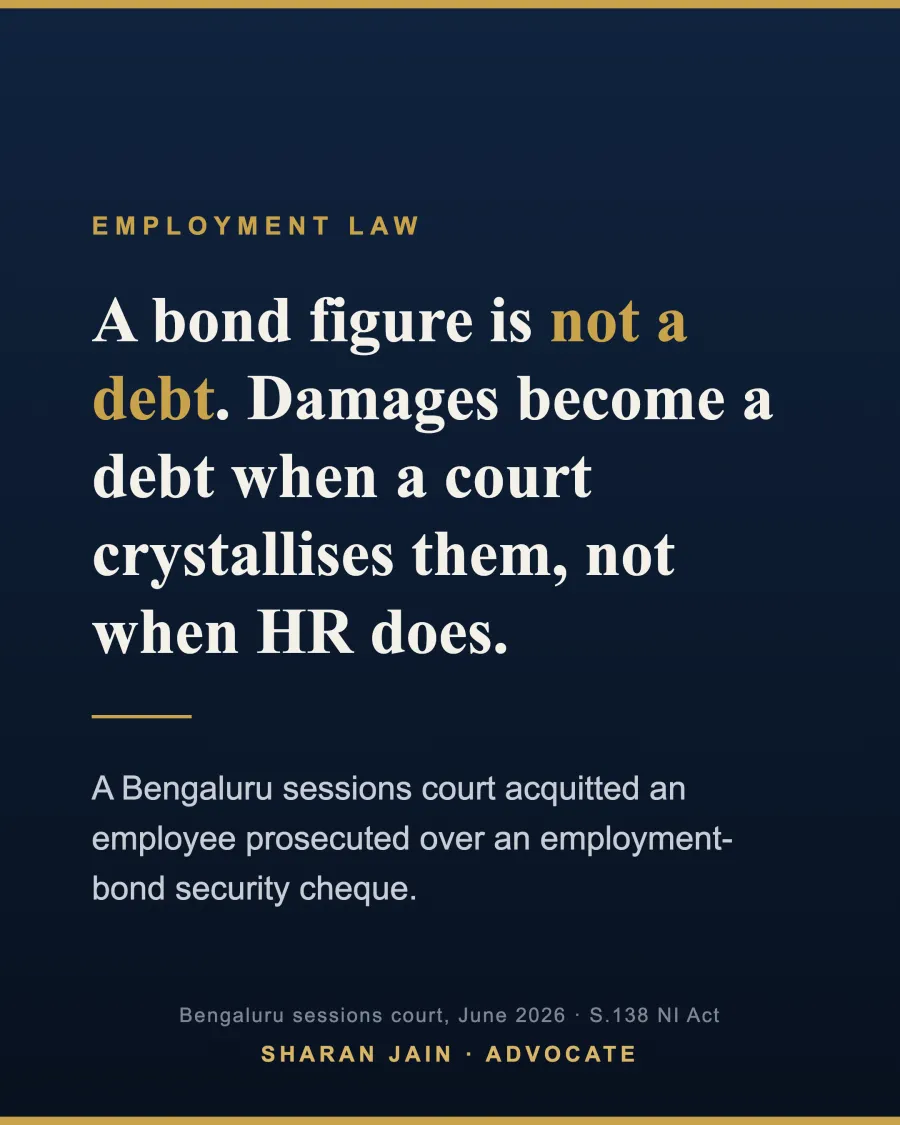
One adjacent July development belongs in every HR and founder briefing: a Bengaluru sessions court acquitted an employee prosecuted over a cheque taken against an employment bond, holding a bond figure is not a "debt" under Section 138 without proof of actual loss. Companies that collect security cheques from employees, and directors who authorise prosecutions on them, should read the acquittal as a costing of that practice: damages must be crystallised before they are debts, and Section 74 of the Contract Act gives reasonable compensation for proven loss, not the bond figure as a resignation fee.
A practice note from both sides of the array
Having drafted these complaints and defended these accused, the asymmetry is striking: the entire fight is usually decided by documents that existed before anyone went to court. On the defence side, the DIR-12, the board minutes and the bank mandate either exist or they do not; no advocacy manufactures them retrospectively. On the complainant's side, the emails identifying who actually negotiated and promised payment either were preserved or they were not. Section 141 rewards, on both sides, the unglamorous habit of keeping corporate paperwork synchronised with corporate reality, and punishes, on both sides, the assumption that designations tell the truth. Audit the gap between the two once a year; it is the cheapest litigation strategy that exists.
Who is in the net, and what it takes to get out
The categories above are easier to hold in the head as a grid. The table sets each class of person against the sub-section that catches them, what the complaint has to say before a court will take cognizance, and the document that usually decides the quashing petition. It is the same material discussed through this guide, arranged the way an accused director and a complainant's counsel each need to read it.
| Who | Statutory hook | Presumptively in the net? | What the complaint must plead | What usually defeats the case |
|---|---|---|---|---|
| The company | Section 138, as the principal offender | Yes, and its arraignment is ordinarily mandatory | That the cheque was drawn on the company's account for a legally enforceable debt | Omitting the company altogether, per Aneeta Hada; or a cheque issued after dissolution |
| Managing director or joint managing director | Section 141(1) | Yes, the office itself signifies charge of the business | The designation, which under S.M.S. Pharmaceuticals carries the role with it | The due-diligence proviso at trial, rarely a quashing |
| Signatory of the cheque | Section 141, read with the act of signing | Yes, whatever the board designation | That this accused signed the dishonoured instrument | Proof that the signature is not theirs, or that the mandate was revoked before issue |
| Whole-time or executive director with a finance role | Section 141(1) | Usually, if the role is pleaded | The specific function: who negotiated, who authorised payment, who ran banking | Board minutes showing the function sat elsewhere |
| Ordinary director with no executive role | Section 141(1) or (2) | No | Particulars of operational control, or of consent, connivance or neglect | The complaint's own silence; a bare recital of the statutory words with no facts |
| Non-executive or independent director | Section 141(2) in practice | No | Actual participation: attendance, correspondence, approvals tied to this transaction | Absence of any executive designation, plus minutes showing an oversight-only role |
| Nominee director of an investor or lender | Section 141(1) or (2) | No | The same role particulars demanded of any outsider on the board | The nomination agreement and the absence of operational involvement |
| Resigned director | Section 141, on the words "at the time the offence was committed" | No, for cheques issued after an effective resignation | That the accused held the role on the relevant date | Form DIR-12 filed with the Registrar before the cheque date, backed by the board's acceptance |
| Manager, secretary or other officer | Section 141(2) | No | Consent, connivance or attributable neglect, pleaded with facts | No role in the transaction and no allegation beyond the job title |
Read across any row and the pattern that runs through this guide holds: the further a person sits from the actual conduct of the business, the more the complaint has to say about them, and the more likely it is that a public record, not oral evidence, settles the question.
Frequently Asked Questions
Is every director liable when a company's cheque bounces?
No. Only those in charge of and responsible for the conduct of the company's business at the relevant time, signatories, and officers whose consent, connivance or neglect is specifically alleged. Designation alone is never enough.
Can a resigned director be prosecuted under Section 138?
Not for cheques issued after an effective resignation, and the filed Form DIR-12 is the decisive public-record evidence. Cheques signed before resignation remain the resigning director's problem.
What happens if the company is not made an accused?
After Aneeta Hada, the prosecution of directors ordinarily fails; the company's arraignment is mandatory except in narrow situations of legal impossibility.
Are independent or non-executive directors safe from cheque bounce cases?
They keep winning quashing petitions where no operational role or specific consent/connivance is pleaded, which is most cases. They are not immune where genuine participation is shown.
Is the managing director automatically liable?
Effectively yes at the pleading stage: the designation itself signifies charge of the business under S.M.S. Pharmaceuticals. The due-diligence proviso remains available at trial.
Can proceedings against a director be quashed before trial?
Yes, under Section 482 CrPC, now Section 528 BNSS, where the complaint lacks the mandatory averments, the accused's non-role is apparent from unimpeachable records (like DIR-12), or the company was dissolved or never arraigned.
Who is liable if the cheque was signed by an employee, not a director?
The signatory is in the net along with the company and those actually running the business; authority and role, not rank, decide the array.
Can an employer prosecute an employee over a bond security cheque?
A Bengaluru court's June 2026 acquittal holds that a bond amount is not a legally enforceable debt without proof of actual loss, making such prosecutions weak; civil recovery of proven training costs is the realistic remedy.
This article is for general informational purposes only and does not constitute legal advice. Specific situations need specific counsel.