A cheque bounce case in India can be settled at every single stage: before the complaint is filed, during trial, in appeal, and even after conviction. Section 147 of the Negotiable Instruments Act makes the offence compoundable, Lok Adalats convert pending cases into binding awards in a single sitting, and the Supreme Court has built an entire framework of graded costs to reward early settlement and penalise late settlement. The one thing the law does not subsidise is delay. This guide explains every settlement route in a Section 138 case, what each one costs at each stage, and how the July 2026 conviction of actor Rajpal Yadav shows a ₹5 crore problem compounding into a ₹7.35 crore problem with a jail term attached.
Part of the cheque bounce practice at S Jain & Attorneys, Bangalore.
Key takeaway: the exit door in a cheque bounce case is open at every stage, but the price of walking through it rises with every court you climb. The cheapest settlement you will ever be offered is the one available in the first fifteen days after the demand notice.
Why cheque bounce cases are built for settlement
Section 138 of the Negotiable Instruments Act, 1881 is a strange criminal offence. It punishes what is at heart a broken payment promise, and Parliament and the Supreme Court have both recognised that the complainant in these cases almost never wants a conviction. The complainant wants the money. That is why the statute and the case law lean so heavily toward compromise:
- Section 147 (inserted by the 2002 amendment) declares every offence punishable under the Act to be compoundable, notwithstanding anything in the Code of Criminal Procedure, the procedural code replaced by the Bharatiya Nagarik Suraksha Sanhita, 2023 from 1 July 2024, though the words of Section 147 itself are unchanged. A valid compromise between the parties closes the criminal case.
- Section 143A (inserted in 2018) lets the trial court order the accused to pay interim compensation of up to 20% of the cheque amount once he pleads not guilty, so the complainant is not starved into a bad settlement while the trial runs.
- Section 148 makes an appeal expensive for a convicted drawer: the appellate court can direct a deposit of a minimum of 20% of the fine or compensation awarded by the trial court, over and above any interim compensation already paid.
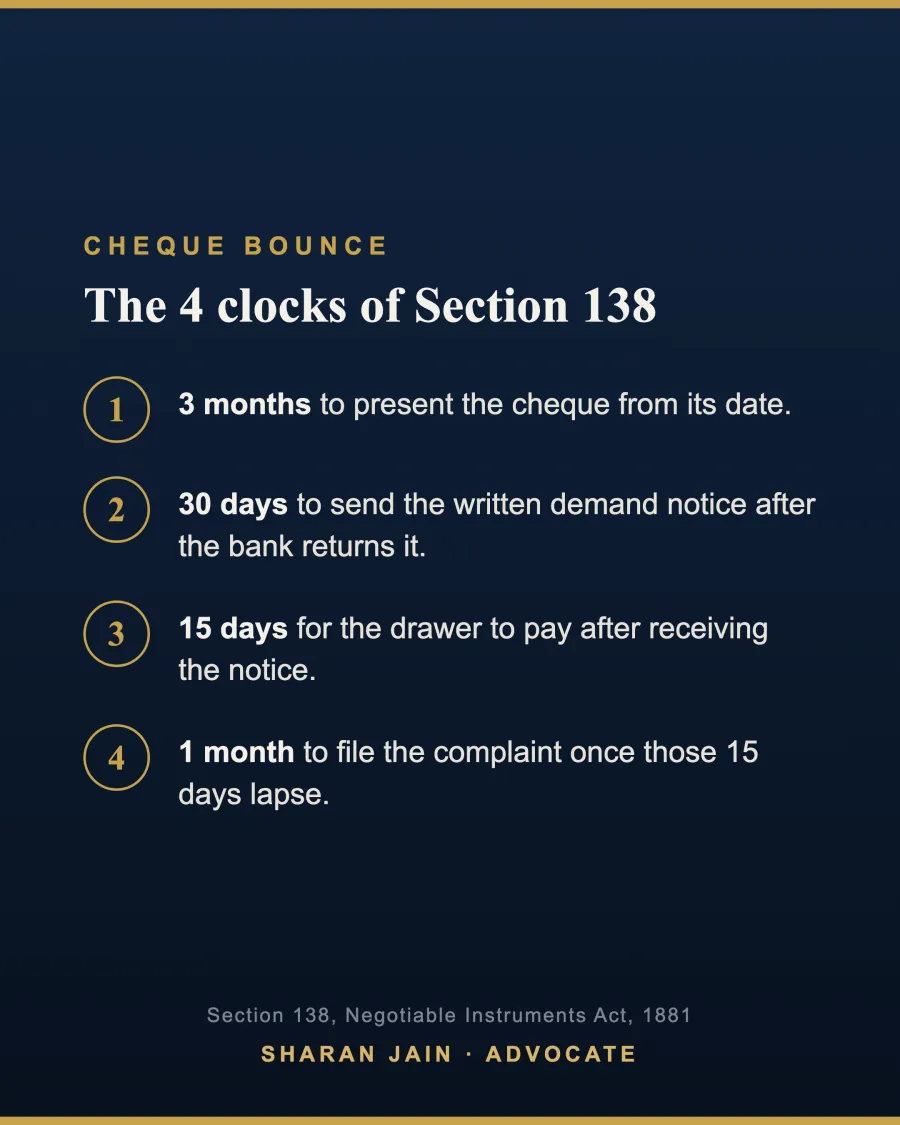
Put together, the architecture pushes both sides toward the negotiating table, and it does so with increasing force as the case ages. If you have just received a bounced cheque or a demand notice, first understand the strict timeline of the offence itself in our guide to the cheque bounce case procedure under Section 138; the settlement clock starts inside those same dates.
The Damodar Prabhu graded-cost framework: settle early or pay for the privilege
In Damodar S. Prabhu v. Sayed Babalal H., (2010) 5 SCC 663, the Supreme Court confronted a pattern every magistrate knows: accused persons contest cheque cases for years and offer to settle only when the appellate writing is on the wall. To change that incentive, the Court laid down guidelines imposing graded costs, payable to legal services authorities, on late compounding:
| Stage at which the case is settled | Cost guideline (of the cheque amount) |
|---|---|
| At the first or second hearing before the magistrate | No cost · compounding allowed freely |
| Later before the trial court | Up to 10% deposited with the Legal Services Authority |
| Before the High Court (revision or appeal) | Up to 15% |
| Before the Supreme Court | Up to 20% |
These are guidelines rather than rigid rules, and courts retain discretion to reduce the costs in deserving cases. But the direction of travel is unmistakable, and the Supreme Court reiterated in June 2026 that its compounding framework applies with equal force at the appellate stage. A drawer who settles at the Supreme Court is buying the same peace that was available free at the first hearing, at a 20% premium plus years of litigation cost and interest.
Two other principles complete the picture. Compounding under Section 147 requires the consent of the complainant; a Constitution Bench clarified in 2021 that the court cannot force a compromise on an unwilling payee. And compounding is possible even after conviction, while an appeal or revision is pending, which is exactly the stage at which most hard bargaining actually happens.
Lok Adalat: the one-day settlement machine
The Lok Adalat is the most underused settlement device in cheque bounce litigation, and it is purpose-built for these cases. Constituted under the Legal Services Authorities Act, 1987, a Lok Adalat can take up any pending Section 138 case (and pre-litigation disputes too) with the consent of both parties. Three features make it uniquely powerful:
- The award is a decree. Under Section 21 of the Act, a Lok Adalat award is deemed to be a decree of a civil court. It is final, binding, and executable like any decree.
- No appeal lies against it. A settlement you agreed to cannot be appealed, which ends the matter genuinely and permanently.
- Court fees come back. Where the settled case was a paid-fee proceeding, the fee is refunded, a real saving in high-value matters.
Legal services authorities periodically hold special Lok Adalats dedicated to cheque bounce cases; several states scheduled one for 18 July 2026, with another round later in the year. Thousands of Section 138 cases are disposed of in a single day at these sittings. For a complainant, a Lok Adalat converts a paper victory three years away into money in the bank this quarter. For an accused, it converts a criminal conviction risk, and the passport, employment and reputational baggage that comes with it, into a closed chapter.

What delay actually costs: the Rajpal Yadav arithmetic
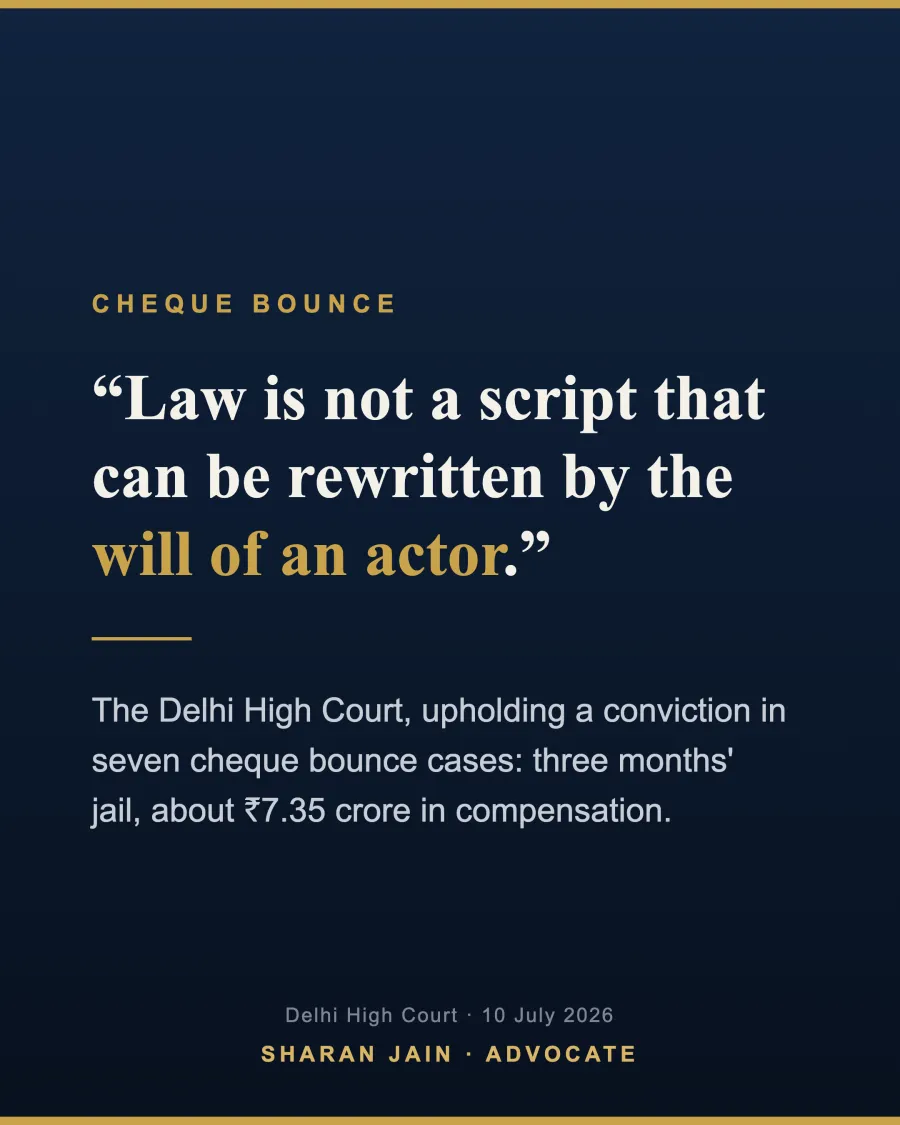
On 10 July 2026 the Delhi High Court upheld the conviction of actor Rajpal Yadav in seven cheque bounce cases arising out of a ₹5 crore film-production loan, sentenced him to three months' imprisonment, and ordered compensation of about ₹7.35 crore. The court refused probation, describing the accused's conduct as "dubious", and observed that "law is not a script that can be rewritten by the will of an actor."
Strip out the celebrity and the case is a textbook of settlement economics:
- The underlying debt was ₹5 crore. Years of failed settlement promises and part-payments that stopped converted it into a ₹7.35 crore liability, a 47% delay premium before counting legal fees.
- Broken settlement commitments did double damage: they added years, and they poisoned the court's view of the accused's conduct, which is precisely what cost him probation.
- Every stage climbed added statutory pressure: interim compensation exposure at trial under Section 143A, a deposit requirement on appeal under Section 148, and Damodar Prabhu costs on any late compounding.
Common mistake: treating a settlement talk as a delay tactic. Courts remember. A drawer who negotiates, commits, and defaults repeatedly is building the record that will later defeat his own probation plea and harden the sentence. Never offer a settlement you do not intend to perform.
The four settlement routes compared
| Route | Stage available | Formality | Finality |
|---|---|---|---|
| Payment within the notice window | 15 days from receiving the demand notice | None; payment itself prevents the offence | Complete, no case ever exists |
| Compounding (S.147) | Any stage, trial to Supreme Court, even post-conviction | Compromise recorded before the court; complainant's consent essential | Acquittal-equivalent closure; graded costs if late |
| Lok Adalat award | Any pending case, with both parties' consent | One sitting; award signed by both sides | Deemed civil decree; no appeal; fee refund |
| Court-referred mediation | Usually after the accused appears | Structured negotiation; settlement placed before the court | Binding once recorded and acted on by the court |
How to paper a cheque bounce settlement so it stays settled
A distressing number of "settled" Section 138 cases come back to life because the settlement itself was drafted casually. From practice, the recurring failure points, and the fixes:
- Record the full consideration. The compromise deed or joint memo must state the total settlement amount, what has been paid, and what remains, with dates. Vague "amicably settled" recitals invite a second round of litigation.
- Endorse part-payments. Where money moves before the case closes, Section 56 of the NI Act contemplates endorsement on the instrument. The Kerala High Court held in July 2026 that complaints concealing part-payments are not maintainable; the same discipline protects both sides at settlement. The full defence landscape is mapped in our guide to Section 138 defences that actually work.
- Avoid settling by post-dated cheque if you can. A settlement performed through another cheque simply reloads the same weapon. Prefer immediate transfer, demand draft, or court deposit.
- Take the closure order. Compounding needs a court order recording it; a Lok Adalat needs its award. A private receipt without the judicial act leaves the criminal case technically alive.
- If the drawer is a company the memo should cover the company and every arraigned director; a settlement that closes the case against the company but forgets the directors closes nothing for them. Who among directors is legitimately in the net at all is examined in our article on directors' liability under Section 141.
What I tell clients on both sides of a bounced cheque
Complainants first: value your case honestly. A decree-grade Lok Adalat settlement at 85% today usually beats a 100% judgment three years away, because interest, executability and the defendant's solvency all decay with time. Ask for Section 143A interim compensation early; nothing concentrates a drawer's mind like a court-ordered 20% deposit.
Accused persons: the first legal notice is the cheapest moment you will ever get, and it only gets more expensive from there. If the debt is genuine, negotiate inside the 15-day window and prevent the offence from ever crystallising. If you have a real defence, take it seriously and litigate it properly, but do not run a fake defence as a negotiating posture; the Rajpal Yadav judgment is a reminder that courts price conduct, not just liability.
Either way, a Section 138 case is a criminal case with a price tag attached. Treat the price tag as the whole point, and settle like it.
Related guides and where to get help
- Compounding vs Quashing of a Cheque Bounce Case
- Quashing a Cheque Bounce Conviction After Settlement
- Cheque Bounce Case Procedure Under Section 138 NI Act
Frequently Asked Questions
Can a cheque bounce case be settled out of court?
Yes. Section 147 of the NI Act makes the offence compoundable at any stage with the complainant's consent, and payment within the 15-day notice window prevents the offence from arising at all. The compromise must be recorded before the court to formally close a filed case.
Can a cheque bounce case be settled after conviction?
Yes, compounding is permissible even at the appellate or revisional stage, but the Supreme Court's Damodar Prabhu guidelines attach graded costs, up to 20% of the cheque amount when settlement comes at the Supreme Court level.
Is a Lok Adalat settlement in a cheque bounce case binding?
Completely. Under Section 21 of the Legal Services Authorities Act, the award is deemed a civil court decree, it is executable as one, and no appeal lies against it.
What is the benefit of settling in a Lok Adalat instead of privately?
Decree-grade finality, no appeal, court-fee refund, and same-day closure of the criminal case, versus a private receipt that still needs a separate court order to end the prosecution.
What is interim compensation under Section 143A?
The trial court can direct the accused to pay up to 20% of the cheque amount as interim compensation once he pleads not guilty, payable within 60 days (extendable by 30). If he is later acquitted, the complainant refunds it with interest.
Does an appeal stop the drawer from having to pay?
No. Section 148 lets the appellate court order a deposit of a minimum of 20% of the fine or compensation awarded by the trial court as a condition of the appeal being heard on its own terms.
Can the court force the complainant to accept a settlement?
No. Compounding under Section 147 requires the complainant's consent. Courts have, in rare and deserving cases where the entire amount was paid, used their extraordinary powers to end proceedings, but that is the exception and never a strategy to rely on.
What happens if the accused breaks the settlement?
If the case was closed by a Lok Adalat award, the award executes as a decree. If a compromise was recorded mid-case with part performance pending, the court can decline to close the case and the prosecution continues, now with the broken promise on record.
This article is for general informational purposes only and does not constitute legal advice. Specific situations need specific counsel.