Selling expired food is not a lapse of courtesy; it is a breach of statutory duty, and in July 2026 two consumer commissions said so against two of India's biggest retail names in the same week. In Kurnool, Vishal Mega Mart was held liable for selling expired Maggi noodles. In Kangra, Reliance Retail was held liable for expired instant noodles, with the commission stating plainly that retailers cannot shift the burden onto consumers to check expiry dates. This guide explains the legal architecture behind those rulings: the seller's duties under the Food Safety and Standards Act, 2006 (FSSA) and FSSAI's labelling regulations, the product liability chapter of the Consumer Protection Act, 2019, the criminal exposure for unsafe food, and the exact, practical sequence for a consumer who finds an expired product in the shopping bag, from photographing the label to collecting compensation.
Part of the consumer protection practice at S Jain & Attorneys, Bangalore.
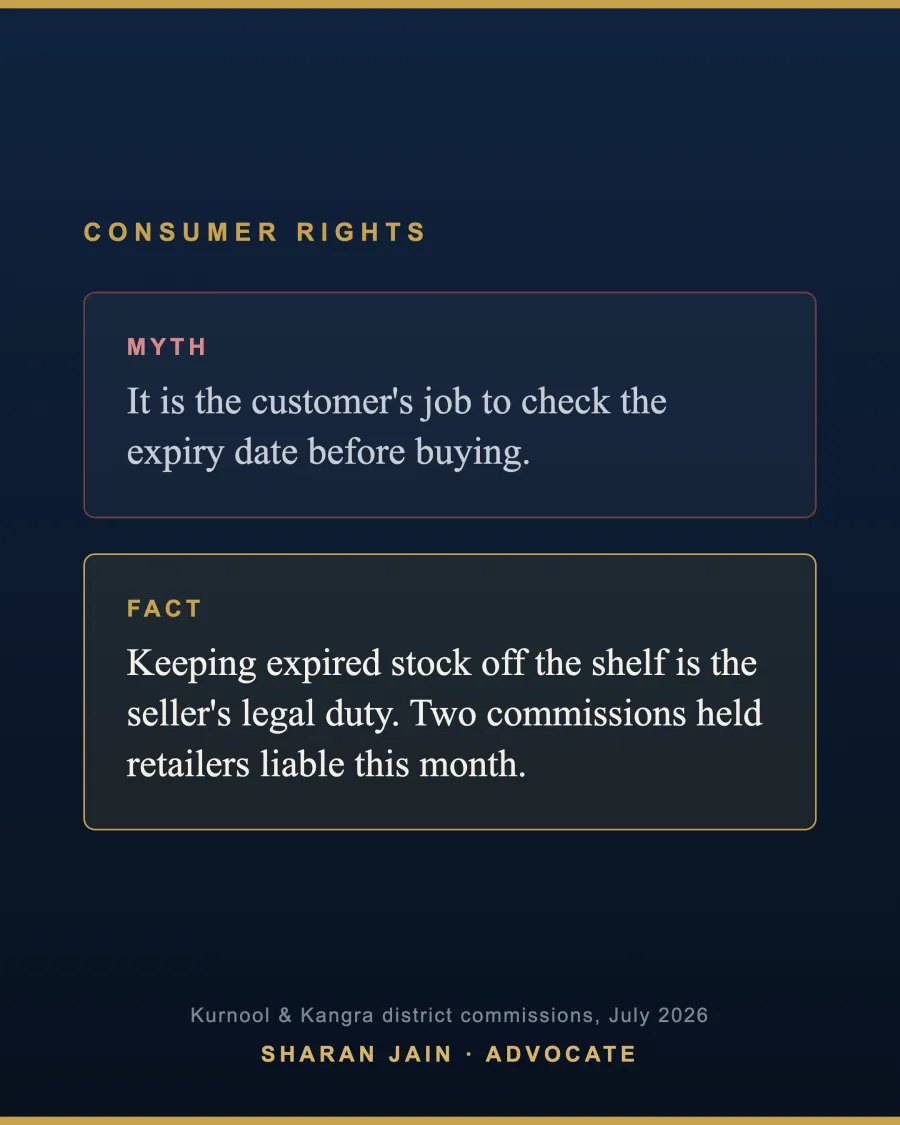
Key takeaway: the legal duty to keep expired stock off the shelf sits entirely on the seller. The customer's duty is to pay the bill. Every argument built on "you should have checked before buying" now runs into two 2026 rulings that rejected it in terms.
The twin July 2026 rulings, and why they matter beyond noodles
Both cases were small in money and large in principle. In each, the consumer bought packaged noodles past their date marking, kept the bill and the packet, and filed before the district commission. The retailers ran the traditional defences: the customer should have checked; the quantity was trivial; no harm was actually suffered. Both commissions rejected the frame. The Kangra commission's formulation travels furthest: a retailer with thousands of SKUs has chosen the business of managing them, and cannot outsource its statutory shelf-hygiene duty to a shopper in aisle six.
Why do such cases matter? Because expired food is a health hazard sold at full price, because the amounts are small enough that almost nobody litigates, and because every order like these forces the next store audit. Consumer law works in aggregates: one ₹10,000 award changes the compliance calculus for a chain with a thousand stores.
The seller's statutory duties: FSSA 2006 and FSSAI labelling law
The Food Safety and Standards Act, 2006 is the spine. The provisions every retailer is measured against:
- Section 26(1) places the primary responsibility on every food business operator to ensure food satisfies the Act at all stages of production, processing, import, distribution and sale within the businesses under his control. A retailer is a food business operator; the duty is not the manufacturer's alone.
- Section 26(2) then prohibits an operator from manufacturing, storing, selling or distributing food that is unsafe, misbranded, sub-standard, or containing extraneous matter. Note the verb "storing". A packet sitting on the shelf after its date has already attracted the section, whether or not anyone buys it.
- Section 26(4) is the quiet ally of every complainant. It deems the bill, cash memo or invoice given on a sale of food to be a guarantee about the nature and quality of that food, even if no separate guarantee form was issued. The receipt in your pocket is therefore not merely proof of purchase; it is a statutory warranty the seller has given you.
- Section 26(5) creates a presumption that where unsafe food is part of a batch or consignment, the whole batch is presumed unsafe unless a detailed assessment shows otherwise. That is why the batch number on the packet matters as much as the date.
- Section 3's definition of "unsafe food" and the FSS (Labelling and Display) Regulations make date marking, "use by" or "expiry date", mandatory on packaged food; sale past that date is prohibited.
- Penalties scale with culpability: selling sub-standard food attracts a penalty which may extend to ₹5 lakh (Section 51), misbranded food up to ₹3 lakh (Section 52), misleading advertisement up to ₹10 lakh (Section 53), and unsafe food is a criminal offence under Section 59.
- Every packaged item must also carry batch number, FSSAI licence number, and net quantity under the Legal Metrology framework; missing or tampered date labels are independent violations.
Enforcement runs through the state's Food Safety Officers and Designated Officer, to whom any consumer can complain directly (FSSAI's Food Safety Connect channels take complaints online). That is the regulatory track; it punishes the seller. Compensation for you runs through the consumer track.
Section 27(3)(a): the single line that decides most of these cases
If you read only one provision before walking into a district commission, read Section 27 of the FSSA. It allocates liability along the chain, and sub-section (3) deals with the shop in front of you. It provides that the seller shall be liable under the Act for any article of food which is sold after the date of its expiry, or handled or kept in unhygienic conditions, or misbranded, or whose manufacturer or distributor cannot be identified, or which was received by the seller with knowledge of being unsafe.
Read that first clause again. There is no qualifier about knowledge, no exception for large stores, no allowance for a busy Sunday, and no reference at all to what the customer did or did not notice. Liability attaches to the fact of the sale after the date. Section 27(2) puts a parallel duty on the wholesaler or distributor for food supplied after expiry, which is why a well-drafted complaint sometimes names the distributor too. The retailer's answer that "we were sent old stock" is an argument about who else is liable, not about whether the retailer is.
There is also a provision most consumers never hear about. Under Section 40, a purchaser may have an article of food analysed by a Food Analyst on payment of fees, provided the purchaser tells the food business operator at the time of purchase that he intends to do so. If the analysis shows non-compliance, the purchaser gets the fees refunded, and the Analyst forwards the report to the Designated Officer to launch prosecution under Section 42. That route matters where the complaint is about contents rather than a printed date.
The consumer track: deficiency, unfair trade practice and product liability
The Consumer Protection Act, 2019 gives an expired-product buyer three overlapping hooks:
- Defect and deficiency: an expired product is a defective good, and selling it is a deficiency in the sale service. This is the classic route the noodle cases used.
- Unfair trade practice: offering for sale goods that do not comply with mandatory standards misleads the consumer about their fitness; commissions treat expired stock on an open shelf as exactly that.
- Product liability (Chapter VI, Sections 82 to 87): where the expired product causes actual harm, food poisoning, an allergic episode, a child's hospitalisation, the 2019 Act's product liability chapter lets you sue the product seller directly. Section 86 fixes sellers with liability where, among other things, they exercised substantial control over the product's designing, testing, manufacturing, packaging or labelling; where the manufacturer cannot be identified or served; or where the seller failed to exercise reasonable care in assembling, inspecting or maintaining the product. Storage past expiry is the textbook case of a seller-side failure of inspection and maintenance. Section 87 carries the exceptions, chiefly misuse, alteration or modification of the product after sale, so preserving the packet unopened is not fussiness, it is how you close off the only real defence.
| Route | When it fits | What you recover |
|---|---|---|
| FSSAI / Food Safety Officer complaint | Any expired or unsafe food sale, harm or not | Penalties on the seller; enforcement action; no compensation to you |
| Consumer commission: defect / unfair trade practice | Expired product bought; no serious injury | Refund, compensation for hazard and harassment, litigation costs |
| Consumer commission: product liability | Actual harm caused by the product | Full compensatory damages: medical costs, loss, suffering |
| Criminal complaint (FSSA S.59) | Unsafe food, especially where injury results | Prosecution of the operator; runs parallel to your claim |
What the criminal side is actually worth: Sections 59 and 65
Most readers treat the FSSA's criminal chapter as background noise. It is not, because it carries its own compensation regime that runs independently of anything a consumer commission awards.
Section 59 punishes selling, storing or distributing unsafe food on a sliding scale: up to six months' imprisonment and fine up to ₹1 lakh where no injury results; up to one year and ₹3 lakh for non-grievous injury; up to six years and ₹5 lakh for grievous injury; and not less than seven years, extending to imprisonment for life, with a fine of not less than ₹10 lakh, where the contravention results in death.
Section 65 then empowers the Adjudicating Officer or the court to direct payment of compensation to the victim or the victim's legal representatives: not less than ₹5 lakh in case of death, up to ₹3 lakh for grievous injury, and up to ₹1 lakh in other cases of injury. The compensation is to be paid at the earliest and in no case later than six months from the incident, with interim relief to the next of kin within thirty days in a death case. Section 65 opens with the words "without prejudice", so this is in addition to, not instead of, the consumer remedy. Families dealing with a serious food-poisoning incident routinely miss this provision entirely.
Deadline warning: a consumer complaint must be filed within two years of the cause of action under Section 69 of the Consumer Protection Act, 2019. Delay can be condoned only on a satisfactory explanation, recorded in writing, and commissions are not generous about it. Separately, the physical evidence in a food case decays fast, so treat the useful window as days, not years.
The evidence: five minutes at the store decides the case
Every one of these cases is won or lost on a handful of documents created within minutes of the purchase:
- The bill. It proves the purchase, the date, and the seller, and by force of Section 26(4) of the FSSA it operates as the seller's guarantee of quality. Card or UPI records corroborate.
- The packet, unopened if possible with the date marking intact. Do not discard it, do not consume the contents once the date is noticed. An unopened packet also defeats the Section 87 "misuse or alteration" defence before it is made.
- Photographs the same day: the date label, the batch number, the FSSAI licence number, the bill, ideally together in one frame with a timestamp.
- The shelf, if you can. A photograph of other packets of the same batch still on display converts a one-off complaint into evidence of a systemic failure, and invites the Section 26(5) batch presumption.
- The store complaint: tell the outlet in writing (their app, email, or the complaint book) and keep the acknowledgment. Refusal to acknowledge is itself useful evidence.
- If anyone consumed it and fell ill: medical records, prescriptions and bills, and where feasible preservation of the remaining sample; in serious cases the Food Safety Officer can have samples analysed by an accredited lab.
Common mistake: accepting the counter staff's instant offer of a replacement packet and walking away. A replacement is not the remedy for being sold a health hazard; it is the erasure of your evidence. Take the replacement if you wish, but photograph everything first and put the complaint in writing anyway.
Filing the case: forum, fees, limitation
District commissions hear claims up to ₹50 lakh; expired-product cases almost always belong there, and claims up to ₹5 lakh carry no filing fee. File where you live or work, where the seller resides or carries on business, or where the cause of action arose, on the e-Daakhil portal or at the registry, within two years. Plead the purchase, the date marking, the statutory duties, and value the claim sensibly: refund, a compensation figure proportionate to the hazard and conduct (the noodle cases show commissions will not laugh small claims out of the room), and costs. No lawyer is required at this level, though a crisply drafted complaint shortens everything. The wider filing mechanics, including how hearings proceed and appeals lie, are covered in our step-by-step guide to filing a consumer complaint in India.
Step by step, from the aisle to the award
- Stop and photograph before you leave the store, or the moment you notice at home. Date marking, batch number, FSSAI licence number, MRP panel and the bill. Same-day metadata is what makes the file credible.
- Do not open or consume the product. If it is already opened, keep whatever remains, sealed, and keep the wrapper.
- Complain to the outlet in writing the same day. Store app, customer-care email, or the complaint register, asking for refund and an explanation of how expired stock reached the shelf. Keep the ticket number.
- Complain to the regulator. Report to the district Food Safety Officer or Designated Officer, or through FSSAI's online complaint channel. This costs nothing, triggers an inspection, and creates an independent record dated close to the purchase. If the issue is contents rather than a printed date, invoke Section 40 and ask for analysis by a Food Analyst.
- Send a short legal notice. Two pages: purchase details, the Section 26 and Section 27(3)(a) violation, the harm, and a demand for refund and compensation within 15 days. Many chains settle here once the sections are cited.
- Draft the complaint. Parties, jurisdiction (pecuniary and territorial), facts in dated paragraphs, the statutory violations, the deficiency and unfair trade practice pleas, product liability under Sections 82 to 87 if there was harm, and a numbered prayer. Support it with an affidavit and a list of documents.
- File on e-Daakhil. Register, upload the complaint, affidavit, index and documents, pay the fee if any, and note the case number. Serve as directed.
- Attend the hearings. The opposite party gets 30 days, extendable by 15, to file its version under Section 38(2)(a). Evidence goes in by affidavit under Section 38(6); personal or video-conference hearing is allowed for reasons recorded.
- Argue and take the order. Section 38(7) sets the target of deciding within three months of notice to the opposite party, or five months where the goods need analysis or testing.
- Enforce or appeal. Orders are enforceable under Section 71, and non-compliance is punishable under Section 72. An appeal to the State Commission lies within 45 days under Section 41, and a losing opposite party must deposit 50 per cent of the awarded amount before its appeal is entertained.
Costs and timelines, realistically
These are indicative ranges for a straightforward expired-product complaint in a metro district commission, not a quotation, and they move with the forum and the complexity of the case.
| Item | Indicative cost | Indicative time |
|---|---|---|
| Complaint to the outlet and to the Food Safety Officer | Nil | Same day to file; 2 to 6 weeks for an inspection response |
| Legal notice drafted by an advocate | ₹3,000 to ₹10,000 | 1 to 3 days to draft; 15 days to comply |
| District commission filing fee, claim up to ₹5 lakh | Nil | Filing is same day on e-Daakhil |
| District commission filing fee, ₹5 lakh to ₹10 lakh | A few hundred rupees, per the prescribed slab | Same day |
| Advocate's professional fee, district commission | ₹10,000 to ₹40,000 depending on city and contest | Spread over the life of the case |
| Disposal of the complaint | Costs are usually awarded to a successful complainant | Statutory target 3 months (5 with testing); in practice 8 to 24 months in busy districts |
| Appeal to the State Commission | Court fee plus 50 per cent pre-deposit by a losing opposite party (Section 41) | 45 days to file; 1 to 3 years to hear in many states |
Two practical points follow from that table. First, the economics favour the complainant at the district level: the filing is free below ₹5 lakh and the paperwork is doable without counsel, so the only real cost is time. Second, the statutory three-month target and the actual disposal time are different animals, so anyone who needs money quickly should treat the legal notice stage as the serious settlement opportunity rather than an empty formality.
The mistakes that sink these complaints
- Throwing away the packet after taking a photograph. The photograph proves the label; the packet proves the batch, and lets the commission or the laboratory look at it. Keep both.
- Consuming the product to "prove" it was bad. This hands the seller the Section 87 argument that the product was altered or misused, and it is dangerous. If someone has already eaten it, get medical attention first and treat the medical record as the evidence.
- Claiming a wildly inflated figure. A claim of ₹50 lakh for a ₹35 packet does not increase the award; it invites the commission to doubt everything else in the complaint. Ask for the refund, a proportionate compensation, and costs.
- Suing the wrong entity. "Vishal Mega Mart, MG Road" is not a legal person. Name the company as it appears on the bill and the GST particulars, at its registered office, and add the store as a branch.
- Ignoring the regulator. A Food Safety Officer's inspection report is independent, contemporaneous, official evidence, and it costs nothing. Complainants who skip it end up relying only on their own affidavit.
- Missing limitation. Two years under Section 69 runs from the cause of action, not from when you got annoyed enough to act.
- Settling orally at the counter. If the store offers money, take it in writing, and be clear whether you are giving up the complaint. An oral "we will look into it" has settled nothing.
- Filing in the wrong forum. A claim above ₹50 lakh belongs before the State Commission, and above ₹2 crore before the National Commission. Getting this wrong costs months.

And if the seller's response to your complaint is silence or a shrug, remember the range of what consumer forums will do when deficiency is proved and documented: the same fortnight as the noodle rulings, the NCDRC upheld ₹20 lakh against Air India over a defective business-class seat. Forums calibrate to the facts; they do not calibrate to the seller's size.
A practice note for businesses on the other side of this
For retailers and D2C sellers reading this from the compliance chair: expiry-date liability is a systems problem with a systems fix. First-expiry-first-out shelf rotation with logged audits, automated recall of date-expired SKUs at billing (the point-of-sale system should simply refuse to bill an expired barcode), and a written markdown-and-destroy protocol will together eliminate nearly every one of these cases. Section 28 of the FSSA independently obliges an operator who believes his food is non-compliant to initiate withdrawal immediately and inform the authorities, so a documented recall is not merely good practice, it is the statutory expectation. When a complaint still arrives, the worst possible response is the one both retailers ran in July: blaming the customer. The commissions have now priced that argument, and every future complainant will cite these orders. Respond, refund, document the corrective step, and the ₹10,000 problem stays a ₹10,000 problem.
Frequently Asked Questions
Who is liable if I am sold an expired product, the shop or the manufacturer?
The seller. Section 27(3)(a) of the FSSA makes the seller liable for any article of food sold after the date of its expiry, and the July 2026 Kurnool and Kangra rulings held retailers liable in terms. The manufacturer or distributor may additionally be liable where the defect originated with them.
Is it my responsibility to check the expiry date before buying?
No. Checking helps you practically, but the legal burden cannot be shifted to the consumer; the Kangra commission said precisely this while holding Reliance Retail liable.
What compensation can I get for expired food if I wasn't harmed?
Refund of the price plus compensation for the hazard, mental agony and litigation costs. Amounts are modest but real, and the order itself disciplines the seller.
What if I ate the expired food and fell sick?
That becomes a product liability claim under Chapter VI of the CPA 2019 for full compensatory damages, alongside a complaint to the Food Safety Officer. On the criminal side, Section 59 of the FSSA punishes unsafe food on a scale rising with the injury, and Section 65 allows the adjudicating officer or court to award compensation up to ₹1 lakh for injury, up to ₹3 lakh for grievous injury, and not less than ₹5 lakh in a death case. Preserve medical records and the sample.
Does the shop bill help me legally, or is it just proof of purchase?
Both. Section 26(4) of the FSSA deems a bill, cash memo or invoice for a sale of food to be a guarantee of the nature and quality of that food, so the receipt is a statutory warranty as well as evidence.
The store says its distributor supplied old stock. Does that get it off the hook?
No. Section 27(2) makes the wholesaler or distributor liable for food supplied after expiry, and Section 27(3) independently makes the seller liable for food sold after expiry. Both can be liable at once, which is why complaints sometimes name the distributor as a second opposite party.
Where do I complain about a store selling expired products generally?
To the district's Food Safety Officer or through FSSAI's online complaint channels for enforcement, and to the district consumer commission (e-Daakhil) for your own remedy. The two run in parallel.
Is there a time limit?
Two years from the purchase (or from the harm) for the consumer complaint, under Section 69 of the CPA 2019. Regulatory complaints have no such bar, but immediate reporting is what makes samples and shelf evidence usable.
How long will the case take, and what will it cost?
The statute aims at three months from notice, five where testing is needed, but eight to twenty-four months is realistic in a busy district. Filing is free for claims up to ₹5 lakh, and you can appear yourself.
Do I need a lawyer for a small expired-product case?
No. District commissions are designed for self-representation, filing up to ₹5 lakh is free, and the documentary case, bill, packet, photos, is one you can assemble yourself.
Can the store just replace the item and close the matter?
Only if you accept that as full settlement. A replacement does not extinguish the statutory violation, and you remain entitled to complain both to the regulator and the commission.
This article is for general informational purposes only and does not constitute legal advice. Specific situations need specific counsel.