An insurance rejection letter is written to sound like a verdict. It is actually an opening position, and July 2026 supplied the proof: the NCDRC ordered HDFC Life to pay a ₹75 lakh life insurance claim it had repudiated, because of one provision the insurer could not argue around, Section 45 of the Insurance Act, 1938: once a life policy has run for three years, it cannot be called in question on any ground whatsoever. The same week, a court hearing a mediclaim dispute observed acidly that insurers can appear more interested in premiums than in claims. This guide is the complete playbook for a rejected claim: what Section 45 actually says and the traps inside it, the six-step escalation from grievance cell to IRDAI's Bima Bharosa to the Insurance Ombudsman to the consumer commission, the special rules for health-policy rejections, and the documentation habits that decide these fights before they begin.
Part of the consumer protection practice at S Jain & Attorneys, Bangalore.
Key takeaway. Families abandon lakhs every year because a repudiation letter sounds final. It is the start of a process, not the end of one, and the process is stacked with free forums: the insurer's own grievance cell, the regulator's portal, and an Ombudsman whose award binds the insurer up to ₹50 lakh. Escalate with records, not adjectives.
Section 45: the three-year rule that ends most arguments
As substituted by the Insurance Laws (Amendment) Act 2015, Section 45 draws one of the brightest lines in Indian financial law. It is worth reading sub-section by sub-section, because insurers argue in the gaps.
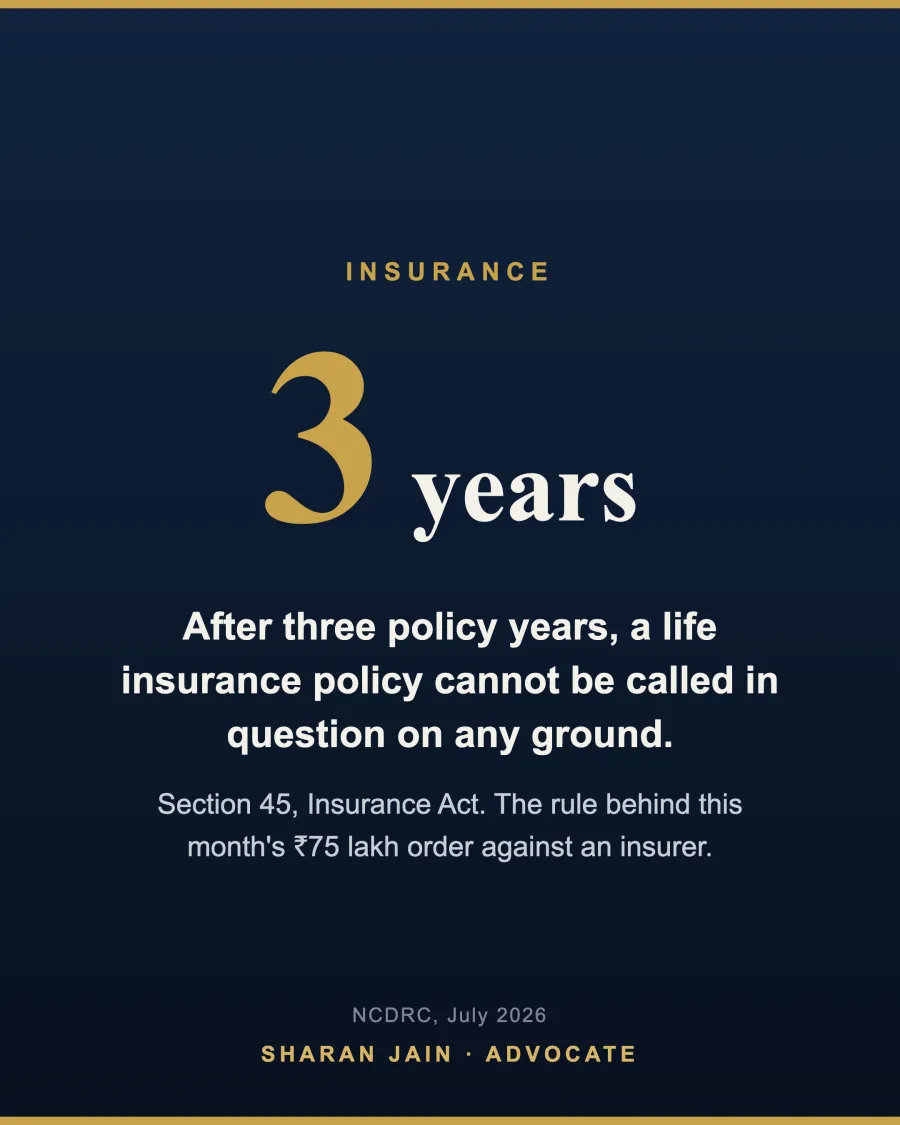
- Section 45(1): the absolute bar. No policy of life insurance shall be called in question on any ground whatsoever after the expiry of three years from the date of the policy, which the section defines as the date of issuance of the policy, the date of commencement of risk, the date of revival of the policy, or the date of the rider, whichever is later. Not misstatement, not non-disclosure, not even alleged fraud.
- Section 45(2): fraud, within three years only. A life policy may be called in question within three years on the ground of fraud, but the proviso requires the insurer to communicate in writing to the insured, or to the legal representatives, nominees or assignees, the grounds and materials on which the decision is based. Explanation I defines fraud narrowly, as the suggestion of an untruth the insured does not believe to be true, active concealment with knowledge, any other act fitted to deceive, or an act the law declares fraudulent, in each case with intent to deceive the insurer. Explanation II says mere silence about facts likely to affect the assessment of risk is not fraud, unless there was a duty to speak or the silence is itself equivalent to speech.
- Section 45(3): the escape hatch inside the fraud ground. Even within three years, the insurer cannot repudiate on fraud if the insured can prove that the misstatement or suppression was true to the best of his knowledge and belief, or that there was no deliberate intention to suppress, or that the fact was within the insurer's own knowledge. Where the policyholder is not alive, the proviso places the onus of disproving fraud on the beneficiaries.
- Section 45(4): non-fraudulent misstatement. A policy may be questioned within three years on the ground of a material misstatement or suppression, again only after written communication of the grounds and materials. Two protections attach. Where repudiation is for misstatement and not fraud, the premiums collected until the date of repudiation must be paid back within ninety days. And the Explanation provides that a misstatement is not material unless it has a direct bearing on the risk undertaken, with the onus on the insurer to show that, had it known the fact, no policy would have been issued at all.
- Section 45(5): proof of age. Nothing in the section prevents the insurer from calling for proof of age, and adjusting the policy terms on later proof that the age was incorrectly stated is not treated as calling the policy in question.
Parliament wrote the rule to end a specific abuse: insurers collecting premiums for years without question, then investigating only when the claim arrived, mining the proposal form for an undisclosed clinic visit from a decade earlier. Section 45 forces underwriting scrutiny to the start of the relationship, where it belongs. The July 2026 NCDRC order is the provision working exactly as designed: the policy had run its three years, and the "concealment" defence died on the date arithmetic alone.
The two traps hiding inside the three-year clock
- Revival restarts the clock. Because Section 45(1) counts three years from the later of issuance, commencement of risk, revival or rider, a lapsed policy that is revived gives the insurer a fresh three-year window from the revival date. The practical rule: keep premiums regular. A lapse-and-revive cycle is not just an administrative event, it re-arms the repudiation power. The same is true of a rider added late in the life of an old policy.
- The proposal form is everything within the window. Most repudiations are built from a form an agent filled in a hurry while the customer signed at the flagged boxes. Fill the form yourself, disclose generously (illnesses, habits, other policies, occupation), and keep a copy. Over-disclosure costs a slightly higher premium; under-disclosure costs the claim. One statutory point helps if the agent did fill it: the Explanation to Section 45(3) provides that a person who solicits and negotiates a contract of insurance is deemed, for the purpose of the formation of the contract, to be the agent of the insurer.
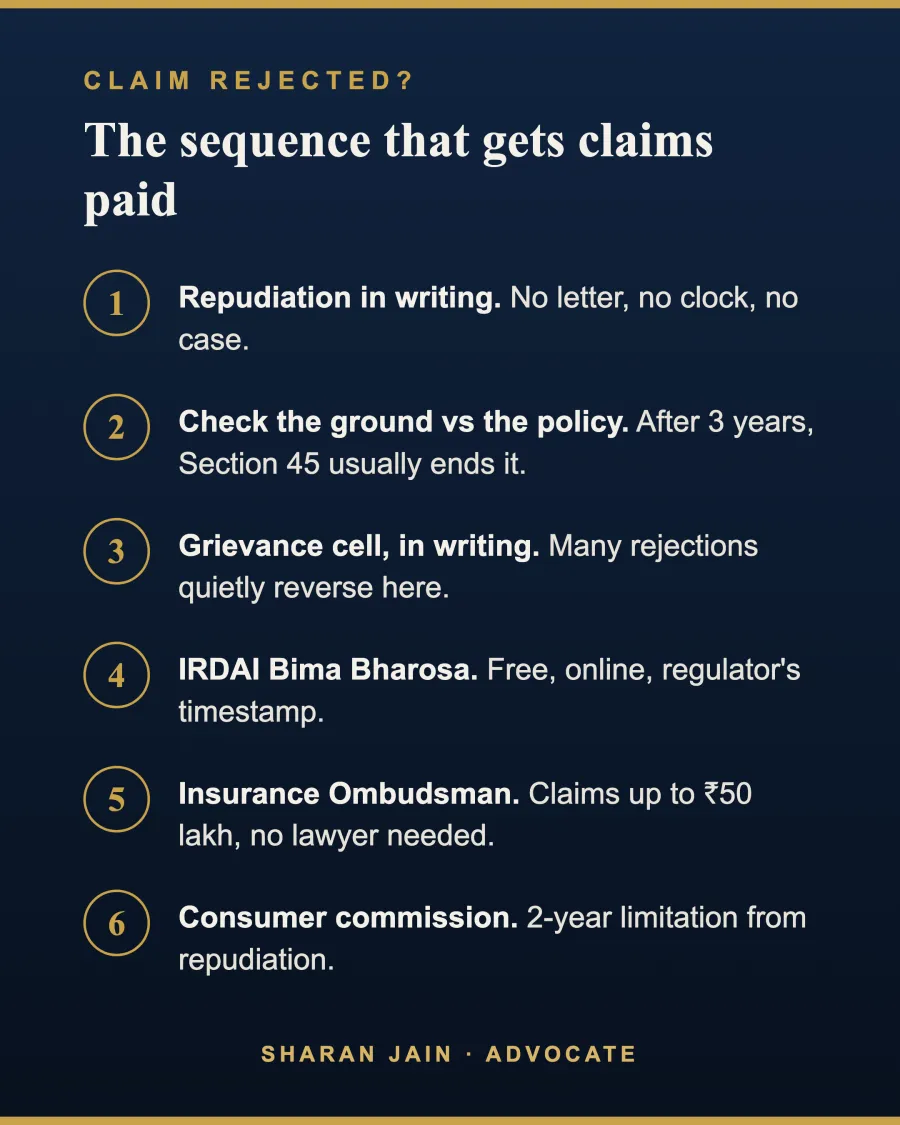
The six-step escalation ladder
| Step | Forum | Cost / time | What it achieves |
|---|---|---|---|
| 1 | Written repudiation with reasons | Immediate | No letter, no clock, no case. Insist on it; oral rejections are stalling |
| 2 | Policy-vs-ground check | A careful evening | Waiting periods, defined exclusions and Section 45 dispose of many rejections on paper |
| 3 | Insurer's Grievance Redressal Officer | Free; the Ombudsman rules treat one month without reply as enough to move on | A surprising share of wrongful rejections quietly reverse here |
| 4 | IRDAI Bima Bharosa portal | Free; online | Puts the regulator's timestamp on the dispute; insurers respond on the record |
| 5 | Insurance Ombudsman (awards capped at ₹50 lakh) | Free; award due within three months of all requirements being received | Award binds the insurer under Rule 17(8); policyholder stays free to litigate if unhappy |
| 6 | Consumer commission | Slab-based filing fee; two-year limitation under s.69, Consumer Protection Act 2019 | Compensation beyond the claim: interest, harassment, costs; the ₹75 lakh order came from this track |
Sequence matters for two reasons. The Ombudsman expects the insurer's grievance process to have been tried first, and every written round you complete builds the record the later forum reads first. The consumer-commission mechanics, forum by claim value, e-Daakhil filing, evidence, are covered in our standing guide to filing a consumer complaint in India.
What to file, and in what order
- Demand the repudiation in writing, with reasons. Ask by email for the specific policy clause relied on and the material considered. For life policies repudiated within three years, Section 45(2) and 45(4) require the insurer to communicate the grounds and materials in writing anyway.
- Do the Section 45 arithmetic. Write down four dates: issuance, commencement of risk, any revival, any rider. Take the latest. If the repudiation falls more than three years after that date, the ground does not matter.
- Match the stated ground to the policy wording. Read the exclusion or waiting period the insurer actually cites, not the one it describes in the letter. Ambiguity in a policy drafted by the insurer is read against the drafter.
- Write once to the Grievance Redressal Officer. Attach the policy, the claim, the repudiation and your point-by-point answer, and ask for a reasoned review. Keep the acknowledgement.
- Register on IRDAI's Bima Bharosa portal if there is no satisfactory reply. This creates the regulator's own record of the dispute and a ticket number the later forums can see.
- Choose the Ombudsman or the consumer commission, not both. Under Rule 14(5) of the Insurance Ombudsman Rules 2017 no complaint is maintainable before the Ombudsman on the same subject matter that is pending before, or already disposed of by, a court, consumer forum or arbitrator.
- File within the clock. One year to the Ombudsman under Rule 14(3)(b); two years to the consumer commission under Section 69 of the Consumer Protection Act 2019.
The Insurance Ombudsman: what the rules actually say
Most people are told the Ombudsman exists and nothing else. The Insurance Ombudsman Rules 2017, as amended, are short and unusually policyholder-friendly, and it is worth knowing the four rules that govern the outcome.
Rule 13 lists what the Ombudsman can hear, and it is broad: delay in settlement beyond the regulatory timelines, partial or total repudiation of a claim by a life, general or health insurer, disputes over premium, misrepresentation of policy terms, the legal construction of the policy so far as it relates to the claim, policy-servicing grievances, issuance of a policy not in conformity with the proposal form, and non-issuance of a policy after premium has been received.
Rule 14(3) sets the entry conditions. You must first have made a written representation to the insurer, and one of three things must have happened: the insurer rejected it, you received no reply within one month, or you are not satisfied with the reply. Rule 14(3)(b) then requires the complaint to be made within one year of the rejection, of the unsatisfactory decision, or of the expiry of that one month of silence. Rule 14(4) allows the Ombudsman to condone delay for recorded reasons after hearing the insurer's objections, and Rule 14(5) is the bar on parallel proceedings noted above.
Rule 16 deals with mediation: a recommendation within a month of mutual written consent, acceptance by the complainant within fifteen days, and compliance by the insurer within fifteen days of receiving the recommendation. Rule 17 deals with the award: reasons in writing, compensation capped at ₹50 lakh including relevant expenses and never more than the loss actually suffered, an award within three months of all requirements being received, compliance by the insurer within thirty days, interest at the rate specified in the IRDAI regulations from the date the claim ought to have been settled, and, in sub-rule (8), the sentence that matters most, that the award is binding on the insurer.
There is a real enforcement tail as well. IRDAI's Master Circular on Health Insurance Business dated 29 May 2024 requires insurers to comply with an Ombudsman award within thirty days and provides that an insurer that does not honour the award is liable to pay the complainant a penalty of ₹5,000 per day, over and above the penal interest payable under the Ombudsman Rules.
| Question | Insurance Ombudsman | Consumer commission |
|---|---|---|
| Cost | Free, no lawyer needed | Slab-based filing fee; lawyer optional |
| Ceiling | Award capped at ₹50 lakh (Rule 17(3)) | District up to ₹50 lakh, State above ₹50 lakh to ₹2 crore, National above ₹2 crore (2021 Jurisdiction Rules) |
| Time limit to approach | One year from the insurer's rejection, unsatisfactory reply, or one month of silence (Rule 14(3)(b)) | Two years from the date the cause of action arose (s.69, Consumer Protection Act 2019) |
| Who is bound | Binding on the insurer only; you remain free to litigate (Rule 17(8)) | Binding on both, subject to appeal |
| Speed | Award due within three months of all requirements (Rule 17(4)) | Longer, but capable of awarding interest, compensation and costs |
| Can you run both? | No. Rule 14(5) bars a complaint on the same subject matter pending before or decided by a court, consumer forum or arbitrator | Yes, after an Ombudsman award you are dissatisfied with |
Health insurance rejections: the special battleground
Mediclaim repudiations lean on a small set of recurring grounds, each with a counter the policyholder should know. The current framework is the IRDAI (Insurance Products) Regulations 2024 read with the Master Circular on Health Insurance Business dated 29 May 2024.
- "Pre-existing disease" (PED) has a fixed definition. Under the 2024 Regulations, a PED is a condition, ailment, injury or disease diagnosed by a physician not more than 36 months before the date of commencement of the policy, or for which medical advice or treatment was recommended by or received from a physician within that same 36 months. An insurer cannot stretch "PED" to cover every ailment with a hindsight connection to something older than that, and commissions test whether the condition was actually diagnosed, actually material, and actually concealed.
- PED waiting periods are capped. The waiting period for disclosed pre-existing diseases can be no more than 36 months of continuous coverage, and a "specific waiting period" is likewise a period of up to 36 months. Once the period is served on a continuously renewed policy, the exclusion is spent.
- Moratorium: the health-cover cousin of Section 45. After sixty continuous months of coverage, including periods carried over through portability and migration, no policy and no claim can be contested on grounds of non-disclosure or misrepresentation, except on the ground of established fraud. Where the sum insured was enhanced, the sixty months runs afresh only on the enhanced limits.
- Waiting periods and exclusions must be in the policy words and were required to be disclosed at sale. Ambiguity is read against the drafter, the insurer, under the contra proferentem principle.
- Portability preserves continuity. Credits gained for sum insured, no-claim bonus, specific waiting periods, the PED waiting period and the moratorium transfer from the existing insurer to the acquiring insurer. A ported policy is not a fresh window for PED arguments.
- Repudiation is not a clerk's decision. Under the Master Circular, no claim may be repudiated without the approval of the insurer's Product Management Committee or a three-member Claims Review Committee, and where a claim is repudiated or partly disallowed, the details must be conveyed to the claimant with full reasons referring to the specific terms and conditions of the policy. A one-line rejection that cites no clause is not compliant.
- Cashless has a clock. The insurer must decide a cashless authorisation request immediately and in no case later than one hour of receipt, and must grant final authorisation for discharge within three hours of the hospital's request. If discharge is delayed beyond three hours, the additional amount charged by the hospital is to be borne by the insurer from its shareholders' funds. Insurers and TPAs are also required to collect the documents from the hospital rather than making the policyholder run them.
The July mediclaim matter in the news, where the court rebuked the insurer's premiums-over-claims posture while dealing with a Tata AIG rejection, is a reminder that judicial patience with mechanical repudiation is thinning. Where hospitalisation itself went wrong rather than the insurance, the remedies run on a different track entirely: see our guide to medical negligence claims and forums.
Common mistake. Arguing on the phone for six months. Phone calls do not exist, legally speaking. The claim that gets paid is the claim with a paper spine: the repudiation letter, your written grievance, the Bima Bharosa ticket, the Ombudsman filing. Two crisp written pages beat forty phone calls, and the two-year consumer limitation runs while you are on hold.
Deadline warning. Two clocks run at once and they are different lengths. The Insurance Ombudsman must be approached within one year of the insurer's rejection, its unsatisfactory decision, or the expiry of one month from your written representation (Rule 14(3)(b)). The consumer commission will not admit a complaint filed more than two years after the cause of action arose (Section 69, Consumer Protection Act 2019), though it may condone delay for sufficient cause recorded in writing. Diarise both the day the repudiation letter is received.
What to do this week if you are sitting on a rejection
- Pull out the repudiation letter; if you never received one in writing, demand it today by email.
- Diary two dates: two years from the cause of action (consumer limitation) and one year from the insurer's final reply (Ombudsman window).
- Check the Section 45 arithmetic on a life policy: issuance, commencement of risk, any revival, any rider, against the date and ground of repudiation.
- On a health policy, map the stated ground against the policy's own definitions, the 36-month PED rules and the 60-month moratorium.
- Write once to the Grievance Redressal Officer, attaching the policy, the claim, and the repudiation, and asking for review with reasons.
- No satisfactory reply within a month: escalate to Bima Bharosa, then the Ombudsman or the commission as the amount and conduct warrant.
- Before signing anything described as a full and final discharge voucher, read it twice and price the claim with interest.
A practice note on why insurers fold
Having handled these disputes, the pattern is unheroic: insurers price litigation risk, and a policyholder who demonstrates process discipline changes the price. A file that arrives at the Ombudsman with the repudiation letter, a reasoned grievance, the portal ticket and the policy's own clauses flagged reads like a file that will win at the commission with interest and costs added, and insurers settle those. The families who lose are almost never wrong on the law; they are unrepresented on paper. They also lose time in predictable ways: by negotiating verbally while the limitation runs, by filing before the Ombudsman and the commission at the same time and having the Ombudsman complaint thrown out under Rule 14(5), and by accepting an ex gratia figure in the week the file finally became strong. Build the paper, pick one forum at a time, and watch the two clocks. The system, for all its frustrations, genuinely rewards it: free forums the whole way to ₹50 lakh, a binding award at step five backed by a ₹5,000-per-day penalty for non-compliance in health matters, and a commission at step six that has just shown, at ₹75 lakh, that it will enforce the statute against the largest insurers in the country.
Frequently Asked Questions
Can an insurer reject a life insurance claim after 3 years of the policy?
No. Section 45(1) bars questioning a life policy on any ground, including alleged fraud or non-disclosure, after three years from issuance, commencement of risk, revival or the addition of a rider, whichever is later. The NCDRC's July 2026 ₹75 lakh order against HDFC Life applied exactly this.
Does a revived policy restart the three-year window?
Yes. Because Section 45(1) counts from the latest of the four listed dates, revival gives the insurer a fresh three-year period from the revival date. That is the strongest practical reason to keep premiums from lapsing.
What is the time limit to challenge a claim rejection?
Two years from the cause of action for the consumer commission under Section 69 of the Consumer Protection Act 2019, and one year for the Insurance Ombudsman under Rule 14(3)(b) of the Insurance Ombudsman Rules 2017. Neither clock pauses for phone negotiations.
Is the Insurance Ombudsman's decision binding?
Rule 17(8) makes the award binding on the insurer, and Rule 17(6) requires compliance within thirty days. Compensation is capped at ₹50 lakh under Rule 17(3). The policyholder remains free to pursue other remedies if unsatisfied, and the process is free and needs no lawyer.
Can I go to the Ombudsman and the consumer commission at the same time?
No. Rule 14(5) of the Insurance Ombudsman Rules 2017 says no complaint is maintainable before the Ombudsman on the same subject matter that is pending before, or has been disposed of by, any court, consumer forum or arbitrator. Choose one, and escalate only after it concludes.
What is Bima Bharosa?
IRDAI's online grievance portal. It registers your complaint with the regulator, routes it to the insurer for a time-bound response, and creates the official record later forums read.
Can a health claim be rejected for a pre-existing disease?
Only within the definition and waiting periods fixed by the IRDAI (Insurance Products) Regulations 2024: a condition diagnosed, or for which advice or treatment was received, not more than 36 months before the policy commenced, with a waiting period of at most 36 months of continuous coverage. After sixty continuous months of coverage the moratorium applies and the claim cannot be contested on non-disclosure grounds at all, except for established fraud.
How quickly must a cashless claim be approved?
Under IRDAI's Master Circular on Health Insurance Business dated 29 May 2024, the insurer must decide a cashless authorisation request within one hour of receipt, and grant final authorisation for discharge within three hours of the hospital's request. Any additional hospital charge caused by a delay beyond three hours is to be borne by the insurer.
The agent filled my proposal form incorrectly. Am I stuck?
Not necessarily. The Explanation to Section 45(3) deems a person who solicits and negotiates a contract of insurance to be the agent of the insurer for the purpose of forming the contract, and forums have relieved policyholders who signed in good faith. The safer course is always to complete the form yourself and keep a copy.
Should I accept the insurer's "ex gratia" partial offer?
Only with the numbers in front of you. Partial offers arrive precisely because the file looks strong; measure the offer against the claim plus interest and the realistic Ombudsman or commission timeline before signing any discharge voucher, and remember that a full-and-final discharge can end the claim.
This article is for general informational purposes only and does not constitute legal advice. Specific situations need specific counsel.