
A transfer petition is the remedy for a litigant who is being made to fight a case in the wrong city. In matrimonial disputes it is almost a standard chapter of the file: the husband institutes divorce proceedings in Delhi, the wife has moved back to her parents in Bengaluru with a three-year-old, and every date of hearing now demands a 2,000 kilometre journey, leave from work and someone to mind the child. Indian law does not force her to make that journey endlessly. The Supreme Court can transfer a divorce case from one State to another under Section 25 of the Code of Civil Procedure, 1908 (CPC), a High Court can move it within the State under Section 24 CPC, and criminal proceedings such as a 498A cruelty case travel under the transfer provisions of the Bharatiya Nagarik Suraksha Sanhita, 2023 (BNSS). This guide explains when transfer is available, what the courts actually weigh, and how the petition is filed and fought.
Part of the family and divorce law practice at S Jain & Attorneys, Bangalore.
When Does a Transfer Petition Arise in Matrimonial Cases?
The typical trigger is separation across cities. After a marriage breaks down, spouses rarely stay in the same town: one returns to a parental home, one moves for work, one goes abroad. The first spouse to sue picks the forum, and the forum chosen is usually convenient for the filer and punishing for the other side. Common patterns we see:
- Divorce filed where the husband lives, while the wife and children live in another State, making a transfer of the divorce case to her city the immediate question.
- Cross-litigation in two cities: his divorce petition in one State, her maintenance or domestic violence case in another, with both sides seeking consolidation.
- A 498A or dowry case registered where the wife resides, while the husband and his parents live and work elsewhere and seek a criminal transfer.
- NRI matrimonial disputes, where one spouse litigates from abroad through a power of attorney and the real contest is about which Indian court will control the case. The forum battle overlaps with the issues covered in our guide on NRI divorce in India.
Transfer is not an appeal and it does not judge the merits. It answers a single question: in which court should this case be heard so that justice is not defeated by geography.
The Legal Framework: Section 25 CPC, Section 24 CPC and the BNSS
Four provisions do almost all the work, and choosing the right one is the first step.
Section 25 CPC empowers the Supreme Court to transfer any suit, appeal or other proceeding from a High Court or other civil court in one State to a High Court or other civil court in another State, if it is satisfied that the transfer is expedient for the ends of justice. Divorce petitions, restitution cases, guardianship and custody proceedings and civil maintenance matters all move under this section when the two courts are in different States. Section 25 also lets the Court impose compensation of up to Rs 2,000 on a petitioner whose application was frivolous or vexatious, a small but real deterrent.
Section 24 CPC is the intra-State counterpart: the High Court or a District Court may, on a party's application or on its own motion, transfer any suit, appeal or proceeding pending in a court subordinate to it to another competent court. A wife in Mysuru facing a divorce case in Bengaluru invokes Section 24 before the Karnataka High Court, not Section 25 before the Supreme Court.
On the criminal side, the numbering changed in 2024. Section 446 of the BNSS (the successor to Section 406 of the CrPC) gives the Supreme Court the power to transfer a criminal case or appeal from one High Court to another, or from a criminal court in one State to a criminal court of equal or superior jurisdiction in another State, whenever it is made to appear that this is expedient for the ends of justice. Section 447 of the BNSS (old Section 407 CrPC) gives the High Court the equivalent power within the State. A cruelty case under the old Section 498A of the Indian Penal Code, now Section 85 of the Bharatiya Nyaya Sanhita, 2023, therefore moves interstate only through the Supreme Court under Section 446 BNSS. How these cases are investigated and tried is covered in our explainer on Section 498A and its BNS successor.
Key takeaway: civil and criminal matrimonial cases travel on different tracks. A wife seeking to move both the husband's divorce petition and her own 498A case must often file two transfer petitions in the Supreme Court, one under Section 25 CPC and one under Section 446 BNSS, and have them heard together.
The Wife's Convenience Rule: Sumita Singh and the Balancing That Followed
The foundational authority is Sumita Singh v. Kumar Sanjay, (2001) 10 SCC 41. The husband had sued in Ara, Bihar; the wife lived and worked in Delhi, about 1,100 kilometres away, with no one to stay with in Ara. The Supreme Court put the principle in one line: since it is the husband's suit against the wife, it is the wife's convenience that must be looked at, and transferred the case to Delhi. For years that sentence made matrimonial transfers close to routine, and the phrase wife convenience transfer entered every family lawyer's vocabulary.
The Court then corrected the drift. In Anindita Das v. Srijit Das, (2006) 9 SCC 197, it recorded that ten to fifteen transfer petitions were appearing on each admission day and observed that its leniency was being misused, holding that each petition must be decided on its own merits. On the facts, the wife's petition was dismissed, but the husband was directed to pay the travel and stay expenses of the wife and a companion for every hearing. The modern position sits between the two decisions: the wife's convenience carries real weight, especially where she has custody of a young child, limited income or genuine safety concerns, but it is a strong factor, not an automatic rule, and an offer by the husband to bear travel costs can tilt an evenly balanced case.
Video Conferencing Instead of Transfer? Krishna Veni Nagam and Santhini
In Krishna Veni Nagam v. Harish Nagam, AIR 2017 SC 1345, a two-judge bench tried to reduce the flood of transfer petitions by suggesting that technology could do the travelling instead of the wife: family courts could hear parties by video conferencing, and transfer could become the exception. Within months, the issue went to a three-judge bench. In Santhini v. Vijaya Venketesh (Supreme Court, 9 October 2017), the majority overruled Krishna Veni Nagam on this point, holding that video conferencing cannot be directed in a transfer petition. In family court proceedings, the majority held, video conferencing may be resorted to only after the settlement effort fails and only on the joint application of both parties; a wife's statutory rights cannot be defeated by routing her into a screen. Justice D.Y. Chandrachud dissented, favouring technology, and the debate continues in academic writing, but the binding position today is Santhini: if the forum is genuinely oppressive, the remedy is transfer, not a webcam.
What the Supreme Court Actually Weighs
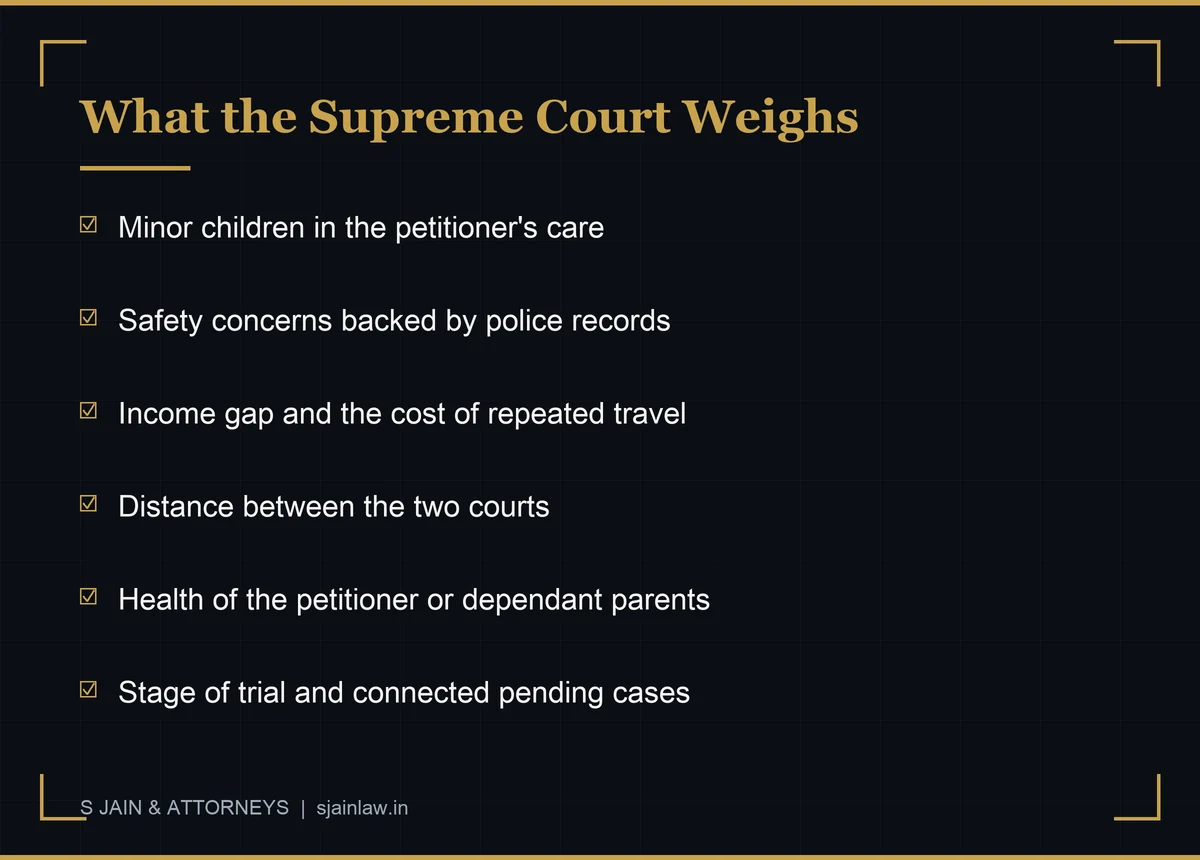
Reported orders show a consistent set of factors. A transfer petition is won on facts, and these are the facts that matter:
- Minor children: a young child in the petitioner's sole care, with no one else to leave the child with during travel, is among the strongest grounds.
- Safety: credible apprehension of threat in the respondent's city, supported by complaints or police records, not bare assertion.
- Income disparity: a homemaker or modestly earning wife facing a well-resourced husband; repeated travel costs become a denial of access to justice.
- Distance and connectivity: 1,100 kilometres mattered in Sumita Singh; an overnight train between neighbouring districts persuades far less.
- Health: illness of the petitioner, or of dependent parents needing daily care, backed by medical records.
- The litigation map: where the maintenance, domestic violence and custody cases are already pending; courts favour consolidating connected matters in one city.
- Stage of trial: a case at the fag end of evidence is harder to move than one at the notice stage.
How to File a Transfer Petition in the Supreme Court: Step by Step
A transfer petition in the Supreme Court is a self-contained original proceeding, filed and served like any other petition before that Court:
- Engage an Advocate-on-Record (AOR). Only an AOR can file in the Supreme Court. Your local family lawyer prepares the factual base; the AOR settles and files the petition.
- Draft the petition. It states the parties, the case sought to be transferred with its number and court, the grounds (children, safety, income, distance, health, connected cases) and the prayer, supported by an affidavit and annexures.
- File with an interim application. Almost every petition includes a prayer for stay of further proceedings in the trial court so the case does not race ahead while the transfer is decided.
- First listing: the Court issues notice to the respondent and, in most matrimonial matters, grants the interim stay.
- Service and response: the respondent files a counter-affidavit; the Court frequently explores mediation between the spouses at this stage, since a transfer petition is often the first time both sides are before one judge.
- Disposal: the Court allows or dismisses the petition. If allowed, the record of the case is transmitted to the transferee court.
Women, litigants below the income ceiling, and certain other categories are entitled to free legal aid through the Supreme Court Legal Services Committee under the Legal Services Authorities Act, 1987, which can cover the AOR and drafting at no cost. The procedure before the family court after transfer follows the ordinary course described in our guide to family court procedure in India.
Costs and Timelines
The court fee on a transfer petition is nominal; the real cost is professional. Depending on counsel and the number of hearings, total professional charges commonly fall between Rs 40,000 and Rs 2,00,000 or more, with senior counsel raising the figure further. Time-wise, notice and interim stay typically come within the first few weeks of filing; contested petitions are generally disposed of within three to nine months; petitions settled through mediation can close faster.
Note: these figures are indicative ranges drawn from practice, not fixed tariffs or promised timelines. Fees vary with counsel and complexity, and court timelines shift with the Supreme Court's board. Legal aid, where available, can bring the cost to nil.
Opposing a Transfer Petition
Transfer petitions are contested more often than they used to be, and respondents win their share. The recurring defence themes:
- Offer to pay travel and stay costs of the petitioner and a companion for every hearing, the course accepted in Anindita Das; it directly answers the hardship plea.
- Show the grounds are generic: petitions that recite distance and hardship without documents invite dismissal on merits.
- Children and dependants on the respondent's side: an ailing parent or school-going child in the respondent's custody makes the balance of convenience genuinely two-sided.
- Stage of proceedings: if evidence is substantially over, transfer would waste completed work.
- Forum shopping: where the petitioner herself chose a distant forum for her own cases, the hardship argument weakens.
What a respondent can no longer do, after Santhini, is defeat a well-founded transfer petition by unilaterally offering video conferencing; that option needs both parties' consent.
Supreme Court vs High Court Transfer: A Comparison
| Aspect | Supreme Court transfer | High Court transfer |
|---|---|---|
| Civil / matrimonial provision | Section 25 CPC | Section 24 CPC |
| Criminal provision | Section 446 BNSS (old S. 406 CrPC) | Section 447 BNSS (old S. 407 CrPC) |
| Reach | One State to another | Between courts within the same State |
| Typical matrimonial use | Divorce in Delhi, wife in Bengaluru | Case in Bengaluru, wife in Mysuru |
| Who moves it | A party, through an AOR | A party, or the court on its own motion |
| Interim protection | Stay of trial court proceedings commonly granted | Stay available on similar principles |
| Relative cost | Higher (Supreme Court practice) | Lower (local High Court practice) |
Evidence Worth Annexing
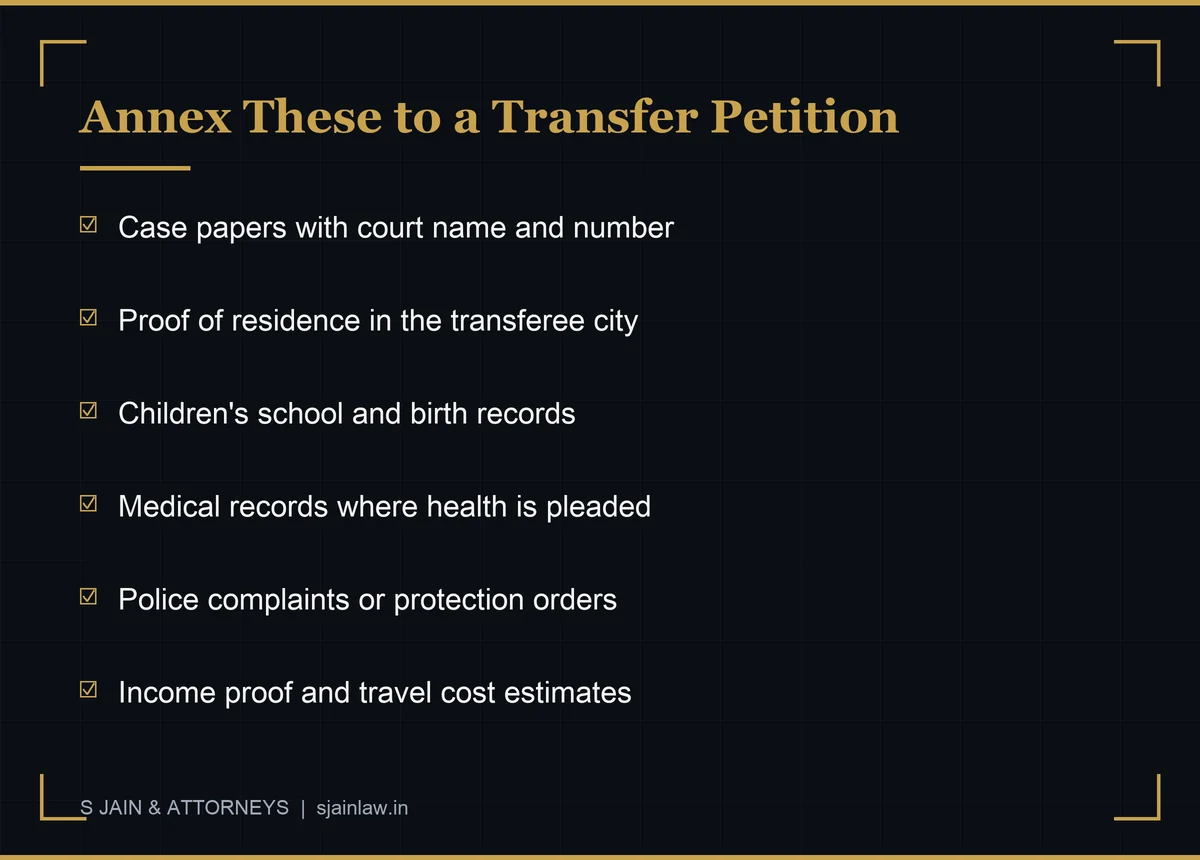
Because transfer petitions are decided on affidavits, the annexures are the case. A petition that documents its grounds is treated very differently from one that asserts them:
- Copy of the petition or complaint sought to be transferred, with the cause title showing the court and case number.
- Proof of your current residence: rental agreement, Aadhaar or utility records in the transferee city.
- Children's birth certificates and school records showing where they study and who cares for them.
- Medical records of the petitioner or dependent parents where health is pleaded.
- Police complaints, FIR copies or protection orders where safety is pleaded.
- Income proof: salary slips or the absence of income, plus indicative travel costs between the two cities.
- The list of all pending cases between the parties, with courts and stages, to support consolidation.
In my practice, the transfer petitions that succeed are boring on law and rich on record. Judges have read the convenience argument a thousand times; what they have not read is your specific school diary, your specific duty roster, your specific train timetable. When a client comes to us after her husband files in another State, the first week is spent not on drafting but on assembling that record, and on mapping every pending case between the couple so the Court sees one consolidated picture. The second thing I tell clients is to be realistic about mediation: a large share of matrimonial transfer petitions become the venue where settlement talks finally start, because for the first time both spouses are standing before the same court. Going in with a worked-out position on maintenance and custody, prepared with your family law counsel, converts a procedural skirmish into leverage.
What Happens After the Transfer Is Allowed
Once the Supreme Court allows the petition, the transferor court's record is transmitted to the transferee court, which, subject to any special directions in the order, either retries the case or proceeds from the stage at which it was transferred; completed evidence is not automatically wasted. Under Section 25(5) CPC, the transferee court applies the law that the original court would have applied, so no advantage is gained or lost on the substantive law. Interim orders already operating, such as maintenance pendente lite, continue unless varied by the new court. If the petition is dismissed, the original case simply resumes, and a petitioner who litigated frivolously risks the Section 25 compensation and costs.
Related guides and where to get help
- Frivolous Cases in Matrimonial Disputes: What the Law Says
- False Dowry Cases: Safeguards for the Wrongly Accused
- Wife's Right to Residence in the Matrimonial Home: Section 17 DV Act Explained (2026)
Frequently Asked Questions
What is a transfer petition?
It is a petition asking a superior court to move a pending case from one court to another. The Supreme Court transfers civil cases between States under Section 25 CPC and criminal cases under Section 446 BNSS; within a State, the High Court acts under Section 24 CPC or Section 447 BNSS.
Can a wife get a divorce case transferred to her city?
Frequently, yes. Under Sumita Singh v. Kumar Sanjay (2001), the wife's convenience is the primary consideration when the husband has sued. She must still show concrete hardship: a child in her care, income constraints, distance, safety or health grounds supported by documents.
Is the wife's convenience always decisive?
No. In Anindita Das v. Srijit Das (2006), the Supreme Court cautioned that its leniency was being misused and dismissed the wife's petition, directing the husband to fund her travel instead. Each petition is decided on its own merits.
Can a 498A case be transferred to another State?
Yes, but only the Supreme Court can do it, under Section 446 BNSS (the old Section 406 CrPC). The petitioner must show that transfer is expedient for the ends of justice; mere inconvenience of attending court in another State is usually not enough by itself.
Can the court order video conferencing instead of transferring the case?
Not in a transfer petition. In Santhini v. Vijaya Venketesh (2017), a three-judge bench held that video conferencing cannot be directed in a transfer petition and, in family court matters, requires the joint consent of both parties after settlement efforts fail.
Does the trial continue while the transfer petition is pending?
Usually not. The standard practice is to seek an interim stay of the trial court proceedings at the first listing, and the Supreme Court commonly grants it in matrimonial matters so the case does not proceed in the meanwhile.
How long does a Supreme Court transfer petition take?
Indicatively, notice and interim stay come within weeks, and contested petitions are typically decided in three to nine months. Petitions resolved through mediation can end sooner, sometimes with the entire dispute settling.
What happens if my transfer petition is dismissed?
The case continues in the original court from where it stood. Courts often soften the outcome with directions, such as the respondent paying the petitioner's travel expenses, and a frivolous petition can attract compensation of up to Rs 2,000 under Section 25 CPC plus costs.
This article is general legal information, not legal advice, and does not create a lawyer-client relationship. Transfer petitions turn on their specific facts. For advice on your situation, consult a qualified advocate.