"Leave this house" is one of the commonest threats in a broken marriage, and it is usually an empty one. Indian law gives a wife a right to residence in the matrimonial home under Section 17 of the Protection of Women from Domestic Violence Act, 2005 (DV Act), whether or not the house is in her name, her husband's name or her in-laws' name. She cannot be evicted or locked out except through a procedure established by law, and a Magistrate can pass residence orders under Section 19 to protect her possession. This guide explains what a shared household is, what the Supreme Court has held, and how the right works in practice.
Part of the domestic violence practice at S Jain & Attorneys, Bangalore.
The residence right sits inside the wider DV Act machinery of protection, maintenance and compensation orders, which we have covered in our guide to the Domestic Violence Act. This piece goes deep on one question only: who gets to stay in the house.
The Right to Residence in the Matrimonial Home: The Short Answer
Three propositions state the modern law. First, every woman in a domestic relationship has the right to reside in the shared household, regardless of whether she owns any part of it (Section 17(1)). Second, she cannot be evicted or excluded except in accordance with the procedure established by law (Section 17(2)): no lockouts, no bag-packing, no changing the locks while she is at her parents' house. Third, after the Supreme Court's decision in Satish Chander Ahuja v. Sneha Ahuja (2020), the house need not belong to the husband: a home owned exclusively by the father-in-law or mother-in-law can still be a shared household if the couple lived there with some permanency.
What Counts as a Shared Household: Section 2(s) Explained
Section 2(s) defines the shared household as the household where the aggrieved woman lives or has lived in a domestic relationship, alone or with the respondent. The definition expressly covers a house that is owned or tenanted, jointly by both or by either of them, and a household that belongs to the joint family of which the respondent is a member, irrespective of whether the woman or the respondent has any right, title or interest in it.
Notice what the definition does not require. It does not require ownership by the husband. It does not require the wife's name on any document. It does not even require that the family label the house the "matrimonial home". What matters is the fact of living there in a domestic relationship. A rented flat can be a shared household; so can company accommodation the couple occupied; so can the in-laws' self-acquired house where the couple lived after the wedding. What the courts have added is a filter of permanency: a house where the couple merely stayed for a holiday or a short visit does not become a shared household, otherwise every relative's guest room would be sued over.
Section 17: The Right to Reside, Regardless of Ownership
Section 17(1) confers the right to reside on every woman in a domestic relationship: wives, but also mothers, daughters, sisters and women in relationships in the nature of marriage. Section 17(2) is the shield: she "shall not be evicted or excluded from the shared household or any part of it by the respondent save in accordance with the procedure established by law."
The phrase "procedure established by law" is the whole point. A husband or in-law who wants a wife out of the house must go to a court or tribunal and win; he cannot achieve the same result with muscle, locks or movers. Self-help eviction, however the family justifies it, is exactly what Section 17(2) prohibits, and it is undone by a single interim order restoring possession.
From Batra to Ahuja: How the Supreme Court Changed Course
For thirteen years the residence right was read narrowly. In S.R. Batra v. Taruna Batra, (2007) 3 SCC 169, a two-judge bench held that a shared household means only a house belonging to or rented by the husband, or a joint family house in which the husband has a share. On that view, a wife living in her mother-in-law's self-acquired house had no residence right in it at all.
In Satish Chander Ahuja v. Sneha Ahuja (decided 15 October 2020, reported (2021) 1 SCC 414), a three-judge bench overruled Batra. The daughter-in-law there lived on the first floor of a Delhi house owned solely by her father-in-law; when matrimonial disputes erupted, he sued to evict her. The Supreme Court held that Section 2(s) does not require the husband to own or hold a share in the house: the in-laws' exclusively owned house can be a shared household if the woman lived there in a domestic relationship with the required permanency. The Court balanced the ruling carefully: the in-laws are not remediless, eviction can still be sought through a properly constituted civil proceeding, and courts can direct alternative accommodation under Section 19(1)(f) instead of forcing warring generations under one roof.
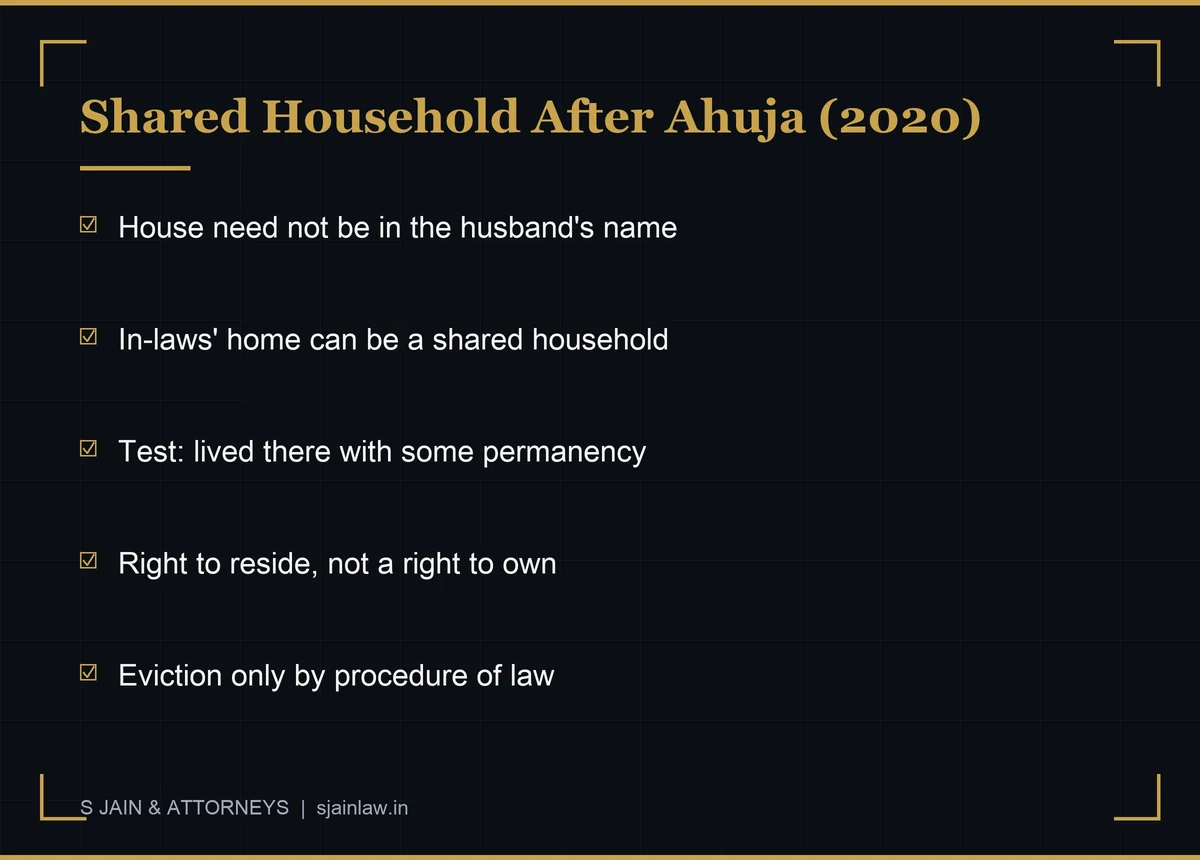
Key takeaway: after Ahuja, "the house is in my father's name" is no longer a complete answer to a wife's residence claim. Ownership decides who ultimately keeps the property; the DV Act decides who cannot be thrown out of it tonight. Those are different questions, decided in different proceedings.
Residence Orders Under Section 19: What the Court Can Actually Order
Section 19 arms the Magistrate with a menu of residence orders once domestic violence is prima facie shown. The court may:
- Restrain dispossession: stop the respondent from dispossessing or disturbing the woman's possession of the shared household, whatever his legal interest in it (Section 19(1)(a)).
- Direct the respondent to remove himself from the shared household (Section 19(1)(b)); by the proviso, this drastic order cannot be passed against a woman respondent.
- Bar entry by the respondent or his relatives into the portion where the woman resides (Section 19(1)(c)).
- Freeze dealings: restrain alienating, disposing of or encumbering the shared household (Section 19(1)(d)), and restrain the respondent from renouncing his rights in it (Section 19(1)(e)).
- Order alternative accommodation: direct the respondent to secure for the woman another accommodation of the same level as she enjoyed in the shared household, or pay rent for one (Section 19(1)(f)).
- Order stridhan returned: direct return of her stridhan, property and valuables (Section 19(8)), a remedy we unpack in the guide on recovering streedhan.
The court can attach conditions, require bonds, and direct the police to help enforce the order. In practice, the two workhorses are 19(1)(a) restraint orders protecting possession and 19(1)(f) alternative-accommodation orders where cohabitation has become impossible.
The Senior Citizens Act Clash: S. Vanitha's Balance
A pattern emerged after 2007: in-laws would file a summary eviction application under the Maintenance and Welfare of Parents and Senior Citizens Act, 2007, and obtain an order ejecting the daughter-in-law from "their" house, sidestepping the DV Act entirely. The Supreme Court shut this down in S. Vanitha v. Deputy Commissioner, Bengaluru Urban District (15 December 2020), a case that began in Bengaluru itself. The Court held that the summary procedure under the Senior Citizens Act cannot be used to defeat a woman's right of residence in a shared household; the two statutes protect two vulnerable groups and must be construed harmoniously, with tribunals moulding relief so that neither protection wipes out the other. The eviction order against the daughter-in-law was set aside.
The decision does not mean elderly parents are hostages. It means the forum matters: claims to evict a daughter-in-law with residence rights must be tested in proceedings where her DV Act protection is weighed, not evaded.
A Right to Reside Is Not a Right to Own
The residence right is protective, not proprietary. Section 17 lets a woman stay; it does not make her an owner, give her a share, or block a genuine sale forever. Title continues to be decided by property and succession law, and a civil court can ultimately decree eviction after a fair contest, typically paired with alternative accommodation or maintenance arrangements. The right also does not depend on the marriage surviving: it protects wives during matrimonial disputes, and courts have applied the shared-household protection to widowed daughters-in-law living in the marital family's home, since the domestic relationship with the husband's family does not vanish on his death.
Common mistake: walking out of the house under pressure, with no interim order and no record, and asking about rights months later. Once possession is gone, the case changes from "protect my possession" to "restore my possession", which is slower and harder. If you must leave for safety, leave, but file quickly and say clearly in the application that you were excluded from the shared household.
Common Scenarios: What Courts Typically Do
| Scenario | Position in law | Anchor |
|---|---|---|
| House in the husband's sole name; he demands the wife leave | She has a right to reside; eviction only through due process | Section 17 |
| House owned solely by the father-in-law or mother-in-law | Can still be a shared household if the couple lived there with permanency | Satish Chander Ahuja (2020) |
| In-laws obtain a summary eviction order under the Senior Citizens Act | Cannot be used to defeat the DV Act residence right; relief must be balanced | S. Vanitha (2020) |
| Couple lived in a rented flat | Tenanted premises are expressly within the shared household definition | Section 2(s) |
| Husband tries to sell or mortgage the house mid-dispute | Alienation and encumbrance can be restrained | Section 19(1)(d) |
| Living together has become impossible | Court can order same-level alternative accommodation or rent | Section 19(1)(f) |
Interim Orders, Breach and the Criminal Backstop
Speed matters in residence disputes, and the DV Act provides for it. Under Section 23, the Magistrate can grant interim and even ex parte orders, including residence orders, on the strength of the application and affidavit. Breach has teeth: under Section 31, breach of a protection order or interim protection order is a criminal offence punishable with imprisonment up to one year, or fine up to twenty thousand rupees, or both, and Section 32 makes it cognizable and non-bailable. DV Act proceedings follow the procedure of the Bharatiya Nagarik Suraksha Sanhita, 2023 (BNSS), which replaced the CrPC. Where the facts disclose cruelty, a parallel criminal case can also lie under Section 85 of the Bharatiya Nyaya Sanhita, 2023 (the old Section 498A IPC), though that is a separate track with a different standard and purpose. For the protective side of the Act, including how protection orders are obtained and enforced, see our protection order guide.
Evidence and Documents That Win Residence Orders
Residence cases are won on proof of two facts: that the house was the shared household, and that exclusion or dispossession happened or is threatened. Build both before you file:
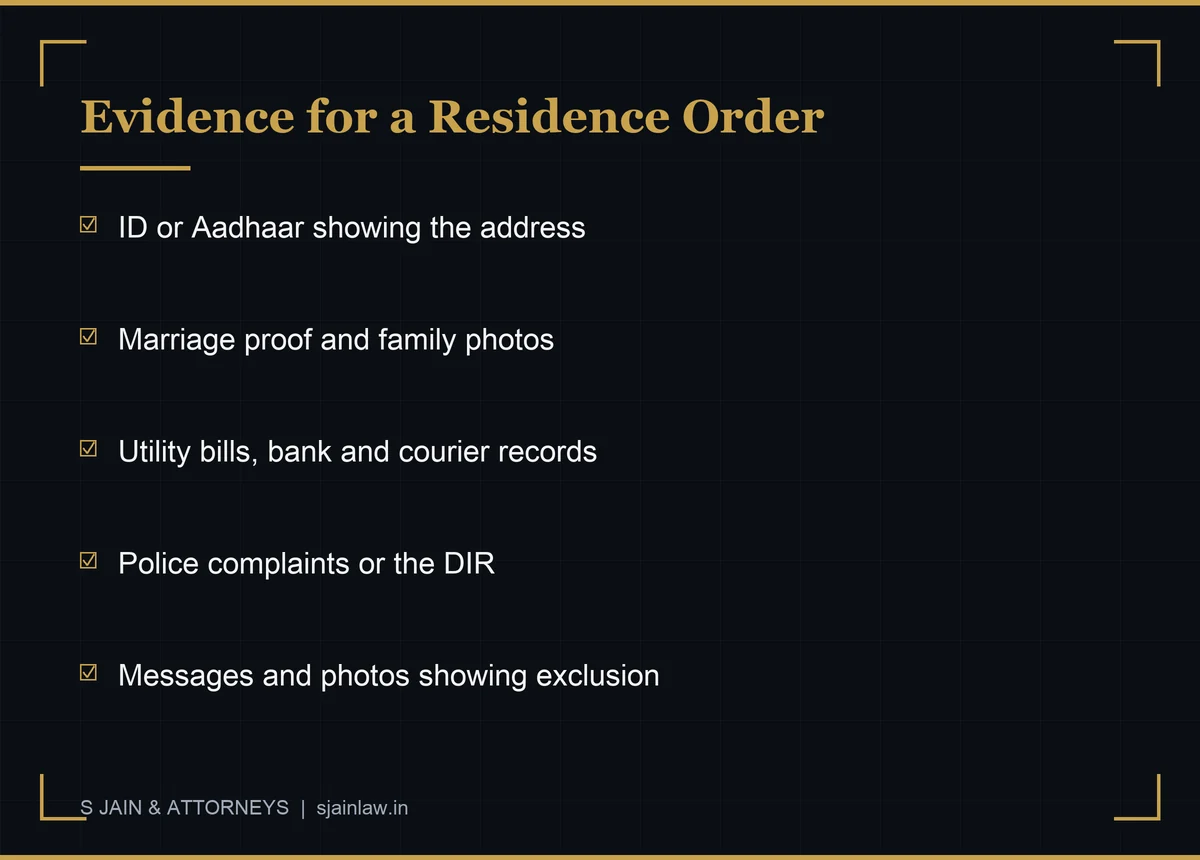
- Proof you lived there: Aadhaar or other ID showing the address, ration card entries, bank and delivery records, school records of children, wedding and festival photographs in the house.
- Proof of the domestic relationship: the marriage certificate or invitation, family photographs, statements of neighbours.
- Proof of exclusion or threat: police complaints, the Domestic Incident Report recorded by the Protection Officer, messages and emails demanding you leave, medical records, photographs or videos of locked doors or discarded belongings.
- Property context: whatever you know of ownership, tenancy or the joint family character of the house, so the court sees the Section 2(s) picture clearly.
In my practice, where these cases actually stall is not the law but the record: the wife has lived in the house for eight years and cannot produce one document with that address on it, because everything was in the husband's name and the in-laws collected the mail. What I tell clients in their first meeting is to spend one weekend fixing that, quietly: update the address on one bank account and one ID, photograph yourself and the children in the home, save the threatening messages to email, and only then decide the litigation strategy. Courts grant interim residence protection quickly when the shared-household fact is undeniable on paper; they hesitate when it rests on assertion alone. If the dispute is already live, take advice early from a family law practitioner on sequencing the DV application, maintenance and any divorce or settlement talks, because the residence order often sets the tone for everything that follows.
Related guides and where to get help
- Dowry Law in India: Act, Section 304B, Penalties
- Transfer Petition in Matrimonial Cases: How to Move Your Divorce or 498A Case (2026)
- Is a Foreign Divorce Decree Valid in India? Section 13 CPC Rules for NRIs (2026)
Frequently Asked Questions
Can a husband legally throw his wife out of the house?
No. Section 17(2) of the DV Act says a woman cannot be evicted or excluded from the shared household except in accordance with the procedure established by law. Lockouts and forced removals are illegal, and a Magistrate can restore her possession by interim order.
Does the wife have rights in the house if it is in her in-laws' name?
After Satish Chander Ahuja v. Sneha Ahuja (2020), yes: a house owned exclusively by the in-laws can be a shared household if the couple lived there with some permanency. The wife gets a right to reside, though the in-laws can still pursue eviction through a proper civil proceeding where her rights are weighed.
What is a shared household under the DV Act?
Under Section 2(s), it is the household where the woman lives or has lived in a domestic relationship, whether owned or tenanted, by either party or jointly, including a joint family house, irrespective of whether she or the respondent has any right, title or interest in it.
Is the right to residence the same as ownership?
No. It is a right to reside and not be unlawfully evicted. It does not give the wife title or a share in the property; ownership is decided separately under property and succession law.
Can in-laws evict a daughter-in-law using the Senior Citizens Act?
Not by summary shortcut. In S. Vanitha v. Deputy Commissioner (2020), the Supreme Court held that Senior Citizens Act eviction proceedings cannot be used to defeat the daughter-in-law's DV Act residence right; the tribunals must balance both statutes.
Can the court order the husband to arrange a separate house instead?
Yes. Under Section 19(1)(f), the Magistrate can direct the respondent to secure alternative accommodation of the same level the woman enjoyed in the shared household, or to pay rent for it. Courts use this where living together has become unworkable.
What happens if the husband violates a residence or protection order?
Breach of a protection order or interim protection order is an offence under Section 31 of the DV Act, punishable with up to one year's imprisonment or fine or both, and it is cognizable and non-bailable under Section 32.
Does a widow have a right to reside in her in-laws' house?
The shared-household protection has been applied to widowed daughters-in-law living in the marital family home, since the domestic relationship does not end with the husband's death. The facts of residence and permanency still have to be shown.
This article is general legal information, not legal advice, and does not create a lawyer-client relationship. Residence disputes are fact-specific and often urgent. For advice on a particular situation, consult a qualified advocate.