When a builder collapses into insolvency, do the flat buyers' cases collapse with it? That question sits at the heart of builder insolvency homebuyer rights in India, and on 27 July 2026 the Supreme Court answered it. In Tejas J. Shah & Amisha T. Shah v Mantri Technology Constellations Pvt Ltd (Civil Appeal Nos. 4289-4290 of 2025), Justices Vikram Nath and Sandeep Mehta held that the moratorium under Section 14 of the Insolvency and Bankruptcy Code, 2016 (IBC) protects only the corporate debtor, the builder company itself. The consumer complaint continues against the promoters, directors, associated companies and landowners of the project. This guide covers the whole field: what happens when a builder enters CIRP, what the Section 14 moratorium actually freezes, what the Mantri ruling held, your status as a financial creditor homebuyer under the IBC, and the three parallel tracks every allottee should be running.
Part of the RERA and homebuyer disputes practice at S Jain & Attorneys, Bangalore.
What Happens When a Builder Enters Insolvency (CIRP)
The IBC route begins with a default. A lender, a vendor or a group of allottees files a petition before the National Company Law Tribunal (NCLT): financial creditors file under Section 7 IBC, operational creditors such as contractors and suppliers under Section 9 IBC. Once the NCLT admits the petition, the Corporate Insolvency Resolution Process (CIRP) commences, and three things happen at once:
- The board of directors is suspended and an interim resolution professional (IRP), later confirmed or replaced as the resolution professional (RP), takes over the management of the company.
- A moratorium under Section 14 IBC freezes suits, executions and recovery actions against the company.
- A public announcement invites all creditors, including homebuyers, to file claims, after which a Committee of Creditors (CoC) is constituted to decide the company's fate.
In the Mantri case itself, the appellants had booked apartments in the Mantri Manyata Energia project in Bengaluru under construction agreements and agreements for sale executed in 2016, with possession promised on or before 31 December 2018. Possession never came. The buyers filed Consumer Case No. 13 of 2023 before the NCDRC against seven parties: the developer company, an associated company (Mantri Developers Pvt Ltd), three promoters and directors, and the two landowners of the project land. Midway through that complaint, on 23 August 2024, the NCLT Bengaluru Bench admitted a Section 9 petition against the developer, CIRP began, and the moratorium clicked in. (For how contested company litigation before the NCLT works more generally, see our guide on oppression and mismanagement cases before the NCLT.)
The Moratorium Under Section 14 IBC: What It Freezes, and for Whom
Section 14(1)(a) IBC prohibits "the institution of suits or continuation of pending suits or proceedings against the corporate debtor including execution of any judgment, decree or order" in any court, tribunal or authority. Companion clauses stop the company from transferring its assets, bar enforcement of security interests against its property, and bar recovery of property in its possession. The object is practical: preserve the company's assets so that one resolution can be worked out in one forum, instead of a hundred courts dismembering the company in parallel.
The words that matter are "against the corporate debtor". The freeze is for the company under insolvency, and for no one else. As the Supreme Court put it in Mantri:
"A plain reading of the provision makes it clear that the moratorium operates against the corporate debtor alone. No other category, whether it be any subsidiary company, any managers/directors, personal guarantors etc. can be added to it unless specifically provided."
The Mantri Ruling: The Consumer Case Against Builder Promoters Survives
What the NCDRC had done
Once the moratorium hit the developer, the buyers filed two applications (I.A. No. 14200 of 2024 and I.A. No. 15656 of 2024) asking the NCDRC to carry on the complaint against the other six respondents, none of whom was under any insolvency process. By order dated 20 January 2025, the NCDRC refused and adjourned the entire complaint sine die, that is, indefinitely. Its reasoning: all the construction and sale agreements were with the developer alone, so the alleged deficiency in service pertained only to the developer, and the liability of the remaining respondents could not be independently examined while the moratorium operated.
What the Supreme Court held
The Supreme Court, in a reportable judgment authored by Justice Vikram Nath (full text here), called that approach erroneous and set it aside. Three strands of the ruling matter to every homebuyer:
- No borrowed protection. Only the developer is the corporate debtor. In the Court's words, "No independent moratorium or independent protection operates in favour of Respondent Nos. 2 to 7." In the absence of any legal bar, the NCDRC was not justified in refusing to proceed against the promoters, directors, the associated company and the landowners.
- No pre-judging at the interlocutory stage. The NCDRC had itself recorded that liability was yet to be determined, yet simultaneously concluded that the deficiency was attributable only to the developer. Whether the other respondents are ultimately liable is precisely what the complaint must decide on pleadings and evidence; it cannot be foreclosed while deciding an adjournment application.
- Merits left open. The Court declined the buyers' invitation to simply allow the consumer complaint. Objections such as absence of privity of contract and maintainability remain open for the NCDRC to decide in accordance with law.
The operative result: the rejection of both applications was set aside, the applications were allowed, and the NCDRC was directed to proceed to hear Consumer Complaint No. 13 of 2023 against respondents 2 to 7, while proceedings against the developer itself remain governed by the Section 14 moratorium. If you are weighing a similar complaint, our consumer protection practice page explains the forum and procedure basics.
The Doctrine Line: Mohanraj, Anjali Rathi, Ansal Crown Heights, Saranga
Mantri is not a bolt from the blue. It is the newest link in a chain the Supreme Court has been forging since 2021, and knowing the chain helps you argue it before any forum:
- P. Mohanraj v Shah Brothers Ispat Pvt Ltd, (2021) 6 SCC 258. A three-judge bench held that cheque dishonour proceedings under Sections 138 and 141 of the Negotiable Instruments Act, 1881 against the corporate debtor are covered by the Section 14 moratorium, but the natural persons in charge of the company continue to be statutorily liable and can be prosecuted.
- Anjali Rathi v Today Homes & Infrastructure Pvt Ltd (Supreme Court, 8 September 2021). In a homebuyer execution battle, the Court clarified, relying on Mohanraj, that the buyers "would not be prevented by the moratorium under Section 14 of the IBC from initiating proceedings against the promoters" of the builder personally, in that case to honour settlements reached before the Court.
- Ansal Crown Heights Flat Buyers Association v Ansal Crown Infrabuild Pvt Ltd, (2024) 5 SCC 745. Execution of an NCDRC order could continue against the directors and officers of an insolvent developer. The moratorium does not shield them, though whether a particular director is personally bound by the order is for the forum to decide.
- Saranga Anilkumar Aggarwal v Bhavesh Dhirajlal Sheth, 2025 INSC 314. Even the interim moratorium under Section 96 IBC in personal insolvency does not stay penalty proceedings under Section 27 of the Consumer Protection Act. Mantri expressly carries this principle forward: the protective sweep of a moratorium must remain within the four walls carved out by the statute and must not be expanded in a way that stultifies consumer remedies.
The through line is simple: the IBC exists to rescue the company, not to gift its promoters a litigation holiday.
Homebuyers as Financial Creditors: Section 5(8)(f) IBC
The second pillar of IBC homebuyers law is status. By the Insolvency and Bankruptcy Code (Second Amendment) Act, 2018, Parliament added an Explanation to Section 5(8)(f) IBC deeming any amount raised from an allottee under a real estate project to have the commercial effect of a borrowing. A homebuyer is therefore a financial creditor, not a mere consumer of services. The Supreme Court upheld the amendment's constitutionality in Pioneer Urban Land and Infrastructure Ltd v Union of India (9 August 2019), reasoning that allottees substantially finance the very construction of the project. Three consequences follow:
- You file your claim in the CIRP as a financial creditor in a class, using Form CA under the IBBI (Insolvency Resolution Process for Corporate Persons) Regulations, 2016.
- Homebuyers sit in the Committee of Creditors through an authorised representative chosen for the class under Sections 21(6A)(b) and 25A IBC, who votes on the resolution plan as per the instructions of the buyers.
- Allottees can themselves trigger CIRP under Section 7, subject to a threshold: under the second proviso to Section 7(1), inserted by the 2020 amendment, a filing needs at least 100 allottees of the same project or 10 per cent of the total allottees, whichever is less. The Supreme Court upheld this threshold in Manish Kumar v Union of India (19 January 2021).
Builder Insolvency Homebuyer Rights: The Three Legal Tracks
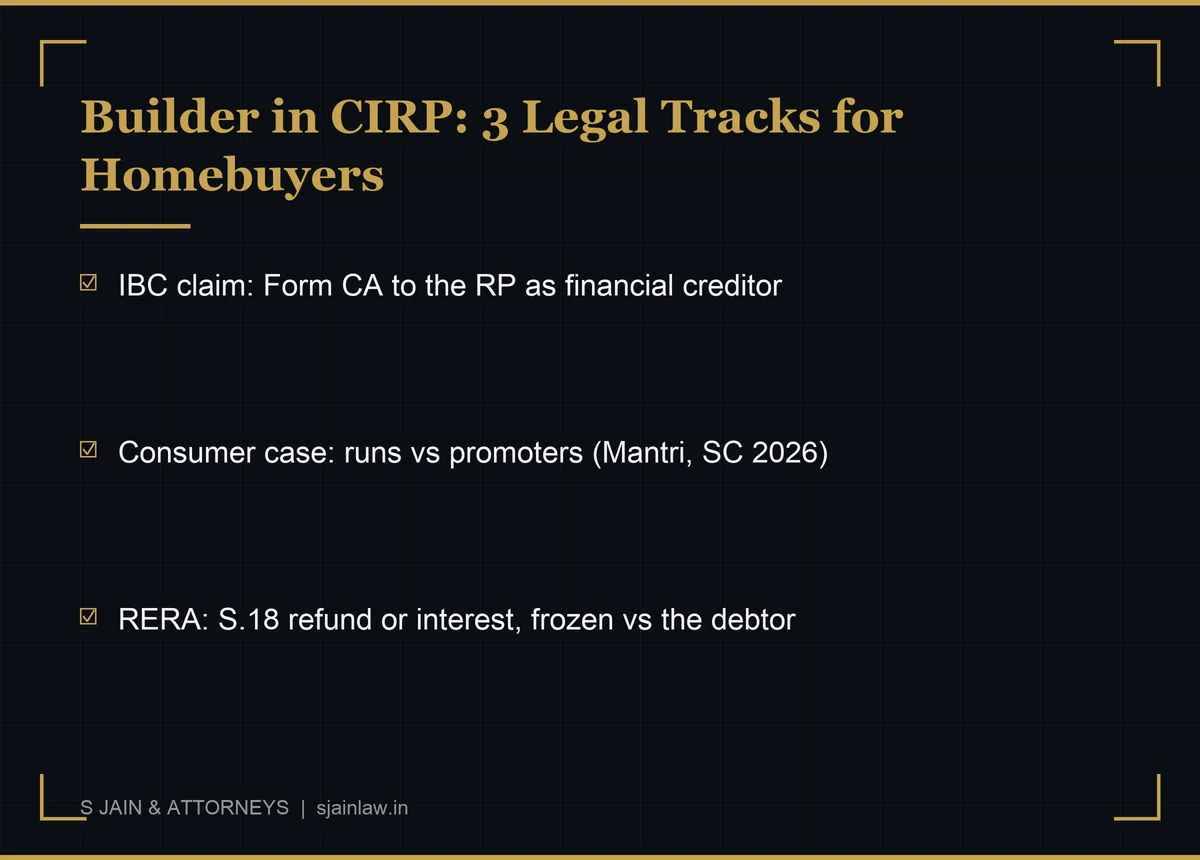
Once CIRP begins, stop thinking of your case as one file. Builder insolvency homebuyer rights run on three parallel tracks, and after Mantri, all three can move at the same time:
| Track | Forum | What you pursue | Effect of the moratorium |
|---|---|---|---|
| 1. IBC claim in CIRP | Resolution professional / NCLT | Form CA claim as a financial creditor in a class; representation in the CoC through the authorised representative; a share in the resolution plan | None. This is the insolvency process itself; the moratorium is its shield, not your bar |
| 2. Consumer complaint | District, State or National Commission (NCDRC) | Deficiency in service and unfair trade practice; refund, interest, compensation | Frozen against the builder company; continues against promoters, directors, associated companies and landowners (Mantri, 2026) |
| 3. RERA | State real estate regulatory authority | Section 18 refund with interest if you exit, or interest for every month of delay if you stay in the project | Proceedings and execution against the corporate debtor cannot continue during the moratorium; the IBC prevails via Section 238 |
Builder in NCLT: What Happens to My Flat?
The honest answer: it depends on how the CIRP ends. If a resolution plan is approved by the CoC and sanctioned by the NCLT under Section 31(1) IBC, the plan binds everyone, including every allottee, even those who voted against it or never filed a claim. A plan may bring in a new developer to complete the project and hand over flats, or provide refunds at a negotiated value, often with a haircut. Claims that were never filed risk being extinguished once the plan is approved, which is why the claim form is not optional paperwork.
Real estate insolvency has also developed its own tools. In Flat Buyers Association Winter Hills 77, Gurgaon v Umang Realtech Pvt Ltd (NCLAT, 28 February 2020), the appellate tribunal fashioned the "reverse CIRP": the promoter funds completion of the project from outside as a lender, the CIRP stays confined to the affected project rather than swallowing the whole company, and allottees get flats instead of a liquidation queue. That project-wise approach has since become a recurring feature of real estate insolvency practice. Liquidation remains the worst case for buyers: in the Section 53 waterfall, allottees generally stand behind secured creditors, and recoveries there are typically poor, which is exactly why tribunals push hard for resolution or completion in housing cases.
RERA vs IBC: Where Your RERA Complaint Stands
Under Section 18 of the Real Estate (Regulation and Development) Act, 2016, a buyer whose possession is delayed may withdraw and demand a full refund with prescribed interest, or stay in the project and claim interest for every month of delay. We have covered the mechanics in our guides on filing a RERA complaint in India and builder delay and RERA homebuyer rights.
But once CIRP is admitted, the moratorium applies to RERA too: complaints and execution proceedings against the corporate debtor cannot continue, and by Section 238 IBC the Code overrides anything inconsistent in other statutes. A RERA refund order you already hold does not vanish; it becomes the foundation of your claim before the resolution professional, filed like any other financial creditor claim. The practical sequencing most buyers should follow: use RERA aggressively while the builder is solvent; the moment CIRP begins, pivot to the claim-plus-consumer strategy that Mantri now protects.
Practical Checklist When Your Builder Enters CIRP
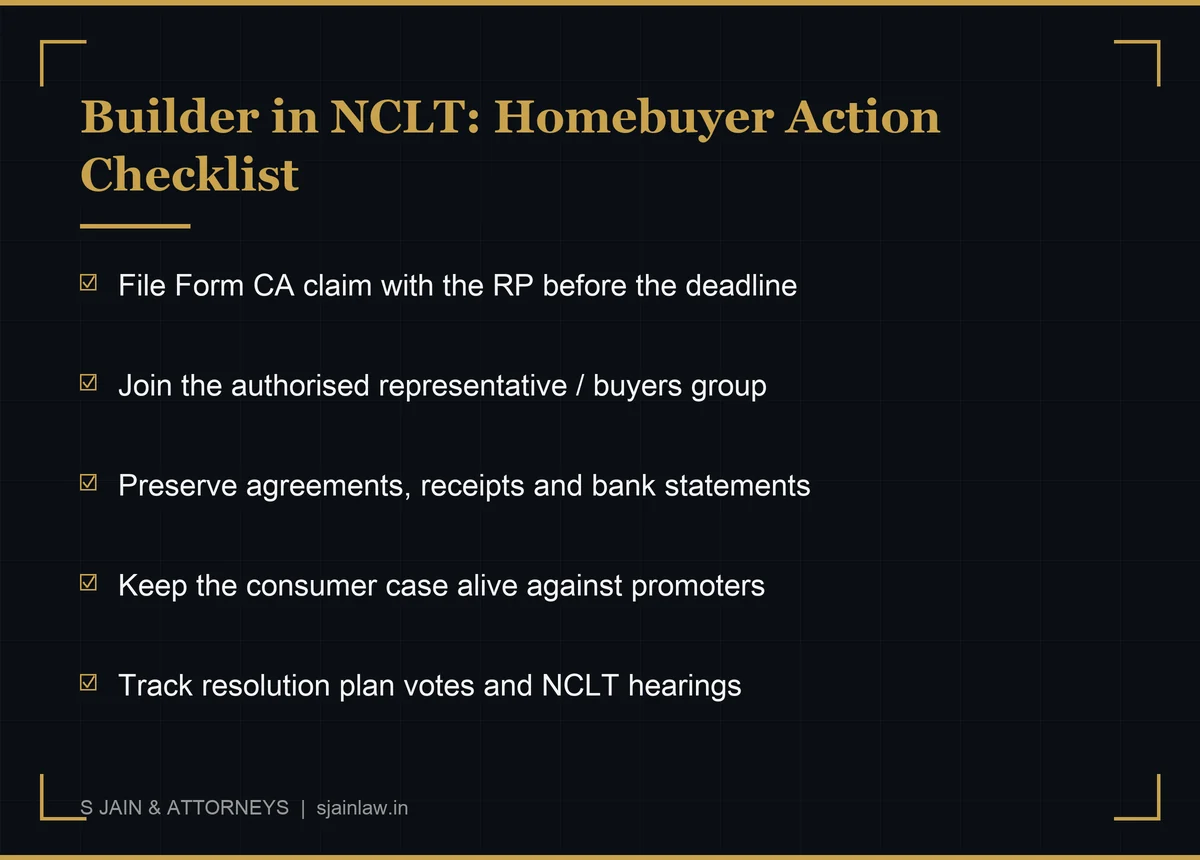
- Find the public announcement. The IRP must publish it and it fixes the last date for claims. Check the NCLT order, newspapers and the IBBI website.
- File Form CA in time, with your agreement, every payment receipt, bank statements and correspondence. Late claims are accepted only up to limited stages and invite objections.
- Join the homebuyers' association and engage with the authorised representative; a scattered class of buyers has no voice in the CoC, an organised one can steer the plan.
- Do not withdraw the consumer case. Keep it alive against the promoters, directors, associated companies and landowners; after Mantri, the moratorium is no answer to it.
- Lodge any RERA or decree amounts as claims so they are provided for in the plan.
- Take advice before signing any settlement or consent terms offered mid-CIRP; what you sign can bind you in the plan.
Deadline warning: an approved resolution plan binds you whether or not you filed a claim. A homebuyer who ignores the public announcement can find the dues wiped out by a plan they never saw. Treat the claim deadline like a limitation period, not a formality.
A word from practice. In Bengaluru we have seen enough stalled-project files to know exactly where buyers lose ground: they treat the NCLT process as someone else's fight. What I tell clients is blunt. Your claim form is your seat at the table, your consumer case is your leverage against the individuals behind the company, and your documents are the whole game. The buyers who come out ahead are the ones with a complete paper file, the agreement, every receipt, every email promising possession, and a presence on all three tracks at once. Since the Mantri judgment, the first thing we check in any new stalled-project brief at our property and real estate practice is whether the consumer complaint arrays the promoters, directors and landowners as parties, and not merely the company that is headed into, or already inside, the NCLT.
Timelines, Haircuts and Realistic Expectations
On paper, Section 12 IBC requires CIRP to finish in 180 days, extendable by 90, with an outer limit of 330 days including litigation time. In practice, contested real estate CIRPs regularly overshoot these limits as admission orders, plan approvals and appeals are fought at every rung. Budget for years, not months, and expect the consumer track to run on a similarly long clock at the NCDRC. On money: resolution plans routinely involve haircuts for financial creditors, and homebuyer refunds through a plan are rarely rupee-for-rupee. Where the project is viable, possession through a completed project usually beats a refund claim in value; where it is not, an early, well-documented claim plus a live consumer case against the individuals gives you the most pressure points. Anyone promising you a guaranteed outcome in this field is not being straight with you.
Related guides and where to get help
- Builder Delay and Fraud: How Homebuyers in India Can Fight Delayed Possession and Recover Compensation
- Can a Homebuyer's NCLT Plea Halt Your Project?
- Fake AI Citations in Indian Courts: What the Supreme Court's 2026 Ruling Means for Lawyers
Frequently Asked Questions
My builder is in NCLT; what happens to my flat?
The project's fate is decided inside the CIRP: a resolution plan approved under Section 31(1) IBC binds all allottees and may provide for completion and possession, or refunds (often with a haircut). File your Form CA claim so your dues are counted, and watch the plan; in suitable cases the tribunal may permit a reverse CIRP where the promoter funds completion of your specific project.
Does the IBC moratorium stop my consumer case against the builder?
It freezes the complaint only as against the builder company, the corporate debtor. After Tejas J. Shah v Mantri Technology Constellations (Supreme Court, 27 July 2026), the complaint continues against promoters, directors, associated companies and landowners arrayed as parties, and the NCDRC cannot adjourn it sine die because of the moratorium.
Are homebuyers financial creditors under the IBC?
Yes. The Explanation to Section 5(8)(f), inserted in 2018, deems amounts raised from allottees to have the commercial effect of a borrowing. Pioneer Urban (2019) upheld this, so homebuyers file claims as financial creditors and sit in the CoC through an authorised representative.
How do I file my claim when the builder enters CIRP?
Submit Form CA (claim by a financial creditor in a class) to the interim resolution professional named in the public announcement, with the sale agreement, payment receipts and bank proof, before the last date announced. Late claims face objections and, once a plan is approved, unfiled claims risk extinguishment.
Can homebuyers themselves take the builder to NCLT?
Yes, under Section 7 IBC, but the second proviso to Section 7(1) requires a joint filing by at least 100 allottees of the same project or 10 per cent of its total allottees, whichever is less. Manish Kumar v Union of India (2021) upheld this threshold.
What happens to my RERA case during the moratorium?
RERA proceedings and execution against the corporate debtor cannot continue while the moratorium runs; Section 238 IBC gives the Code overriding effect. A RERA refund order should be lodged as a claim with the resolution professional so it is provided for in the plan.
Can I recover from the builder's directors personally?
The moratorium does not protect them, so proceedings can continue against them: P. Mohanraj (2021) for cheque bounce cases, Anjali Rathi (2021) for promoters' settlement obligations, Ansal Crown Heights (2024) for execution of consumer orders. Whether a particular director is ultimately liable is decided on the merits in each forum.
Is the resolution plan binding on me if I voted against it?
Yes. Once the NCLT approves a plan under Section 31(1) IBC it binds the corporate debtor and all stakeholders, including dissenting allottees. Your protection lies in filing your claim, voting through the authorised representative and raising objections before the NCLT at the approval stage.
This article is for general informational purposes only and does not constitute legal advice. Insolvency and consumer proceedings are fact-specific; consult a qualified advocate before acting on anything stated here.