When the people in control run a company as if it were their personal property, Indian law gives the minority a targeted weapon. Oppression and mismanagement proceedings under Sections 241 and 242 of the Companies Act, 2013 allow a shareholder to ask the National Company Law Tribunal (NCLT) to step into the company's affairs, undo tainted transactions, restrain the board, and, most often in practice, order one side to buy the other out at a fair value. This guide explains what counts as oppression, the Section 244 eligibility threshold and its waiver, what the Tata v Mistry litigation settled, and how a petition actually runs before the NCLT Bengaluru Bench.
Part of the corporate and commercial law practice at S Jain & Attorneys, Bangalore.
What is oppression under Section 241 of the Companies Act?
Section 241(1)(a) lets a member complain that the affairs of the company have been or are being conducted in a manner prejudicial or oppressive to him or any other member, or prejudicial to public interest or to the interests of the company. The Act does not define oppression; the courts have.
The classic formulation comes from Shanti Prasad Jain v Kalinga Tubes Ltd (Supreme Court, 1965): the conduct must be burdensome, harsh and wrongful to the minority, involving a visible departure from the standards of fair dealing on which every shareholder is entitled to rely. A single stray act is normally not enough; the tribunal looks for a course of conduct, though one grave act, such as a share allotment that converts a majority into a minority, can by itself justify relief.
The Supreme Court refined the test in Needle Industries (India) Ltd v Needle Industries Newey (India) Holding Ltd, (1981) 3 SCC 333: the petitioner must show conduct lacking in probity that prejudices his rights as a shareholder. Needle Industries also cuts the other way, and it is a warning every intending petitioner should hear: conduct that is merely illegal or irregular is not automatically oppressive, and conduct can be oppressive even if it is technically legal. The tribunal judges substance, not form.
Key takeaway: Oppression is about unfair, mala fide use of corporate power against a member as a member. A bad business decision, an unprofitable year, or a boardroom defeat is not oppression. A rigged allotment, a starved shareholder, or a company treated as the promoter's private till usually is.
What counts as oppression in practice: the recurring patterns
Across reported cases, the same fact patterns keep appearing. If your dispute matches one or more of these, a Section 241 petition deserves serious consideration:
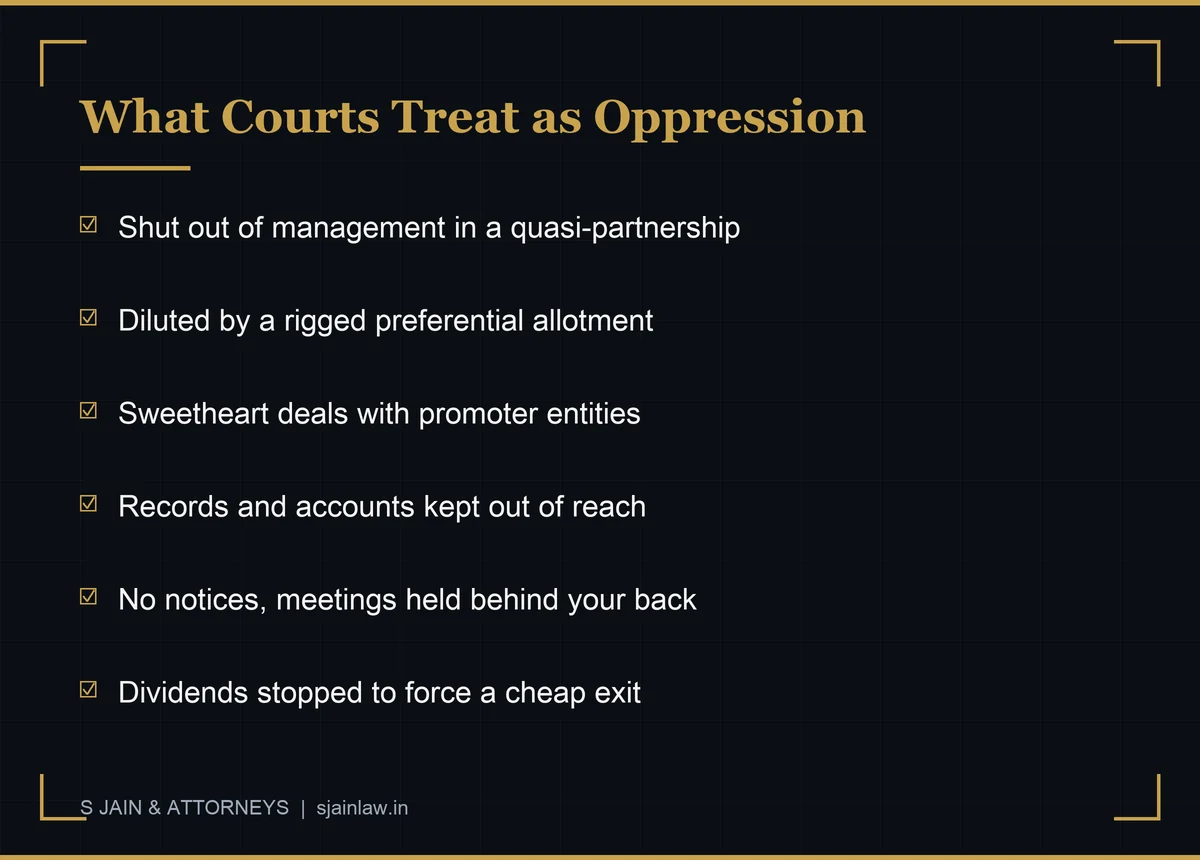
- Exclusion from management in a quasi-partnership. Where a private company is really a partnership in corporate clothing, shutting a founding shareholder out of the board and the business can be oppressive even if the articles technically permit it.
- Dilution through preferential allotment. Issuing further shares to the controlling group, at par or on selective terms, to convert the majority into a minority. In Dale & Carrington Invt (P) Ltd v P.K. Prathapan, (2005) 1 SCC 212, the Supreme Court set aside exactly such an allotment, holding that directors who issue shares to gain or cement control breach their fiduciary duty.
- Sweetheart related-party deals. Diverting the company's business, assets, leases or contracts to entities owned by the controllers, on terms no independent board would sign.
- Sitting on records. Denying inspection of statutory registers, withholding accounts, not sending notices of meetings, and keeping the minority in the dark so that decisions cannot be challenged in time.
- Financial starvation. Stopping dividends and salaries to minority directors while the controllers draw freely, to force a cheap exit.
Mismanagement under Section 241(1)(b)
Mismanagement is the second limb: the affairs of the company are being conducted in a manner prejudicial to the interests of the company, or a material change in control has taken place and the affairs are likely to be so conducted. Typical examples include serious diversion of funds, continuing without a validly constituted board, deadlock that paralyses the business, and asset-stripping. The focus here is harm to the company itself, not only to the complaining member, which is why the two limbs are usually pleaded together.
The quasi-partnership doctrine: Ebrahimi in India
Many private companies in India are two families or two friends who chose a company form for tax and liability reasons but ran the venture on mutual trust, equal management and an understanding that everyone participates. English law recognised this in Ebrahimi v Westbourne Galleries Ltd [1973] AC 360: where a company rests on a personal relationship of mutual confidence, equitable considerations can make it unjust for the majority to use its strict legal powers, for example to remove a founder from management. The Supreme Court of India accepted this approach in Hind Overseas Pvt Ltd v Raghunath Prasad Jhunjhunwalla (1976), and the doctrine now runs through Indian oppression jurisprudence.
Two practical points follow. First, in a genuine quasi-partnership, exclusion from management is itself a strong plank of oppression, because participation was the basis of the association. Second, the label is not automatic: in the Tata litigation the Supreme Court refused to treat Tata Sons, a large holding company with institutional shareholders, as a quasi-partnership merely because the Mistry group had a long association with it. The smaller and more personal the company, the stronger the doctrine.
Who can file: the Section 244 threshold and the waiver power
Section 241 rights are gated by Section 244, which fixes the minimum shareholding or numbers needed to maintain a petition:
| Company type | Members who can apply under Section 244 |
|---|---|
| Company having share capital | At least 100 members or one-tenth of the total number of members, whichever is less; or any member or members holding at least one-tenth of the issued share capital, provided all calls and dues on the shares are paid |
| Company not having share capital | At least one-fifth of the total number of members |
| Falling short of either test | Apply for a waiver under the proviso to Section 244(1); the Tribunal may, on application, allow any member to proceed despite the shortfall |
The waiver is not a formality. In Cyrus Investments Pvt Ltd v Tata Sons Ltd (NCLAT, 21 September 2017), the Mistry companies held about 18.37 percent of Tata Sons' equity shares but only about 2.17 percent of its total issued share capital once preference shares were counted, so they failed the ten percent test. The NCLAT granted waiver, holding that the power must be exercised by a reasoned order looking at factors such as whether the applicants' stake is substantial in real terms and whether the allegations, if proved, would amount to oppression. That waiver is what allowed the Tata case to be fought on merits at all.
Common mistake: Computing the ten percent on equity alone. Section 244 speaks of issued share capital, which includes preference capital. If preference shares dwarf the equity, even a large equity holder may need a waiver, so plead the waiver application alongside the main petition rather than discovering the gap at the maintainability hearing.
Tata v Mistry: what the Supreme Court settled in 2021
The dispute that began with the Tata Sons board removing Cyrus Mistry as executive chairman in October 2016 ended with Tata Consultancy Services Ltd v Cyrus Investments Pvt Ltd, (2021) 9 SCC 449, decided on 26 March 2021. The NCLAT had reinstated Mistry as executive chairman; the Supreme Court overturned that order in full. For everyday shareholder disputes, the judgment settled three things.
- Removal from office is not, by itself, oppression. A director or chairman losing his post is a boardroom outcome, not a wrong to him as a shareholder, unless the removal is part of conduct oppressive or prejudicial to members. Section 241 is not a service-law remedy for directors.
- Relief must track the statute and the pleadings. The NCLAT had granted reinstatement, a relief Mistry had not even pressed, and had put the order on hold company-wide. The Supreme Court held the tribunal's task under Section 242 is to bring the affairs of the company to an end state free of oppression, not to run the company or rewrite its power structure.
- Articles and legitimate expectations. The Court declined to import a quasi-partnership analysis into a large holding company and refused to dilute contractual governance rights, including affirmative voting rights, that shareholders had negotiated.
What the NCLT can order: the Section 242 toolkit
If the tribunal finds that the affairs have been conducted oppressively or prejudicially, and that winding up the company would unfairly prejudice the complaining members though the facts would otherwise justify a just-and-equitable winding up, it may pass, with a view to bringing an end to the matters complained of, virtually any order. Section 242(2) lists the main tools:
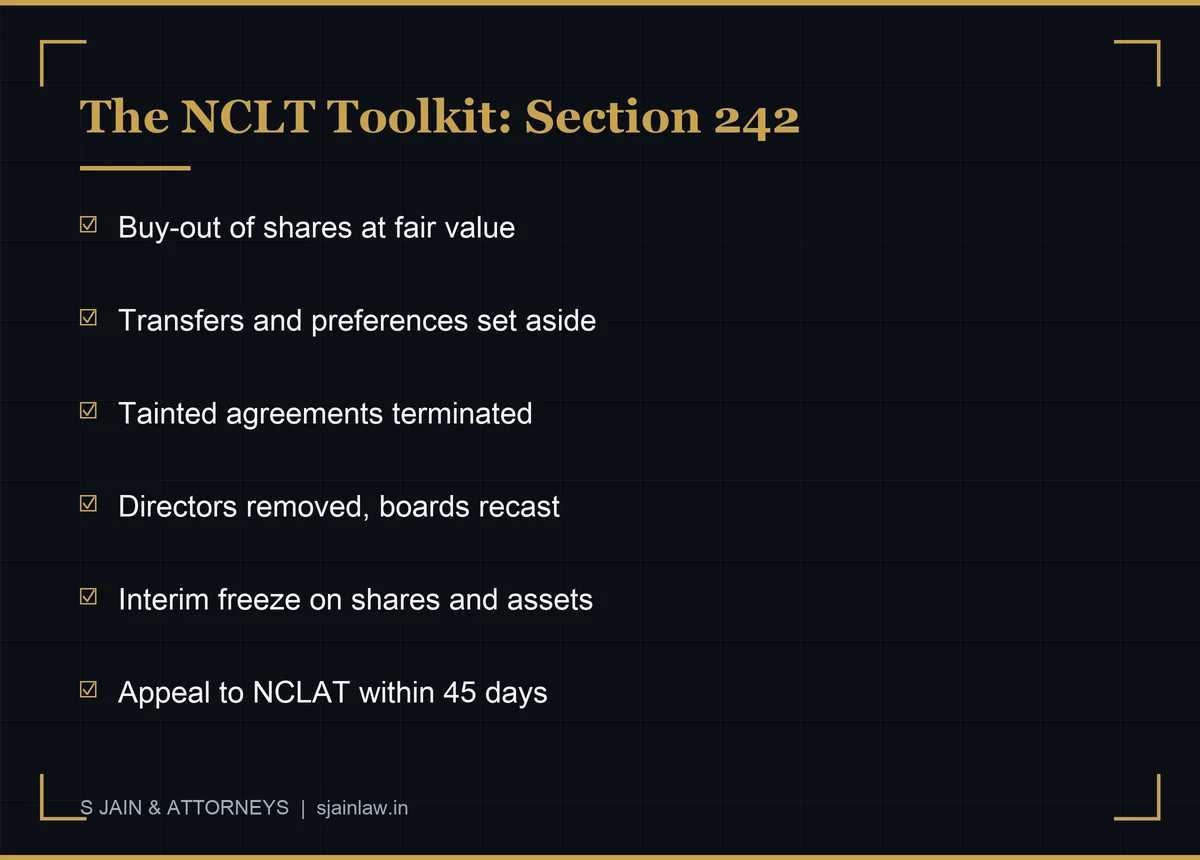
- Regulating the future conduct of the company's affairs;
- Ordering the purchase of the shares of any members by other members or by the company itself (the buy-out order), with a consequent reduction of capital where the company buys;
- Restricting the transfer or allotment of shares;
- Terminating, setting aside or modifying agreements between the company and its managing director or directors, or with third parties;
- Setting aside transfers, deliveries and payments made within three months before the application which would amount to fraudulent preferences;
- Removing the managing director, manager or any director, recovering undue gains made by them, and appointing new directors, which in substance lets the tribunal supersede a board;
- Imposing costs and any other matter the tribunal considers just and equitable.
Under Section 242(4), the tribunal can pass interim orders at any stage: status quo on shareholding, restraints on board resolutions, embargoes on selling company assets, appointment of observers or administrators in extreme cases. In a live dispute, the interim stage is often where the real battle is fought, because it freezes the majority's ability to create new facts on the ground.
Exit at fair value: the realistic endgame
Petitioners often file dreaming of control; most successful petitions end in an exit at fair value. Courts have long recognised that once trust between shareholder groups is dead, forcing them to cohabit is futile, so the standard resolution is a buy-out: the majority purchases the minority's shares at a value fixed by an independent valuer appointed by the tribunal.
The fight then shifts to valuation, and above all the valuation date. A date before the oppressive conduct protects the minority from a value depressed by the very acts complained of; a current date captures growth since. The tribunal has discretion and parties contest it fiercely, so a petitioner should plead the valuation date it seeks and the reasons, rather than leaving it to chance. Expect the valuer to work from audited financials, and expect adjustments where funds were diverted or assets moved out.
Section 241 petition or Section 245 class action?
The Companies Act contains a second collective remedy: the class action under Section 245, available to members or depositors who claim the company's affairs are being conducted in a manner prejudicial to the interests of the company or its members. It looks similar but serves a different job:
| Feature | Section 241 (oppression & mismanagement) | Section 245 (class action) |
|---|---|---|
| Who files | Members meeting the Section 244 threshold (or with waiver) | Members or depositors meeting the requisite numbers fixed under the NCLT Rules (for members of a company with share capital: the lesser of 100 members or 5 percent of members, or holders of a set percentage of issued capital, lower for listed companies) |
| Target of the complaint | The controllers: how corporate power is being used against members | The company, directors, auditors, experts and advisers, for wrongful acts |
| Typical relief | Buy-out, setting aside transactions, board changes, interim control | Restraining ultra vires or unlawful acts, damages and compensation from wrongdoers including auditors |
| Character | A shareholders' war over control and exit | A representative suit for collective compensation |
| Track record | Rich, decades of case law from Section 397/398 of the 1956 Act onwards | Still sparse; few decided class actions so far |
For a shut-out minority shareholder in a private company, Section 241 is almost always the right vehicle. Section 245 matters where a wide, scattered class of investors seeks compensation for a wrong done to everyone alike.
Procedure: filing an NCLT company petition in Bengaluru
For companies with their registered office in Karnataka, the petition goes to the NCLT Bengaluru Bench. The mechanics, under the NCLT Rules, 2016:
- Draft the petition in Form NCLT-1 (Rule 81), setting out the acts of oppression and mismanagement chronologically, with the supporting documents listed in the Rules, a verifying affidavit and the prescribed filing fee. A waiver application, where needed, goes in Form NCLT-9.
- Seek interim relief in the same filing: status quo on shareholding and assets is the usual first prayer, because the petition's value collapses if the majority can dilute or strip while the case runs.
- The company and the respondent shareholders file replies; a rejoinder follows; the tribunal then hears the petition on the pleadings and documents. Serious disputed forgeries can be sent for forensic examination.
- Appeals lie to the National Company Law Appellate Tribunal (NCLAT) within 45 days under Section 421, and from there to the Supreme Court on questions of law under Section 423.
Timelines vary with the bench's load and the ferocity of interim skirmishes; a contested petition commonly takes a couple of years to final orders, which is exactly why the interim stage and a credible buy-out negotiation matter so much.
Are oppression and mismanagement disputes arbitrable?
No. The settled position is that a genuine oppression and mismanagement petition cannot be referred to arbitration, even if the shareholders' agreement contains a wide arbitration clause. The leading authority is the Bombay High Court's decision in Rakesh Malhotra v Rajinder Kumar Malhotra (2014): the reliefs under what is now Section 242, which can bind the company, all its members and even third parties, are beyond an arbitrator's power, so the NCLT's jurisdiction is exclusive. This fits the Supreme Court's later four-fold test in Vidya Drolia v Durga Trading Corporation (2020): claims that operate in rem or affect parties beyond the two contracting sides are non-arbitrable.
Watch out: The protection is for genuine petitions. Rakesh Malhotra also holds that a petition that is merely dressed up, a contractual dispute in oppression costume filed to dodge an arbitration clause, can be sent to arbitration and may be dismissed as vexatious. If your grievance is really a breach of a shareholders' agreement, plead it as one, in the right forum.
Evidence to preserve before you file
Oppression petitions are decided on documents. Before filing, and quietly, secure:
- Your share certificates, allotment letters and proof of payment for shares;
- Copies of the articles, shareholders' agreement and board minutes you have, with the MCA master data and filings (annual returns, PAS-3 allotment filings, DIR-12 director changes) downloaded and dated;
- Notices, or the absence of them: emails, WhatsApp messages and courier records showing meetings held without notice to you;
- Bank statements, ledgers and invoices evidencing related-party payments and diversions, to the extent lawfully available to you;
- A written inspection demand and the company's refusal, which itself becomes evidence of stonewalling.
When not to file a Section 241 petition
Some disputes look like oppression but are not, and filing anyway wastes years. Do not file where the grievance is a pure contractual dispute under a shareholders' agreement, such as a missed put option, a tag-along breach or a valuation disagreement: those belong in arbitration or a civil suit, and a dressed-up petition risks dismissal. Do not file over a lost board seat alone: after Tata v Mistry, directorial removal without more is not oppression. And do not file to relitigate commercial decisions that went badly; the tribunal does not sit in appeal over business judgment.
A word from practice. When founders and investors sit across my table in Bangalore with a shareholder war brewing, my first questions are not about Section 241 at all: they are about what the client actually wants in two years, money out at a fair price, or the company back. Nine times out of ten the honest answer is money out, and then the entire strategy, the interim reliefs sought, the tone of the correspondence, even the timing of the petition, is built to produce a well-priced buy-out rather than a pyrrhic victory. The petitions that fail are the ones drafted in anger, listing every slight since incorporation; the ones that succeed read like an auditor's report with a lawyer's spine. Start with the anatomy of shareholder disputes in private companies, and if your paperwork is still being written, invest in a proper shareholders' agreement and founders' agreement now; they are far cheaper than a tribunal. Our corporate and commercial law team handles both the drafting and the disputes.
Related guides and where to get help
- Share Valuation in NCLT Buy-Out Orders: How Fair Value Is Fixed When a Minority Shareholder Exits
- Shareholder Disputes in Private Limited Companies: Legal Remedies & Prevention
- Shareholders Agreement in India: Key Clauses Explained
Frequently Asked Questions
What is oppression and mismanagement under the Companies Act, 2013?
Oppression is conduct of a company's affairs that is burdensome, harsh and wrongful to a member or members, lacking in probity and fair dealing; mismanagement is conduct prejudicial to the interests of the company itself. Both are remedied by the NCLT under Sections 241 and 242.
Who can file a petition under Section 241?
For a company with share capital: at least 100 members or one-tenth of the total members, whichever is less, or members holding at least one-tenth of the issued share capital. For a company without share capital: one-fifth of the members. Section 244 fixes these thresholds.
Can the NCLT waive the Section 244 threshold?
Yes. The proviso to Section 244(1) lets the tribunal waive the requirements by a reasoned order, as the NCLAT did for the Mistry companies in 2017, whose holding was about 2.17 percent of Tata Sons' total issued capital though over 18 percent of its equity.
Is removing a director or chairman oppression?
Not by itself. In Tata Consultancy Services v Cyrus Investments (2021) the Supreme Court held that removal from office is not oppression unless it forms part of conduct oppressive or prejudicial to members as members.
Can an oppression and mismanagement dispute be referred to arbitration?
No. Genuine Section 241 petitions are non-arbitrable because the NCLT's powers under Section 242 bind the company and third parties, which no arbitrator can do. A dressed-up contractual dispute, however, can be sent back to arbitration.
What orders can the NCLT pass under Section 242?
It can order buy-outs of shares, restrict transfers, set aside recent fraudulent preferences, terminate tainted agreements, remove directors and appoint new ones, recover undue gains, and pass interim orders freezing shareholding or assets while the case runs.
How long does an NCLT oppression petition take?
A contested petition typically runs for two years or more to final orders, with appeals adding time. Interim orders protecting the status quo usually come much earlier and often drive the parties to a negotiated buy-out.
What is the most common outcome of a successful petition?
An exit at fair value: the tribunal directs one group, usually the majority, to buy the other's shares at a price fixed by an independent valuer. The valuation date is often the most heavily contested issue.
This article is general legal information, not legal advice, and does not create a lawyer-client relationship. Shareholder disputes turn on their documents and facts. For advice on a specific situation, consult a qualified advocate.