AI hallucinated case law is no longer a curiosity imported from an American courtroom. On 2 July 2026, the Supreme Court of India set aside orders of the National Company Law Tribunal (NCLT) and the National Company Law Appellate Tribunal (NCLAT) because the reasoning rested on judgments that do not exist, and held in terms that citing an unverified AI-generated precedent is misconduct on the part of an advocate. The short answer for any practitioner is this: a generative model does not look up the law, it predicts text that reads like law, and the duty to check every citation before it reaches the record sits with the human being who signs the pleading. This guide covers what the Court actually held, the Indian cases that led up to it, the international position, why hallucination happens at all, and a verification protocol you can apply to the next brief you file.
Part of the civil litigation practice at S Jain & Attorneys, Bangalore.
The 2 July 2026 Ruling: Pooja Ramesh Singh v Jammu and Kashmir Bank
The judgment is reported as Pooja Ramesh Singh v Jammu and Kashmir Bank Ltd & Anr, 2026 INSC 668 (also carried as 2026 SCC OnLine SC 1258 and 2026 LiveLaw (SC) 653), arising out of Civil Appeal No. 11950 of 2025 and decided by a Bench of Justice P.S. Narasimha and Justice Alok Aradhe on 2 July 2026.
The underlying dispute was an ordinary insolvency matter. Essel Infraprojects Ltd stood as corporate guarantor for facilities taken by Pan India Utilities Distribution Company Ltd from Jammu and Kashmir Bank. On default, the bank invoked the guarantee and filed an application under Section 7 of the Insolvency and Bankruptcy Code, 2016 before the NCLT, Mumbai in August 2024. The application was admitted, the corporate insolvency resolution process began, and the NCLAT dismissed the appeal filed by a suspended director of the guarantor company. Nothing about the commercial question was novel. What was novel was what the Supreme Court found inside the tribunal's reasoning.
Judgments that do not exist
The NCLT order rested on six purported Supreme Court decisions. Several of them could not be traced on any legal database, in any law report, or on the Supreme Court's own record. Two of the untraceable ones were cited with full, confident, entirely invented references: ICICI Bank Ltd v Urban Infrastructure Real Estate Ltd, (2019) 16 SCC 528 and Sarbjit Singh v Union Bank of India, (2022) 7 SCC 464. Others in the list carried the names of genuine decisions but were made to say things the judges never said, with paragraphs that appear nowhere in the real text or with the wrong case title attached to a real proposition. That second category is the more dangerous one, because a real case name survives a lazy search and only fails a proper one.
The most striking fact is how the fabrications entered the record. Jammu and Kashmir Bank filed an affidavit stating that its counsel had cited none of these cases and that the tribunal had obtained them through its own research. The fake authorities therefore did not come from an advocate at all in this instance. They entered at the adjudicating end, were reproduced in a reasoned order, and then survived an entire appeal to the NCLAT without anyone opening the judgments to check.
The metaphor the Court chose
The Bench reached for the language of industrial catastrophe. As reported by Live Law, the Bench observed:
"The production of fake, non-existing and hallucinated material ... is like release of methyl isocyanate in the province of law and justice. Invisible, insidious, catastrophic."
Methyl isocyanate is the gas that escaped at Bhopal in 1984. The comparison is deliberate and it is about detection, not about scale. A fabricated citation gives off no smell. It sits in a paragraph that reads exactly like every other paragraph, it is picked up by the next bench, cited in the next written submission, and by the time anybody notices, it has been breathed in by a chain of decisions.
What the Court held
Four holdings matter to practitioners, drawn from the reported judgment and the SCC Online case note:
- Zero tolerance. Courts are to adopt a zero-tolerance mode for producing, citing or using AI-generated precedents without verification.
- A single fabricated citation can vitiate the whole decision. A decision resting on fake material is "no decision in the eyes of the law", irrespective of whether the material had a direct or an indirect bearing on the outcome. There is no de minimis defence and no severability argument.
- Misconduct, not error. In the Court's words, "it is a misconduct on the part of an advocate to cite such judgments without verification." That is a deliberate choice of vocabulary. An error of law is corrected on appeal. Misconduct engages the disciplinary jurisdiction of the Bar Councils under the Advocates Act, 1961.
- Human control is retained. The Bench was careful not to write technology out of the courtroom, resolving "to adopt artificial intelligence technology in aid of adjudication, while at the same time asserting and declaring total and absolute control over adjudication, with a human in the loop, at every stage."
The Court also directed the Bar Council of India, as the apex statutory body for the profession, to constitute a committee, deliberate on members of the Bar placing fake and hallucinated material before courts as if it were precedent, and prescribe guiding principles including disciplinary action for violations. Until those norms are notified, the operative standard for every advocate is the one the judgment itself lays down: verify, or do not cite.
How India Got Here: A Two-Year Trail
The July 2026 ruling did not appear from nowhere. The same Bench had flagged the problem five months earlier, and tribunals and High Courts had been dealing with it for over a year before that.
| When | Forum | What happened |
|---|---|---|
| December 2024 | ITAT, Bengaluru | Order in Buckeye Trust v PCIT (ITA No. 1051/Bang/2024) dated 30 December 2024 rested on authorities that could not be located in any reporter. The order was withdrawn. |
| September 2025 | Delhi High Court | In Greenopolis Welfare Association v Narender Singh, a petition was dismissed as withdrawn after the respondents showed the extracts of Supreme Court judgments in it were fabricated. |
| September 2025 | Karnataka High Court | Writ Petition No. 25280 of 2025 arising out of the Buckeye Trust episode was decided on 18 September 2025. |
| January 2026 | Bombay High Court | Costs of Rs 50,000 imposed on a party for placing a non-existent judgment in written submissions; a separate matter involved a citation the Registry confirmed had never existed. |
| 27 February 2026 | Supreme Court | Gummadi Usha Rani v Sure Mallikarjuna Rao: cognisance taken of a trial court order built on four non-existent decisions. Notice issued to the Attorney General, the Solicitor General and the Bar Council of India. |
| 2 July 2026 | Supreme Court | Pooja Ramesh Singh: NCLT and NCLAT orders set aside; citing unverified AI precedent held to be misconduct; Bar Council of India directed to frame norms. |
The Delhi High Court instance is the one every junior should read. As set out in Live Law's survey, Phantom Precedents, the petition quoted paragraphs 73 and 74 of Raj Narain v Indira Nehru Gandhi, (1972) 3 SCC 850. The judgment contains twenty-seven paragraphs. Other extracts from genuine decisions such as Revajeetu Builders and Kranti Associates were truncated or altered so that they no longer matched the reported text. The petition was withdrawn once this was demonstrated.
The Bengaluru ITAT episode deserves attention locally. As documented in the tax commentary, the tribunal's order of 30 December 2024 referred to authorities that were non-existent, misattributed, or amalgamations of different cases, and the order was pulled within days. In Gummadi Usha Rani v Sure Mallikarjuna Rao, the Supreme Court went further than a rebuke: it issued notice to the law officers and the Bar Council and, as recorded in the SCC Online report, appointed a Senior Advocate as amicus curiae to examine the systemic question. Five months later the same Bench delivered the July ruling.
The International Position: Sanctions, Contempt and Criminal Exposure
Indian courts are not inventing a standard. They are catching up with one.
In Mata v Avianca Inc, Case No. 22-cv-1461 (PKC), 2023 WL 4114965, decided on 22 June 2023, Judge P. Kevin Castel of the United States District Court for the Southern District of New York imposed a USD 5,000 sanction under Rule 11 of the Federal Rules of Civil Procedure on two attorneys and their firm. Seven cited cases could not be found. When the court ordered the cases to be produced, counsel asked ChatGPT to summarise the cases it had cited rather than opening a database. Judge Castel described the resulting analysis as "gibberish" and set out the harms plainly: the opposing party wastes time and money exposing the deception, the court's time is taken from other work, the client may be deprived of arguments based on authentic precedent, and the reputations of judges falsely named as authors of bogus opinions are damaged.
In the United Kingdom, a Divisional Court of the King's Bench Division decided Ayinde v London Borough of Haringey and Al-Haroun v Qatar National Bank, [2025] EWHC 1383 (Admin), on 6 June 2025. The judgment is the clearest statement anywhere of the professional position:
"Freely available generative artificial intelligence tools, trained on a large language model such as ChatGPT are not capable of conducting reliable legal research ... Those who use artificial intelligence to conduct legal research notwithstanding these risks have a professional duty therefore to check the accuracy of such research by reference to authoritative sources, before using it in the course of their professional work."
The court listed the powers available where that duty is broken: public admonition, costs orders, wasted costs orders, striking out the case, referral to the regulator, contempt proceedings, and referral to the police. It noted that in the most egregious cases, deliberately placing false material before a court with intent to interfere with the administration of justice amounts to the common law offence of perverting the course of justice, and that a member of the Bar had once been imprisoned for twelve months and disbarred for causing a fake authority to be placed before a court. On the facts, the court declined to start contempt proceedings but referred the lawyers to their regulators. It also said something Indian firms should read twice: it criticised the absence of training and supervision behind the failure, and warned that in future it would ask whether heads of chambers and managing partners had discharged their leadership responsibilities.
Why AI Hallucinated Case Law Happens at All
The mechanism is simpler than the mystique around it. A large language model is a next-word predictor. It has read an enormous quantity of text, including a great deal of legal writing, and it has learned what legal citations look like: a party name, a versus, another party name, a year, a volume number, a reporter abbreviation, a page. When you ask it for authority on a proposition, it does not open a database, run a query and return rows. It generates the most statistically plausible continuation of your prompt. A citation that has never existed is, structurally, just as plausible a continuation as one that has.
Two consequences follow. First, a hallucinated citation is confident by design. The model has no internal sense of not knowing, so there is no hedge, no warning, no lower confidence score visible to you. Second, asking the model to confirm its own answer proves nothing, which is exactly the trap counsel fell into in Mata v Avianca. A second prediction is not a verification of the first.
This is why the distinction between tool types matters more than the brand name on the interface.
| Tool type | How it produces a citation | Safe to rely on for | Never rely on it for |
|---|---|---|---|
| Open-ended chatbot (general assistant, no legal database behind it) | Predicts plausible text; the citation is generated, not retrieved | Explaining a concept you already know, drafting structure, rephrasing, first-draft summaries of text you paste in | Any citation, any quotation from a judgment, the current state of the law, section numbers |
| Retrieval tool (search over a real judgment database, answers with links) | Runs a search, then summarises documents it actually fetched | Finding candidate authorities, locating the relevant portion of a long judgment, mapping a line of cases | The summary standing in for the judgment; the tool can still mis-paraphrase what it retrieved |
| Traditional legal database (SCC Online, Manupatra, Indian Kanoon, eSCR, court websites) | Returns the reported or certified text of the judgment itself | The citation, the paragraph, the subsequent history, whether the case is still good law | Nothing, provided you actually open and read the judgment rather than the headnote |
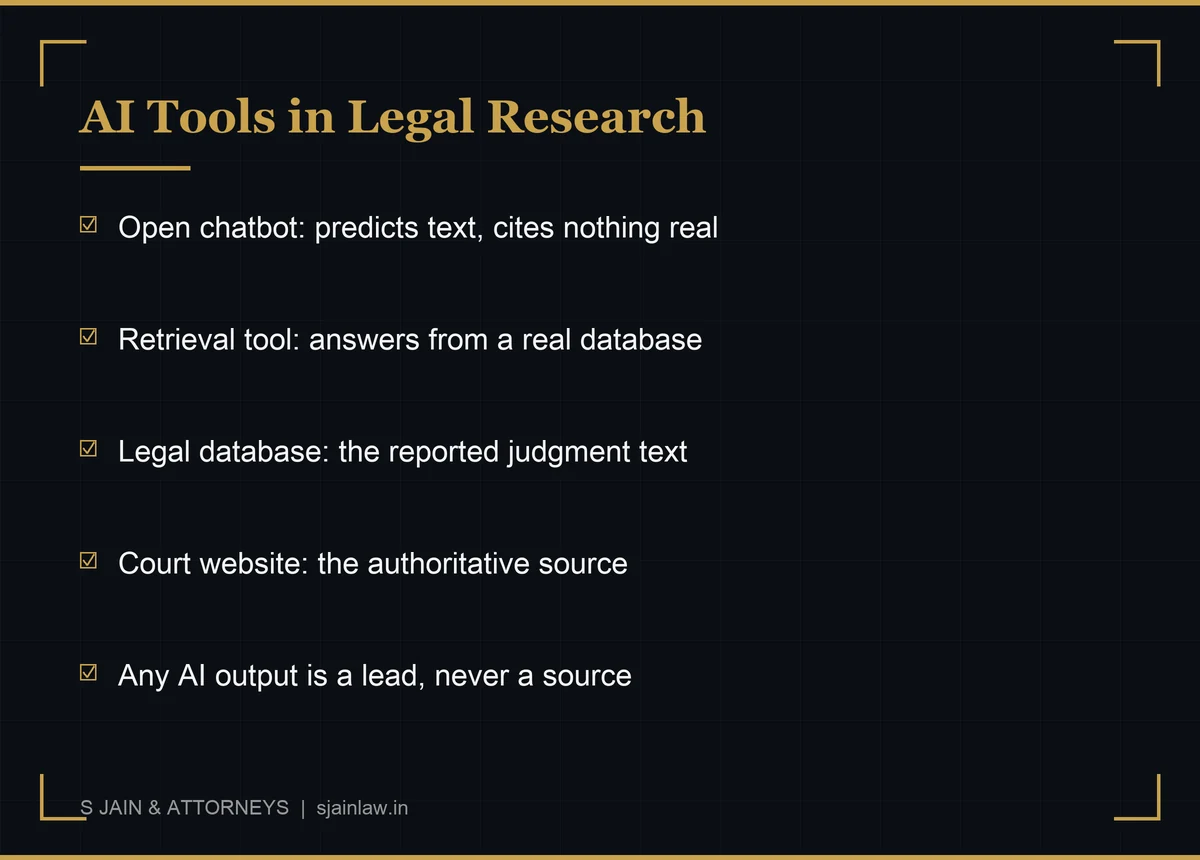
A retrieval tool that cites a real database is a genuinely different animal from an open-ended chatbot, because there is a document behind the answer that you can open. It is still not a substitute for opening it. The correct mental model, and the one the Supreme Court's reasoning assumes, is that AI output is a lead, not a source. A lead tells you where to look. A source is what you cite.
The Professional Duties Engaged
An advocate in India owes a set of duties to the court that sit at the top of the professional hierarchy, above duties to the client. They are codified in the Standards of Professional Conduct and Etiquette framed by the Bar Council of India under Section 49(1)(c) of the Advocates Act, 1961, in Chapter II of Part VI of the Bar Council of India Rules. Section I of that Chapter is headed "Duty to the Court". It requires an advocate to conduct himself with dignity and self-respect towards the court, to maintain a respectful attitude to the dignity of the judicial office, to refuse to act in an illegal or improper manner towards the opposing party, to restrain the client from unfair practices, and to refuse to represent a client who insists on such a course. Running through all of it is the premise the whole adversarial system depends on: the court can trust what counsel tells it.
A fabricated citation attacks that premise directly. The judge has no independent research department checking every authority in every list; the system is built on the assumption that when an advocate says a case says something, it does. That is why the Supreme Court classified the conduct as misconduct rather than error. Professional misconduct is dealt with under Section 35 of the Advocates Act, 1961, under which a State Bar Council refers the complaint to its disciplinary committee, which can reprimand, suspend for a period, or remove the advocate's name from the roll. Nothing in that section requires proof of dishonesty. Carelessness that misleads the court is enough to engage it, which is the entire point of the July 2026 warning.
There is a second exposure. If a fabricated citation is discovered mid-hearing, the immediate casualty is not the advocate's certificate of practice. It is the client's credibility on every other point in the case.
Key takeaway: the standard is not "did you intend to mislead the court". It is "did you verify before you cited". Good faith reliance on a machine is not a defence, because the machine is not the one with a duty to the court.
A Verification Protocol for Every Citation You File
This is the part worth keeping. The protocol below takes a couple of minutes per authority and it eliminates the entire category of risk.
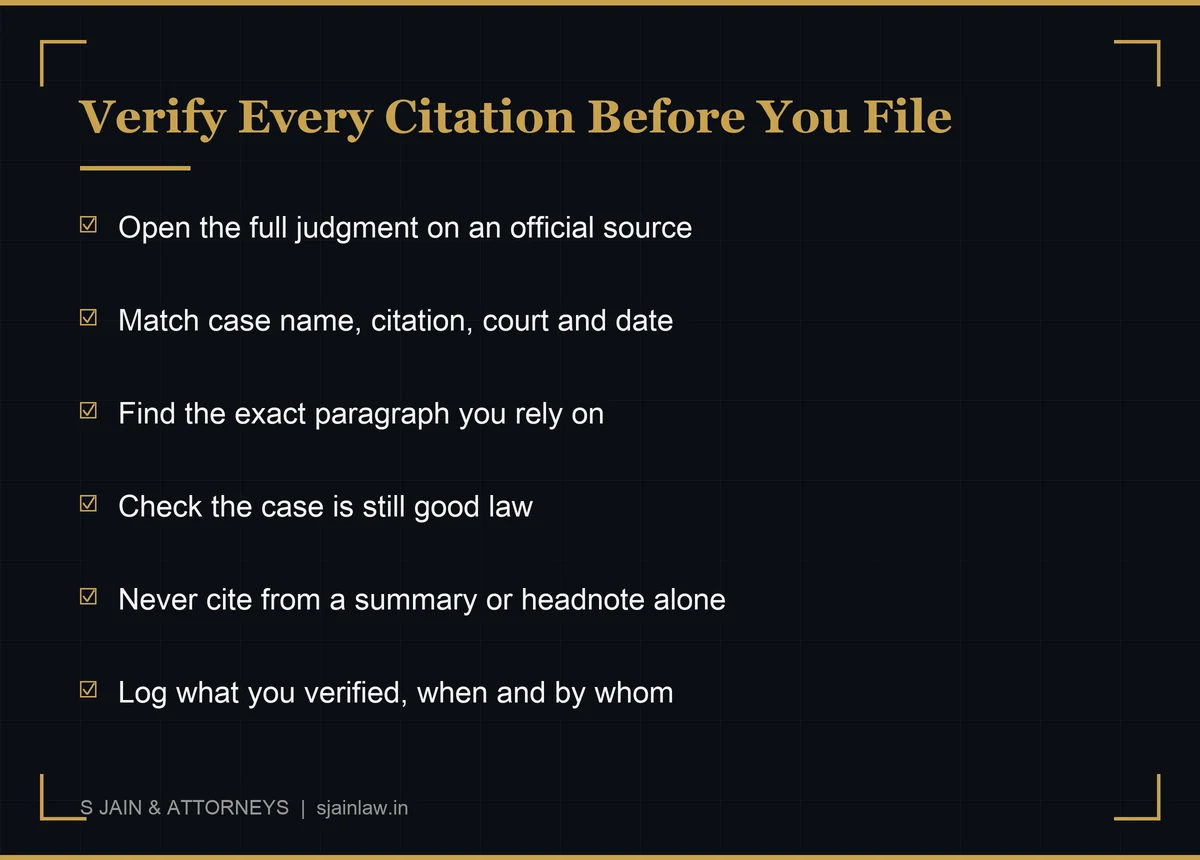
- Open the actual judgment. Not a summary, not a headnote, not a snippet in a search result, and never the AI's own restatement. Go to the court's official site, the eSCR portal, or a subscribed reporter and open the full text.
- Match three things independently: the case name, the citation (volume, reporter, page) and the court and date. A hallucination frequently gets one of the three right and the rest wrong, which is exactly why matching only the name is not enough.
- Find the paragraph. If you are relying on a proposition, locate the paragraph number in the judgment you have opened and read the sentences on either side of it. Extracts that have been truncated or subtly reworded are the hardest hallucinations to catch, and the paragraph check catches them.
- Check whether the case is still good law. Run the citator or note-up function. A real judgment that has been overruled, distinguished into irrelevance, or superseded by statute is a different kind of trap, and no AI tool will reliably warn you.
- Confirm the proposition is actually in it. A judgment can exist, be good law, contain your paragraph number, and still not say what you are about to tell the court it says. Read it.
- Record what you verified. Note the database, the date checked and the initials of the person who checked, in the file or the brief note. If the question is ever asked, an evidenced verification trail is your answer.
Common mistake: asking the same AI tool to confirm that its own citations are real. That is what counsel did in Mata v Avianca, and the model obligingly confirmed cases that did not exist. Verification must come from a different system, one that holds actual documents.
I build legal software myself, and I use these tools every working day, so let me be candid about where the line falls. They are genuinely good at some things: compressing a two-hundred-page order into an issues list, drafting the boring scaffolding of a rejoinder, translating a client's WhatsApp narrative into a chronology, spotting an argument you had not framed. They are useless, and worse than useless, as a source of authority. What I tell juniors in our office is that the tool is allowed to tell you where to look and is never allowed to tell you what the law is. The signature at the foot of the pleading is a human being's, the duty to the court attaches to that human being, and no amount of sophistication in the software transfers it. The day a machine can be held in contempt is the day this changes, and that day is not close.
What Law Firms Should Do Now
The Bar Council of India will frame norms. Firms should not wait for them. Four things are worth putting in place this quarter:
- A written internal AI policy. Name the tools that may be used and for what. Prohibit pasting privileged or client-identifying material into consumer chatbots. State explicitly that no citation may enter a draft that has not been opened in a database by a named person.
- Disclosure norms inside the file. If AI assisted a draft, say so in the internal note, not to shame anyone but so the reviewer knows which parts need a harder look. Some foreign courts now require certification of AI use in filings; Indian practice may head the same way.
- Supervision of juniors, taken seriously. The Ayinde judgment is a warning about training and supervision as much as about technology, and the court there said it would ask in future whether leadership responsibilities had been met. A pupil left to run a practice unsupervised is a firm risk, not just a personal one.
- Record-keeping. A one-line verification log against each authority in the list of dates costs nothing and is the only evidence you will have if a citation is ever challenged.
Data handling deserves its own line. Pasting a client's dispute into a public chatbot is a confidentiality question before it is an accuracy question, and for firms handling personal data it is now also a statutory one. Our guide to the Digital Personal Data Protection Act and what compliance requires of businesses sets out the obligations that follow.
What Clients Should Know
If you are a litigant rather than a lawyer, the risk here is yours as much as your counsel's. A fabricated citation in your pleading does not merely embarrass the advocate. It can get your petition dismissed as withdrawn, as happened in the Delhi High Court in 2025. It can attract costs against you, as happened in the Bombay High Court in 2026. And the Supreme Court has now held that a decision resting on such material is no decision at all, which means the order you spent two years obtaining can be set aside and the whole exercise repeated, with everything that implies for time and money.
You are entitled to ask your lawyer a direct question: are the authorities in my case verified, and against what source? A competent advocate will not be offended. If a matter is heading to a tribunal such as the NCLT, where much of this has surfaced, the point is worth raising at the drafting stage rather than in the hearing; our guide to oppression and mismanagement proceedings before the NCLT explains how those files are built. For contested matters generally, our civil litigation practice page sets out how we approach evidence and authority.
Where This Is Heading
Three developments are worth tracking through the rest of 2026. The Bar Council of India committee will produce guiding principles and a disciplinary framework, and those norms will bind every advocate on the roll. The Gummadi Usha Rani proceedings continue with an amicus appointed and the law officers on notice, which suggests the Supreme Court intends to lay down something systemic rather than case-specific. And courts and tribunals will increasingly build verification into their own processes, since in the Essel Infraprojects matter the fabrications entered at the adjudicating end rather than through counsel.
The broader point is that Indian law is being asked, repeatedly and in different contexts, to decide who answers for what a machine produces. The same question sits behind synthetic media and impersonation, which we have covered in our guide to personality rights and deepfakes in India. The answer the Supreme Court gave on 2 July 2026 is a good one, and it is unglamorous: the human being who puts the material before the court answers for it.
Related guides and where to get help
- Builder in Insolvency? Homebuyer Rights After the Supreme Court's Mantri Ruling (2026)
- Money Recovery Suit in India: Procedure, Limitation and Court Fees
- How to File a Writ Petition in High Court: Grounds & Procedure
Frequently Asked Questions
What is AI hallucinated case law?
It is a citation, quotation or paragraph of a judgment produced by a generative AI tool that does not exist. It can be an entirely invented case name and reporter citation, or a real case made to carry words no judge wrote, or a real proposition attached to the wrong case title.
Which Supreme Court judgment dealt with this in 2026?
Pooja Ramesh Singh v Jammu and Kashmir Bank Ltd, 2026 INSC 668, decided on 2 July 2026 by Justices P.S. Narasimha and Alok Aradhe. It arose from the Essel Infraprojects insolvency matter and set aside the NCLT and NCLAT orders.
Is citing a fake AI-generated case misconduct in India?
Yes. The Supreme Court held that it is misconduct on the part of an advocate to cite such judgments without verification. Professional misconduct is dealt with by the disciplinary committees of the Bar Councils under Section 35 of the Advocates Act, 1961, and the Court has directed the Bar Council of India to frame norms and penalties.
Does one fabricated citation really invalidate an entire order?
On the Supreme Court's reasoning, yes. A decision resting on fake and hallucinated material is no decision in the eyes of the law, whether that material had a direct or an indirect bearing on the result. There is no argument that the rest of the reasoning can be saved.
Why do AI tools invent case citations?
A large language model predicts the most plausible next words rather than looking anything up. It has learned the shape of a legal citation, so it can generate one that looks correct in every respect while corresponding to no real judgment. It has no internal way of knowing that it does not know.
Can I use AI for legal research at all?
Yes, with discipline. Use it to explain concepts, structure a draft, summarise a document you have supplied, or generate candidate lines of inquiry. Treat every output as an unverified lead. Retrieval tools that search a real judgment database and give you links are a better starting point than an open-ended chatbot, but you still open the judgment before you cite it.
How do I verify a citation properly?
Open the full text on an official or subscribed source, match the case name, the citation and the court and date independently of one another, locate the paragraph you are relying on and read around it, run a citator check to see whether the case is still good law, and record what you checked and when.
What happens to my case if my lawyer files a fabricated citation?
Consequences seen in Indian courts include the petition being dismissed as withdrawn, costs imposed on the party, and, after the July 2026 ruling, orders being set aside as no decision at all. Your credibility on every other point in the case also suffers.
Have foreign courts sanctioned lawyers for this?
Yes. In Mata v Avianca Inc (SDNY, 22 June 2023) two attorneys and their firm were sanctioned USD 5,000 for filing a brief with fabricated ChatGPT citations. In Ayinde v Haringey and Al-Haroun v Qatar National Bank, [2025] EWHC 1383 (Admin), an English Divisional Court set out powers ranging from wasted costs and regulatory referral to contempt and, in the worst cases, referral to the police for perverting the course of justice.
Should a law firm have a written AI policy?
Yes. It should name the permitted tools and permitted uses, prohibit putting confidential client material into public chatbots, require that every citation be opened in a database by a named person before filing, and require a short verification record on the file.
This article is general legal information, not legal advice, and does not create a lawyer-client relationship. It reflects reported accounts of the judgments discussed as at 29 July 2026; readers should consult the certified text of any judgment before relying on it. For advice on a specific matter, consult a qualified advocate.