Execution of decree is the stage where a court victory is converted into money, and it is the stage most litigants underestimate. The judgment-debtor who contested your suit for five years does not reach for his chequebook because a decree has been passed; he appeals, he pleads poverty, he moves assets, he obstructs. The Privy Council's century-old lament that the difficulties of a litigant in India begin when he has obtained a decree is still quoted by the Supreme Court because it is still true. The machinery that answers it is Order 21 of the Code of Civil Procedure, 1908 (CPC), the longest order in the Code, backed by Sections 36 to 74. Used well, it can attach bank accounts, sell property, freeze receivables and, in a narrow class of cases, send a defaulter to civil prison. This guide covers the whole toolkit for the decree holder, and the traps that waste years.
Part of the money recovery practice at S Jain & Attorneys, Bangalore.
Winning Is Half the Battle: The Gap Between Decree and Money
A money decree is a declaration of liability, not a payment. Nothing happens automatically after it is passed: no attachment, no notice to the debtor's bank, no recovery officer knocking on his door. Unless the judgment-debtor pays voluntarily, the decree-holder must file an execution petition and drive it, mode by mode, against identified assets. This is why experienced counsel plan execution before the suit is filed: a suit against a defendant with no traceable assets wins a decree and recovers nothing, while a suit planned with attachment before judgment and asset disclosure in mind recovers even against a reluctant payer. If your matter is still at the pre-suit stage, start with our guides on the money recovery suit and the fast-track summary suit under Order 37 CPC.
The Legal Framework: Sections 36 to 74 and Order 21 CPC
The skeleton of execution law is short. Section 36 CPC applies the rules for decrees to orders as well. Section 37 defines the court which passed the decree. Section 38 states the core rule: a decree may be executed either by the court which passed it or by the court to which it is sent for execution. Section 39 permits transfer of the decree to another court, typically where the judgment-debtor resides, works or owns property. Section 51 lists the modes of execution, and Sections 55 to 59 govern arrest and detention. Order 21, with over a hundred rules, supplies the procedure: the application (Rules 10 to 14), attachment (Rules 41 to 57), sale (Rules 64 to 96) and the adjudication of objections (Rules 97 to 106). The execution application itself is a written, tabular application under Order 21 Rule 11(2), stating the decree, the amount due with interest, the relief sought and, critically, the mode of assistance you want from the court.
Where to File the Execution Petition
File before the court which passed the decree. If the judgment-debtor and his assets are elsewhere, apply under Sections 38 and 39 to transfer the decree to the court within whose jurisdiction he resides or the property lies; that transferee court then executes it with the same powers. Transfer is discretionary but routine where assets are shown to be outside the decreeing court's limits. Decrees of foreign courts from reciprocating territories can also be executed in India under Section 44A CPC as if passed by the local district court.
Modes of Execution: The Menu Under Section 51
Section 51 lets the court enforce a decree by delivery of property, by attachment and sale (or sale without attachment), by arrest and detention, by appointing a receiver, or in such other manner as the relief requires. Choosing the right mode against the right asset is the whole craft:
| Mode | Provision | Best used against | Watch out for |
|---|---|---|---|
| Attachment and sale of movables | S. 51(b); O. 21 R. 43 | Vehicles, stock-in-trade, machinery, fixed deposits | Seizure logistics; exempt items under S. 60 |
| Attachment and sale of immovables | S. 51(b); O. 21 RR. 54, 64 to 66 | Land, flats, commercial property | Objections, proclamation formalities, auction delays |
| Garnishee order | O. 21 RR. 46, 46A | Bank accounts, rent, trade receivables, debts owed to the debtor | Must identify the garnishee (bank/branch or debtor's debtor) |
| Arrest and civil prison | S. 51(c) proviso; SS. 55 to 59; O. 21 R. 37 | Defaulters with means who refuse or divert assets | Jolly George Varghese limits; caps in S. 58; no arrest of women (S. 56) |
| Appointment of receiver | S. 51(d); O. 40 | Rent-yielding property, running businesses | Receiver costs eat into recovery; court supervision |
| Delivery of possession | O. 21 RR. 35, 36 | Decrees for possession of property | Resistance proceedings under RR. 97 to 101 |
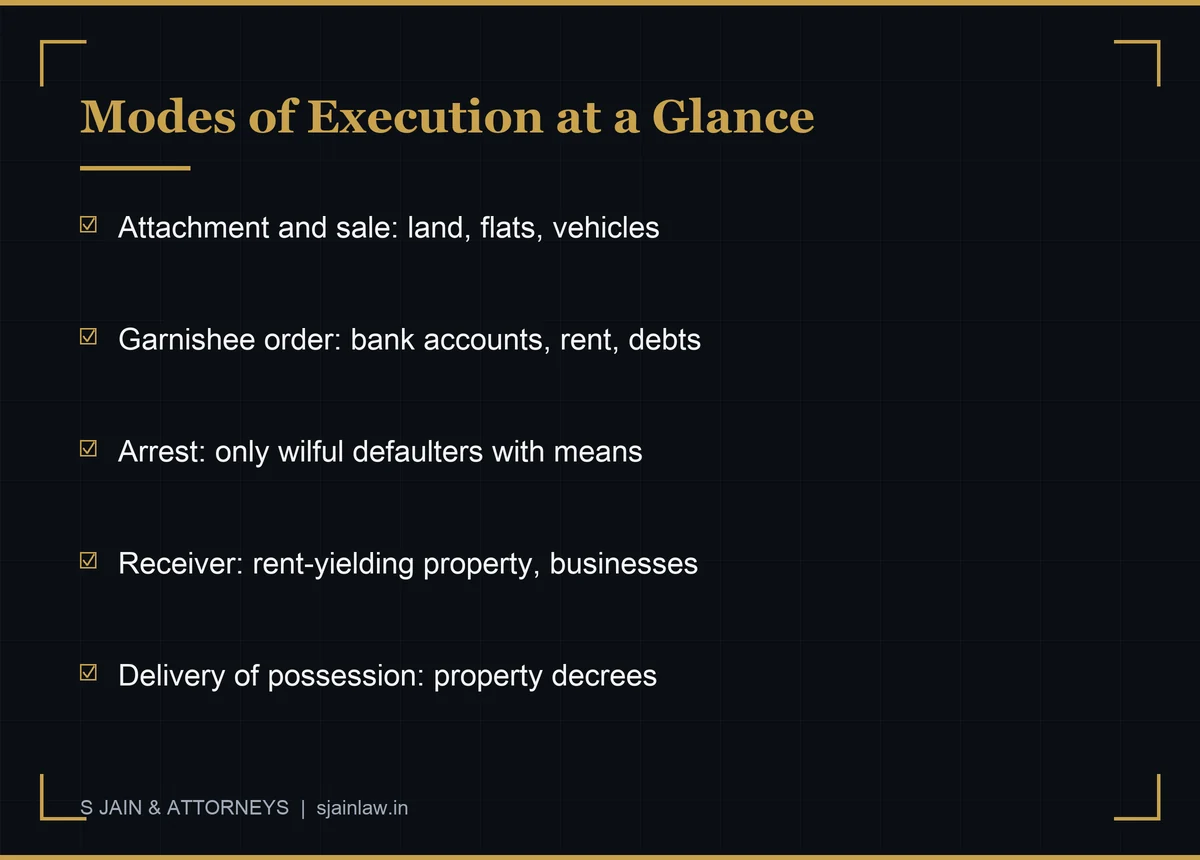
Multiple modes can be pursued in the same execution petition, and pressing two at once, say a bank attachment plus a show-cause notice for arrest, is often what produces a settlement cheque.
Attachment of Property: What You Cannot Touch
Section 60 CPC declares what is attachable, land, houses, money, bank notes, cheques, securities, debts and shares among them, and then lists the exemptions that protect the debtor's survival. The highlights every decree-holder should know before wasting an application:
- Necessaries: necessary wearing apparel, cooking vessels, beds and bedding of the debtor, his wife and children.
- Tools and livelihood: tools of artisans; for an agriculturist, implements of husbandry, cattle and seed; houses of agriculturists, labourers and domestic servants.
- Salary: the first Rs 1,000 and two-thirds of the remainder of salary are exempt from attachment in execution of ordinary money decrees.
- Retirement money: government pensions and gratuities, and compulsory provident fund deposits.
- Insurance and maintenance: life insurance policy proceeds, and a right to future maintenance.
Attachment of immovable property under Order 21 Rule 54 is by a prohibitory order restraining transfer, registered against the property; sale follows under Rules 64 to 66 with a proclamation and public auction. Court auctions are slow and prices are depressed, which is why attachment often functions best as pressure toward a negotiated payment rather than as a route to an actual sale.
Garnishee Orders: Going Straight for the Bank Account
The most efficient weapon against a solvent debtor is the garnishee proceeding under Order 21 Rule 46 and Rule 46A. A debt owed to the judgment-debtor by a third party (the garnishee) is attached by a prohibitory order, and the garnishee can then be directed to deposit the money into court. In practice this means freezing bank accounts, intercepting rent from tenants, and catching trade receivables from the debtor's customers. The order operates from service on the garnishee, which gives it an element of surprise that attachment of immovable property never has. The prerequisite is information: you must name the bank and branch, the tenant, or the paying customer. That is what the examination and disclosure tools below are for.
Arrest and Civil Prison: The Jolly George Varghese Limit
Arrest in execution under Section 51(c) is real but narrow. The proviso to Section 51 requires a show-cause opportunity and written reasons, and detention can be ordered only where the debtor is likely to abscond or obstruct, has dishonestly transferred or concealed property, or has, or has had since the decree, the means to pay and refuses or neglects to pay. In Jolly George Varghese v. Bank of Cochin, AIR 1980 SC 470, Justice Krishna Iyer read this with Article 21 of the Constitution and Article 11 of the International Covenant on Civil and Political Rights: simple default is not enough; poverty is not a crime, and only wilful refusal despite present means, or bad-faith conduct, justifies prison. The statutory caps in Section 58 are modest: up to three months where the decree exceeds Rs 5,000, up to six weeks between Rs 2,000 and Rs 5,000, and no detention at all for decrees of Rs 2,000 or less. Section 56 bars the arrest of women in execution of money decrees altogether, and detention does not extinguish the debt.
Key takeaway: treat the arrest application as a truth machine, not a punishment. Its practical value is the show-cause notice under Order 21 Rule 37, which drags the debtor into court to explain his means on oath. Debtors who plead poverty while running two cars tend to settle at exactly this stage.
Making the Debtor Show His Cards: Order 21 Rule 41
Where a money decree remains unsatisfied, Order 21 Rule 41 lets the court orally examine the judgment-debtor about his assets: bank accounts, debts owed to him, property and income. Under Rule 41(2), the court can order him to file an affidavit of assets, and disobedience is punishable with detention of up to three months under Rule 41(3). The Supreme Court has pushed this further: in Rahul S. Shah v. Jinendra Kumar Gandhi, (2021) 6 SCC 418, it directed that in money suits courts should require the defendant to disclose assets on oath even before execution, and may demand security. Use these tools first; every later mode depends on the asset map they produce.
Obstruction and Objections: Rules 97 to 101 and Section 47
Execution attracts objectors: the debtor's brother claims the attached flat, a tenant refuses to vacate, a stranger surfaces with an unregistered agreement. The Code channels all of it into the executing court. Section 47 requires all questions between the parties relating to execution, discharge or satisfaction of the decree to be decided in execution, not by a separate suit. For resistance to possession, Order 21 Rules 97 to 101 create a complete machinery: the decree-holder complains of resistance (Rule 97), the court adjudicates all questions of right, title and interest arising between the parties (Rule 101), and its determination has the force of a decree (Rule 103). A genuine third party dispossessed can likewise apply under Rule 99. The design is deliberate: no parallel suits, no fresh rounds of litigation, one forum. In Rahul S. Shah, the Supreme Court reinforced this by directing executing courts to refuse a fresh trial of settled issues and to penalise frivolous objections filed only to stall.
Limitation: The 12-Year Window
Under Article 136 of the Limitation Act, 1963, an execution petition may be filed within 12 years from the date the decree becomes enforceable. A decree for a perpetual injunction carries no limitation for enforcement, while a decree for a mandatory injunction must be executed within three years under Article 135. Twelve years sounds generous; in recovery practice it is a trap, because the assets you could have attached in year one are usually gone by year six. The working rule is simple: file the execution petition within weeks of the decree, not years, and pair it with an asset examination immediately.
Executing Arbitral Awards and Cheque Bounce Compensation
Two money remedies from outside the civil suit funnel into the same machinery. An arbitral award is enforced under Section 36 of the Arbitration and Conciliation Act, 1996 in the same manner as a decree once the challenge window closes; in Sundaram Finance Ltd. v. Abdul Samad (Supreme Court, 15 February 2018), the Supreme Court held that the award-holder can file execution directly in any court where the debtor's assets are located, without first obtaining a transfer of the decree. Whether and how an award can be challenged first is covered in our guide on setting aside an arbitral award under Section 34. In cheque bounce cases, the fine or compensation ordered by the criminal court is recovered through the criminal machinery: Section 461 of the BNSS (the old Section 421 CrPC) allows a warrant for levy by attachment and sale of the offender's movables, or a warrant to the District Collector to realise the amount as arrears of land revenue from movable or immovable property, alongside any default imprisonment. The full route from dishonour to recovery is mapped in our guide on the Section 138 cheque bounce procedure.
Execution Against the Government
Decrees against the Union or a State are executable, with one statutory pause: under Section 82 CPC, execution cannot issue unless the decree remains unsatisfied for three months from its date, a window designed to let the government make budgetary provision and pay. In practice, a certified copy served on the department with a reminder citing Section 82 resolves most government decrees; where it does not, execution follows the ordinary course, and contempt or writ remedies add pressure in appropriate cases.
How Long Does Execution of a Decree Take? The Six-Month Mandate
Execution has historically been the slowest stage of Indian civil litigation, with proceedings outliving the suits that produced them. The Supreme Court confronted this in Rahul S. Shah v. Jinendra Kumar Gandhi (22 April 2021), a case arising from Bengaluru property decrees mired in repeated obstruction, and issued binding directions to all civil courts. The headline direction: the executing court must dispose of the execution proceedings within six months from filing, extendable only by recording written reasons. The Court also directed courts to examine parties on third-party interests, use commissioners to inspect property, take evidence in execution only exceptionally, and impose costs for spurious objections.
Deadline warning: the six-month direction is a judicial target, not a guarantee; contested executions with property sales still commonly run one to three years. What the directive gives you is leverage: cite it, seek time-bound orders, and oppose adjournments on its strength. These timelines are indicative and vary by court and by how contested the assets are.
Asset Tracing and the Mistakes Decree-Holders Make
Execution succeeds on information. Practical sources that consistently produce attachable assets: the cheques and account details from your own past dealings with the debtor; the encumbrance certificate and sub-registrar records for property in his name; the MCA master data for his directorships and charges; GST registration details for his trade name and principal place of business; the VAHAN database for vehicles; and his employer, who becomes the garnishee for the attachable slice of salary. The Rule 41 examination then converts suspicion into sworn admissions.
In my practice, the difference between executions that pay and executions that rot is almost always homework done in the first thirty days. The decree-holders who recover are the ones who arrive with the debtor's bank branch, one property survey number and a tenant's name, and ask for a garnishee order and a Rule 41 affidavit on the first date. The ones who struggle file a bare petition that says "attach whatever the debtor owns", wait for the court to conjure assets, and give the debtor two years to move everything to his wife's name. I also tell clients not to sneer at part-payment offers made under attachment pressure: a negotiated 80 per cent this year nearly always beats a theoretical 100 per cent after a court auction in year four. If the decree is large or the debtor sophisticated, involve a civil litigation team at the execution stage itself; this half of the battle has its own tactics.

The recurring mistakes, in one list: filing the execution petition years after the decree; not claiming interest and costs precisely in the tabular application; choosing attachment of a disputed flat over a clean bank garnishee; attaching exempt property and losing months to objections; ignoring the transferee-court route when assets sit in another district; letting the petition be dismissed for non-prosecution; and settling in a corridor without recording the compromise in the execution court, which leaves the decree half-satisfied on paper and unenforceable in fact.
Related guides and where to get help
- Money Recovery Suit in India: Procedure, Limitation and Court Fees
- Order 37 CPC Summary Suit: A Faster Route to Recover Money
- How to Recover Money From Online Fraud in India
Frequently Asked Questions
What is execution of a decree?
It is the judicial process under Sections 36 to 74 and Order 21 CPC by which the decree-holder compels the judgment-debtor to comply with a decree, by attachment and sale of property, garnishee orders, delivery of possession, appointment of a receiver or, in narrow cases, arrest.
Where is an execution petition filed?
Before the court which passed the decree under Section 38 CPC, or before the court to which the decree is transferred under Section 39, usually the court where the judgment-debtor resides or his property is situated.
What is the limitation period for executing a decree?
Twelve years from the date the decree becomes enforceable, under Article 136 of the Limitation Act, 1963. Decrees for perpetual injunctions have no limitation; mandatory injunction decrees must be executed within three years.
Can a judgment-debtor be arrested for not paying?
Only within strict limits. Under Section 51 and Jolly George Varghese v. Bank of Cochin (1980), arrest requires present means to pay with wilful refusal, or dishonest conduct such as concealing assets. Detention is capped at three months, is unavailable for decrees of Rs 2,000 or less, and women cannot be arrested for money decrees at all.
Which properties cannot be attached?
Section 60 CPC exempts necessities like clothing and cooking vessels, artisans' tools, agriculturists' implements and houses, the first Rs 1,000 of salary plus two-thirds of the remainder, government pensions, compulsory provident fund deposits and life insurance proceeds, among others.
What is a garnishee order?
An order under Order 21 Rules 46 and 46A attaching a debt that a third party owes the judgment-debtor, most commonly a bank balance, rent or trade receivable, and directing that third party to pay the money into court instead of to the debtor.
How long does execution actually take?
The Supreme Court in Rahul S. Shah (2021) directed disposal within six months of filing, extendable only for recorded reasons. Uncontested executions against known assets can finish within that window; contested ones involving property sales realistically take one to three years. These are indicative figures.
How is an arbitral award executed?
Under Section 36 of the Arbitration and Conciliation Act, 1996, an award is enforced like a decree once the Section 34 challenge window closes, and after Sundaram Finance v. Abdul Samad (2018) it can be filed for execution directly in any court where the debtor's assets are located.
This article is general legal information, not legal advice, and does not create a lawyer-client relationship. Execution strategy depends on the decree, the debtor and the assets. For advice on a specific recovery, consult a qualified advocate.