MACT Compensation Calculator: Multiplier Table, Formula and Worked Examples (2026)
By Advocate Sharan Jain·
When a family loses an earning member on the road, the law does not leave the compensation figure to guesswork. Motor accident compensation calculation in India follows a structured formula called the multiplier method, refined by the Supreme Court over two decades so that two tribunals looking at the same facts should reach roughly the same number. This guide explains that formula step by step, reproduces the tables courts actually use, works through a complete example, and gives you a MACT compensation calculator that runs the same steps on your own facts, so you can estimate a realistic MACT claim amount before you file. If you want the procedural side, where to file, against whom, and how the case moves, read our companion guide on motor accident compensation claims in India. This article is about one thing only: how the money is computed.
How motor accident compensation calculation works: the multiplier method
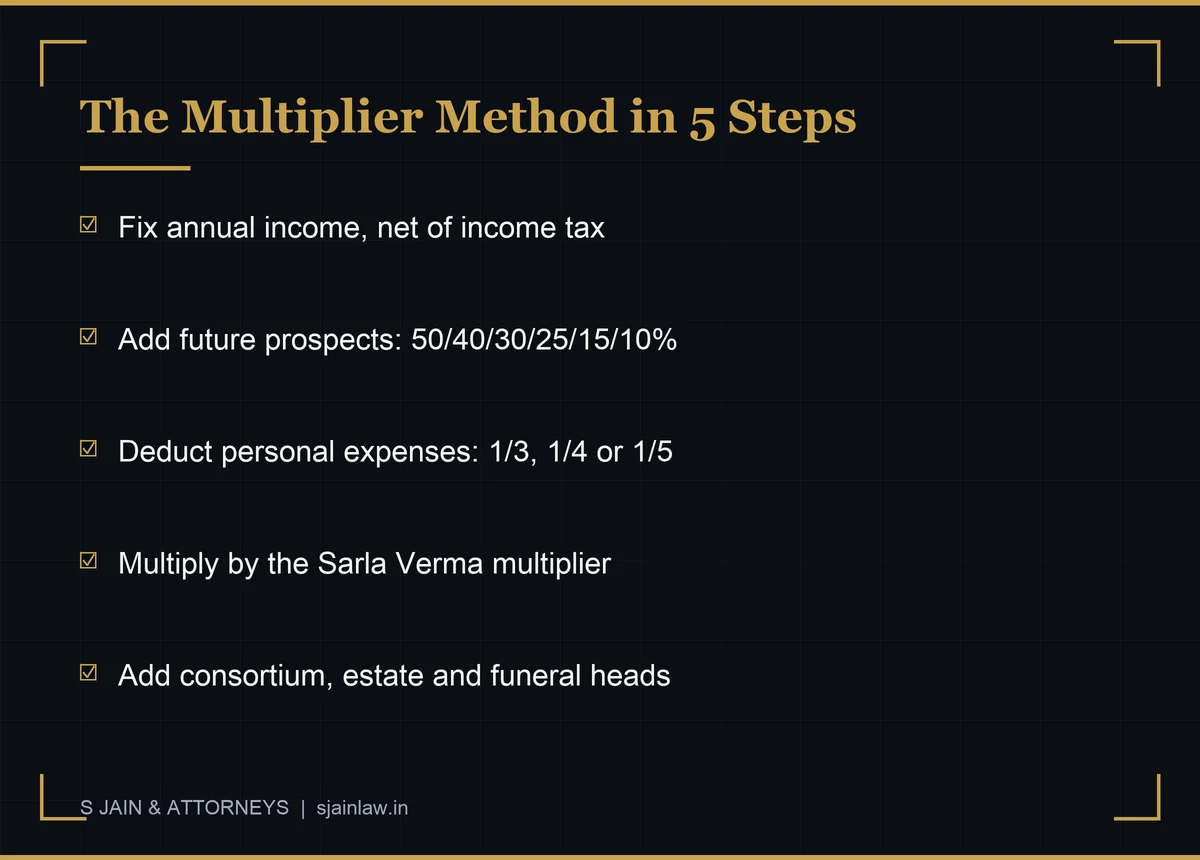
For a fatal accident claim under Section 166 of the Motor Vehicles Act, 1988, the core of the award is the loss of dependency: the income the family would have received from the deceased over a working lifetime, converted into a single present-day figure. In Sarla Verma v. Delhi Transport Corporation, (2009) 6 SCC 121, the Supreme Court standardised the computation into a fixed sequence, and the Constitution Bench in National Insurance Co. Ltd. v. Pranay Sethi, (2017) 16 SCC 680 settled the remaining disputes. The sequence is:
Fix the annual income of the deceased, net of income tax.
Add a percentage for future prospects, based on age and the nature of employment.
Deduct a fraction for the personal and living expenses of the deceased.
Multiply the result (the multiplicand) by the multiplier fixed for the deceased's age.
Add the conventional heads: consortium, loss of estate and funeral expenses.
Three inputs move the figure more than everything else combined:
Net income is the base
The computation starts from actual salary less income tax, proved by Form 16, salary slips or returns, never from a gross figure or a relative's estimate.
Future prospects are added
Pranay Sethi adds 50%, 30% or 15% for a permanent job and 40%, 25% or 10% for the self-employed, by age band, before any deduction is made.
Age fixes the multiplier
The Sarla Verma multiplier runs from 18 for a deceased aged 15 to 20 down to 5 at 66 to 70. The deceased's age governs, not the ages of the dependants.
Step 1: Fix the annual income of the deceased
Income is proved, not assumed. For a salaried person, tribunals rely on salary slips, Form 16, income tax returns and an employer's certificate. For the self-employed, income tax returns and bank statements matter most, and where returns exist they generally trump oral estimates. Pranay Sethi directs that the starting figure is the actual salary less income tax, so the computation runs on take-home income, not gross. Perks with real monetary value (employer PF contribution, bonus that is a regular term of employment) are usually added. Purely reimbursive allowances are not.
Step 2: Add future prospects (the Pranay Sethi percentages)
A person who dies at 35 was not going to earn the same salary until 60. The Pranay Sethi future prospects addition compensates for the lost career growth, and the Constitution Bench fixed the percentages so tribunals no longer improvise:
Age of deceased
Permanent job
Self-employed or fixed salary
Below 40 years
Add 50%
Add 40%
40 to 50 years
Add 30%
Add 25%
50 to 60 years
Add 15%
Add 10%
Two practical points. First, the addition applies to the established income, before any deduction for personal expenses. Second, in Kirti v. Oriental Insurance Co. Ltd., (2021) 2 SCC 166, a three-judge bench confirmed that future prospects apply even where the tribunal is working with notional income, because there is no principled distinction between proven and notional income for this purpose.
Step 3: Deduct personal and living expenses
The deceased would have spent part of the income on himself or herself, so Sarla Verma fixes standard deductions that turn on the number of dependent family members:
2 to 3 dependents: deduct one-third.
4 to 6 dependents: deduct one-fourth.
More than 6 dependents: deduct one-fifth.
Bachelor or unmarried deceased: deduct 50%, relaxed to one-third where the deceased was the mainstay of a large dependent family, for example a widowed mother and younger siblings.
Step 4: Apply the Sarla Verma multiplier table
The multiplier converts one year of dependency into a lifetime figure, discounted for the lump-sum payment and the uncertainties of life. The Sarla Verma multiplier table is fixed by the age of the deceased, not the age of the dependents, and Pranay Sethi reaffirmed it as the governing scale:
Age of deceased
Multiplier
15 to 20 years
18
21 to 25 years
18
26 to 30 years
17
31 to 35 years
16
36 to 40 years
15
41 to 45 years
14
46 to 50 years
13
51 to 55 years
11
56 to 60 years
9
61 to 65 years
7
66 to 70 years
5
Key takeaway. the multiplier is not negotiable and split multipliers are not permitted. If the deceased was 35, the multiplier is 16. Insurers sometimes argue for a lower multiplier keyed to the age of the parents or the widow. That argument is contrary to Sarla Verma and should be resisted in writing.
Notional income: homemakers, non-earners and students
A claim does not fail because the deceased earned no salary. Tribunals assign a notional income to homemakers, students and other non-earners, and the Supreme Court in Kirti put real force behind this. The Court valued a homemaker's services by reference to methods such as the minimum wage for skilled or unskilled work, the cost of replacing her services, or a share of the earning spouse's income, and it granted future prospects on that notional income as well. In Kirti itself, the deceased homemaker's notional income was pegged at Rs 5,547 per month with a 40% future prospects addition. The judgment is blunt that a homemaker's work has real economic value, and insurers who offer token figures for a deceased wife or mother are lowballing against settled law.
Conventional heads: consortium, loss of estate and funeral expenses (2026 figures)
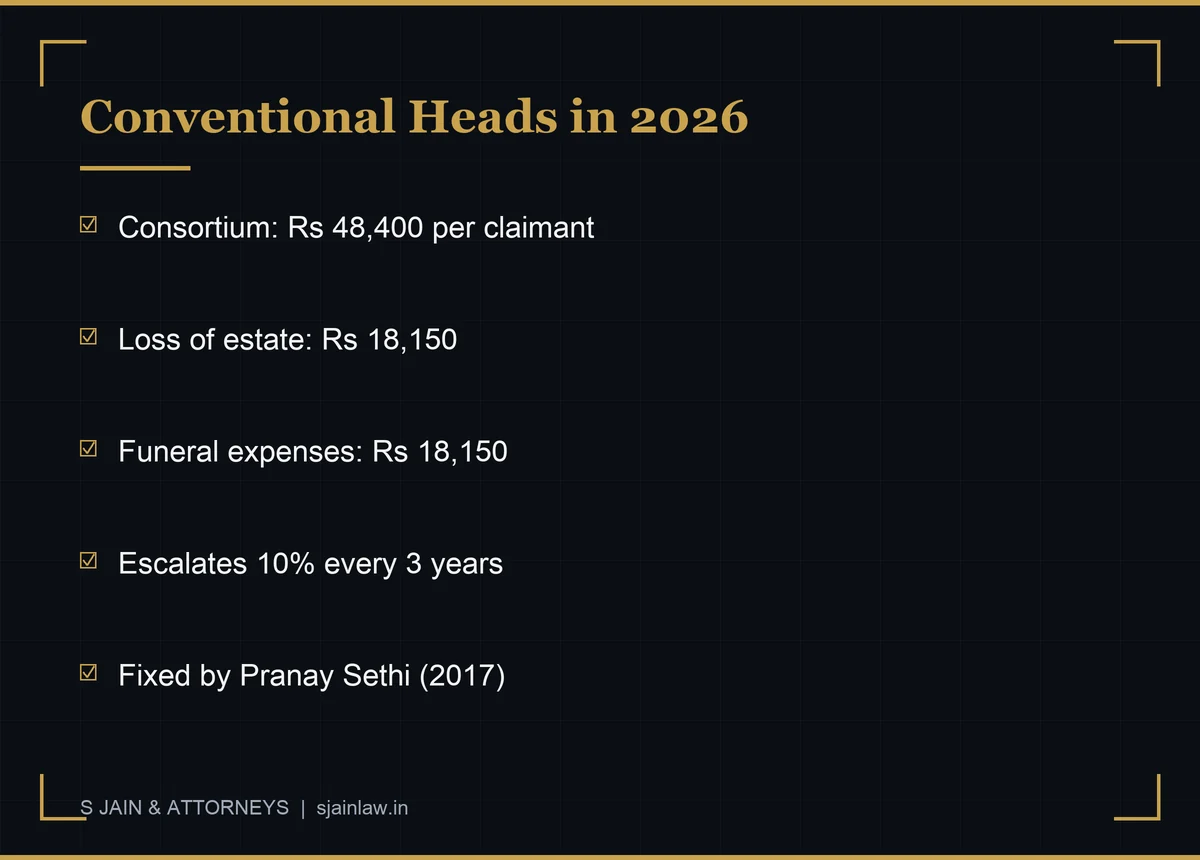
Pranay Sethi standardised three further heads: loss of estate at Rs 15,000, loss of consortium at Rs 40,000 and funeral expenses at Rs 15,000, and directed that these amounts be enhanced by 10% every three years. Counting from the judgment (October 2017), two rounds of escalation have accrued, in 2020 and 2023. The working figures in 2026 are therefore approximately Rs 18,150 for loss of estate, Rs 48,400 for consortium and Rs 18,150 for funeral expenses, with the next 10% revision falling due at the end of October 2026.
Consortium is not a single lump sum for the whole family. In United India Insurance Co. Ltd. v. Satinder Kaur (2020), the Supreme Court confirmed that each eligible claimant receives consortium separately: spousal consortium to the widow or widower, parental consortium to each child who loses a parent, and filial consortium to parents who lose a child. The Court also clarified that loss of love and affection is not a separate head. It is subsumed within consortium.
Worked example: 35-year-old salaried employee, Rs 50,000 per month, two dependents
Take a 35-year-old employee in a permanent job with a take-home salary of Rs 50,000 per month after tax, survived by a wife and one minor child (two dependents). The computation runs:
Step
Computation
Amount
Annual income
Rs 50,000 x 12
Rs 6,00,000
Future prospects
Add 50% (permanent job, below 40)
Rs 9,00,000
Personal expenses
Deduct one-third (2 to 3 dependents)
Rs 6,00,000 (multiplicand)
Loss of dependency
Rs 6,00,000 x multiplier 16 (age 31 to 35)
Rs 96,00,000
Consortium
Rs 48,400 to the wife + Rs 48,400 to the child
Rs 96,800
Loss of estate
Fixed head
Rs 18,150
Funeral expenses
Fixed head
Rs 18,150
Total award
Rs 97,33,100
Interest is added on top from the date the claim petition was filed. The same accident valued lazily, with no future prospects claimed, a 50% deduction wrongly applied and consortium paid once instead of per claimant, would come out 30 to 40 lakh lower. The formula only protects families whose lawyers actually plead every head.
Calculate your own claim: the fatal accident calculator
The worked example above uses one set of facts. The calculator below runs the same five steps on yours. Enter the age of the deceased, the monthly take-home income, the nature of employment and the dependants, and it applies the Pranay Sethi percentages, the Sarla Verma deduction and multiplier, and the 2026 conventional heads for each claimant entitled to consortium. The figure it produces is the Section 166 starting point before interest. It is not a promise of what a tribunal will award, and the section that follows explains why.
Calculator
Fatal accident claim under Section 166
Enter the facts as they will be proved on paper, not as the family remembers them. The figure is the multiplier-method starting point before interest.
This calculator applies the Supreme Court's multiplier method to the facts you enter. It is general legal information, not legal advice, and it is no substitute for an advocate reading the FIR, the income documents and the policy. A tribunal awards what the record proves, and the insurer will contest every input above.
What the tribunal will make you prove before it pays that figure
A calculator gives you the arithmetic. The tribunal gives you the money only if the record proves every input the arithmetic used. Section 168 directs the tribunal to award what it calls just compensation, and just compensation is built on evidence, not on assertion. Each row below is an input the tribunal will test, what usually satisfies it, and how claims lose lakhs on it.
What must be proved
What usually satisfies the tribunal
Where it goes wrong
Income of the deceased
Three years of income tax returns, Form 16, salary slips, bank statements and an employer's certificate. For the self-employed, returns and bank credits.
Nothing on record beyond a family member's word. The tribunal falls back on notional or minimum-wage income and the multiplicand collapses.
Age of the deceased
The post-mortem report, a school leaving certificate, Aadhaar, PAN or the driving licence, ideally two documents that agree.
Documents that disagree by a few years across an age band. The insurer argues for the lower multiplier, and one step on the table can be worth several lakhs.
Who the dependants are
A legal heir or family tree certificate, and evidence that each claimant actually depended on the deceased.
Married daughters, earning sons and parents with their own income are contested as dependants, which changes both the deduction fraction and the consortium count.
Negligence of the offending vehicle
The FIR, the charge sheet, the spot mahazar, the motor vehicle inspector's report and any eyewitness. The tribunal decides this on the balance of probabilities, not on the criminal standard.
Waiting for the criminal case to end. A slow prosecution does not stop the claim, and an acquittal in the criminal court does not end it either.
The vehicle, the driver and the policy
The registration, permit and insurance particulars of the offending vehicle and the driver's licence, taken from the police papers or from the owner, who is bound to give the driver's details under Section 133.
Only the driver is impleaded, or the wrong owner. An award against a person with no assets and no insurer behind him is a paper award.
Timing
A claim petition filed within six months of the accident under Section 166(3), for accidents on or after 1 April 2022.
The family waits for the insurer's surveyor or the charge sheet and the window closes.
Even with every proof in place, four things pull the award below the calculator's figure. Contributory negligence: riding without a helmet, three on a two-wheeler, wrong-side driving or an unlit vehicle at night usually produces a proportionate cut, and the insurer will plead it from the FIR itself. The deceased was driving the offending vehicle: where the deceased caused the accident there is ordinarily no Section 166 claim against that vehicle's own insurer, and the family is left with the personal accident cover under the policy rather than the multiplier figure. The vehicle was never traced: a hit and run claim runs under Section 161 and the Central scheme, which pays a fixed two lakh rupees for death and fifty thousand for grievous hurt, adjusted later if the vehicle is found and a full claim follows. Our answer on what happens in a hit and run case covers that route. Policy defences: no valid licence, the wrong class of licence, a goods vehicle carrying passengers, no permit, or driving under the influence rarely defeat the victim, but they shift the burden, and the tribunal may direct the insurer to pay and then recover from the owner, which is the difference between money in hand and a decree against a defaulter.
Common mistake. Signing the insurer's discharge voucher on the calculator's figure before the income documents are on file. The figure was computed on the papers available that day, the voucher is pleaded as a full and final settlement, and reopening it is a separate fight that starts from behind.
If you remember nothing else from this section, remember these three:
Prove income on paper
Returns, Form 16 and salary slips are the difference between the actual salary and a minimum-wage figure. Get the employer's certificate before the insurer's offer arrives.
Six months to file
For accidents on or after 1 April 2022, Section 166(3) bars a claim filed more than six months after the accident. The criminal case is no reason to wait.
Consortium per claimant
Satinder Kaur makes consortium payable separately to the spouse, to each child and to each parent. Claim it for every eligible person, not once for the family.
Injury claims: how non-fatal compensation is calculated
Where the victim survives, the award is built from different heads, laid out in Raj Kumar v. Ajay Kumar, (2011) 1 SCC 343. Pecuniary heads cover medical expenses, transport and attendant charges, loss of earnings during treatment, future medical expenses and loss of future earning capacity where a permanent disability remains. Non-pecuniary heads cover pain and suffering, loss of amenities, loss of marriage prospects and loss of expectation of life. The most litigated point is disability: Raj Kumar holds that the medical percentage of permanent disability is not automatically the percentage of loss of earning capacity. A 60% disability of the hand may destroy 100% of a driver's earning capacity and very little of a consultant's. The tribunal must assess the functional effect of the injury on the victim's actual occupation, and future prospects additions apply in serious injury cases too.
Interest on MACT awards
Tribunals ordinarily award interest from the date of filing of the claim petition until payment. Rates in practice range between 6% and 9% per annum, and the recent Supreme Court trend has settled around 7.5% to 8%, reflecting the compensatory character of the award. On a large award, an extra percentage point of interest over a four-year trial is a substantial sum, so the interest prayer is worth arguing rather than conceding.
Section 166 fault route vs Section 164 no-fault route
Feature
Section 166 (fault-based)
Section 164 (no-fault)
What must be proved
Negligence of the offending vehicle
Only death or grievous hurt in the accident
Amount
Full compensation on the multiplier method
Fixed: Rs 5,00,000 for death, Rs 2,50,000 for grievous hurt
When it makes sense
Earning deceased, provable negligence
Quick relief, weak evidence of fault
The 2019 amendment replaced the old structured-formula route with Section 164, a no-fault claim where the claimant need not plead negligence at all in exchange for a fixed sum. A family cannot recover twice over for the same death, so the practical choice is between speed and full value. For an earning deceased, the Section 166 route computed above is almost always worth several times the fixed amount.
The six-month deadline: Section 166(3)
For decades there was no limitation period for a motor accident claim. The Motor Vehicles (Amendment) Act, 2019 changed that: Section 166(3) now provides that no application for compensation shall be entertained unless it is made within six months of the accident. The provision was brought into force on 1 April 2022, so it governs accidents after that date. A constitutional challenge to the six-month bar is pending, and the Supreme Court issued notice on the writ petition in April 2024, but until it is decided the safe course is to treat the deadline as absolute.
Deadline warning. for accidents on or after 1 April 2022, file the claim petition within six months. Families often wait for the criminal case or the insurance surveyor. That wait can now cost the entire claim.
Documents and evidence that decide the MACT claim amount
The quantum turns on paper. Collect and preserve: the FIR (in a fatal road accident, typically under Sections 106(1) and 281 of the Bharatiya Nyaya Sanhita, 2023, for causing death by negligence and rash driving), the charge sheet, spot and vehicle inspection reports (the motor vehicle inspector's report), the post-mortem report, death certificate, and legal-heir or family-tree certificate. On income: three years of income tax returns, Form 16, salary slips, bank statements and an employer certificate. In injury cases: the disability certificate, complete medical records, every bill, and proof of attendant care and lost leave. The offending vehicle's insurance policy, permit and the driver's licence records matter because they decide who ultimately pays.
Common mistakes that shrink the award
Not claiming future prospects, or accepting an insurer computation that quietly omits them.
Accepting a token notional income for a homemaker or student instead of arguing Kirti.
Consortium claimed once for the family instead of separately for each claimant under Satinder Kaur.
Underproving income: no ITRs on record, so the tribunal falls back on minimum wage figures.
Missing the six-month window under Section 166(3) while the criminal case crawls.
Settling with the insurer early for a lump sum far below the formula value.
In my practice, the cases that lose lakhs are rarely lost on law. They are lost on records. I have seen a widow's claim computed on minimum wage because nobody obtained the deceased's Form 16 from his employer, and an insurer's "full and final" offer at barely a third of the Sarla Verma figure signed in grief. My standing advice to families is simple: before you sign anything from an insurance company, have a lawyer run this exact computation on one sheet of paper. It takes twenty minutes and it changes the negotiation completely. Our civil litigation team handles MACT claims on precisely this method, and if the insurer has wrongly repudiated a connected policy claim, see our guide on what to do when an insurance claim is rejected.
Related guides and where to get help
If this is a live problem rather than background reading, our civil litigation practice handles these matters from Bengaluru, including for clients who cannot attend court in person. These guides go deeper on the neighbouring questions:
What is the multiplier method in a motor accident claim?
It is the Supreme Court's standard formula for fatal claims: annual income net of tax, plus future prospects, minus personal expenses, multiplied by an age-based multiplier from Sarla Verma, plus fixed conventional heads.
What multiplier applies if the deceased was 35 years old?
The multiplier is 16, which applies to the 31 to 35 age band. The deceased's age governs, not the age of the dependents.
What are future prospects under Pranay Sethi?
A fixed percentage added to established income for lost career growth: 50% below 40, 30% between 40 and 50, and 15% between 50 and 60 for permanent employees, and 40%, 25% and 10% for the self-employed or those on a fixed salary.
How is compensation calculated for a homemaker?
Through notional income. Kirti v. Oriental Insurance (2021) requires tribunals to value household work realistically, using minimum wage or replacement-cost methods, and to add future prospects on that notional income.
What is the time limit for filing a MACT claim?
For accidents on or after 1 April 2022, six months from the accident under Section 166(3), inserted by the 2019 amendment. A constitutional challenge is pending before the Supreme Court, but file within six months regardless.
How much is awarded for loss of consortium in 2026?
Approximately Rs 48,400 per eligible claimant, after applying the two 10% escalations to the Rs 40,000 fixed in Pranay Sethi, and it is payable separately to each spouse, child or parent claimant.
What interest rate do MACT tribunals award?
Usually between 6% and 9% per annum from the date of filing, with recent Supreme Court decisions converging on 7.5% to 8%.
Should I claim under Section 164 or Section 166?
Section 164 gives a fixed Rs 5 lakh for death without proving fault. Section 166 gives full multiplier-method compensation but requires proof of negligence. For an earning deceased the Section 166 route is almost always worth far more, and you cannot recover under both for the same death.
Is the calculator's figure what the tribunal will award?
No. It is the Section 166 starting point on the facts you entered, before interest. The award depends on what the record proves about income, age, dependency and negligence, and on any contributory negligence or policy defence the insurer establishes.
This article is for general informational purposes only and does not constitute legal advice. Compensation in any real case depends on its facts and evidence. Consult a qualified advocate for advice on your specific situation.
Advocate based in Bangalore, practising before the Karnataka High Court and District, Sessions, Consumer and Family courts. Writes on civil, criminal, corporate, family and constitutional law to make Indian law more accessible. More about Sharan Jain ↗