A health insurance claim rejected at the moment you need the money most feels final. It is not. Indian insurance law now stacks a series of protections behind the policyholder: a consolidated IRDAI Master Circular of 29 May 2024 with hard timelines for cashless approvals, a five-year moratorium after which the insurer can no longer question your policy except for proven fraud, a rule that no claim can be repudiated without an internal committee's approval, and a ladder of free remedies ending at the Insurance Ombudsman and the consumer commissions. This guide walks through the common rejection grounds, the rules insurers hope you never read, and exactly how to escalate.
Part of the consumer protection practice at S Jain & Attorneys, Bangalore.
Health insurance claim rejection reasons: the usual suspects
Most rejections cite one of a short list of grounds. Knowing which one you are facing decides your counter-attack:
| Rejection ground | What the insurer says | Your usual counter |
|---|---|---|
| Non-disclosure / pre-existing disease | You hid an illness that existed before the policy | Was it really diagnosed before? Was it material and connected to this claim? Has the moratorium expired? |
| Waiting period | The illness falls in a 30-day, specified-disease or PED waiting period | Check the actual policy wording and dates; PED waiting is now capped at 36 months, and porting carries credit forward |
| Policy exclusion | The treatment is excluded (cosmetic, listed exclusions) | Exclusions are read narrowly and ambiguity goes against the insurer who drafted them |
| "No active line of treatment" | Hospitalisation was not medically necessary, only observation or investigations | Treating doctor's advice and clinical notes; a doctor-advised admission is not defeated by hindsight |
| Late intimation / late documents | You told us too late | A technical delay with a genuine claim is regularly excused by ombudsmen and consumer forums; explain the delay in writing |
The IRDAI Master Circular of 29 May 2024: protections you should quote
On 29 May 2024 the Insurance Regulatory and Development Authority of India (IRDAI) consolidated 55 older circulars into a single Master Circular on Health Insurance Business. Read with the IRDAI (Insurance Products) Regulations, 2024, it rewired the claim process in the policyholder's favour. The load-bearing rules:
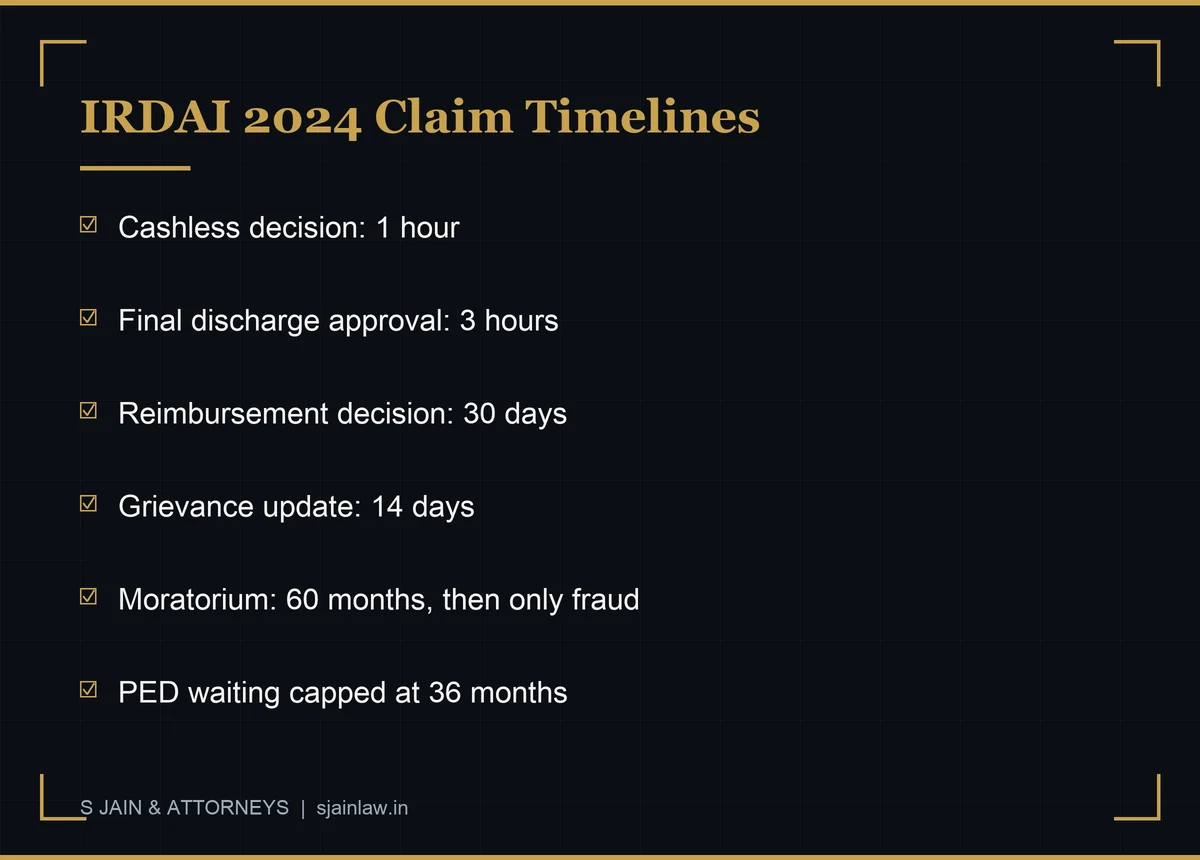
- Cashless decision within 1 hour. The insurer must decide a cashless authorisation request within one hour of receiving it from the hospital.
- Discharge authorisation within 3 hours. The final authorisation must be granted within three hours of the hospital's discharge request. If the insurer takes longer and the hospital levies extra charges for the delay, the insurer bears them.
- Reimbursement claims decided within 30 days of receiving the last necessary document, with the insurer barred from calling for documents in endless drips.
- No rejection without committee approval. A claim cannot be repudiated without the approval of the insurer's Claims Review Committee (a sub-group of its Product Management Committee), and the rejection letter must cite the exact policy terms relied on.
- Moratorium cut to 60 months. After five years of continuous coverage, no policy or claim can be contested on grounds of non-disclosure or misrepresentation, except for established fraud. The earlier period was eight years.
- PED waiting capped at 36 months. From 1 April 2024, the waiting period for disclosed pre-existing diseases cannot exceed 36 months of continuous cover, down from 48, and the definition of a pre-existing disease itself now looks back only 36 months before the policy.
- Portability with credit. If you switch insurers, the waiting periods you have already served travel with you; a port is not a fresh start for the clock.
Key takeaway: When you dispute a rejection, cite the Master Circular of 29 May 2024 by name and date. Ask, in writing, whether the Claims Review Committee approved the repudiation and demand the specific policy clause relied on. A surprising number of rejections soften once the insurer realises the policyholder knows the rulebook.
The 60-month moratorium and Section 45 of the Insurance Act
Policyholders often hear about Section 45 of the Insurance Act, 1938, which, after the 2015 amendment, provides that no policy of life insurance can be called in question on any ground whatsoever after three years from issue, revival or rider, and within those three years only on stated grounds of fraud or material misstatement, communicated in writing. Strictly, Section 45 governs life insurance. For health insurance, the equivalent shield is the regulatory moratorium: after 60 months of continuous coverage (including ported coverage), the insurer cannot contest the policy or a claim for non-disclosure or misrepresentation; only established fraud remains open, and proving fraud is the insurer's burden.
The practical meaning: if your policy has run five continuous years, a rejection letter citing an old, allegedly undisclosed ailment is on very weak legal footing, and you should say so in your first reply.
Suppression vs inducement: what the Supreme Court actually requires
Insurers treat every gap in a proposal form as fatal non-disclosure. The Supreme Court does not. Two decisions are worth quoting in any dispute over a pre-existing disease insurance rejection:
- Sulbha Prakash Motegaonkar v Life Insurance Corporation of India (Supreme Court, 5 October 2015): the insured had not disclosed lumbar spondylitis with a disc prolapse; he later died of a heart attack. The Court held the suppression was not material to the risk that actually occurred and had no nexus with the cause of death, so repudiation was unjustified. Non-disclosure defeats a claim only when it is of a fact material to the loss.
- Manmohan Nanda v United India Insurance Co Ltd (Supreme Court, 6 December 2021): a traveller's overseas mediclaim was repudiated after a heart attack in the USA, on the ground that he had not disclosed statin use. The Court held the repudiation illegal: once the insurer issues a policy after assessing the insured's medical condition, it cannot later hide behind a condition it evaluated or could have elicited. A prudent insurer must gauge the risk before accepting the premium, not after the claim.
Common mistake: Accepting a "non-disclosure" rejection at face value. Ask three questions. Was the fact actually known to the insured and suppressed? Is it material to this very claim? Did the insurer conduct or waive medicals when selling the policy? If any answer favours you, the rejection is contestable, and the case law above is on your side.
Cashless claim denied at the hospital: what to do in the moment
A cashless claim denied at the TPA desk is not a rejection of your claim; it is only a refusal to pre-authorise. Keep the paper trail: the pre-authorisation request, the denial note and its stated reason, and every clinical record. Pay if you must, take a detailed discharge summary and itemised bills, and file the same claim as a reimbursement claim, which the insurer must decide within 30 days of your last document. Many claims denied at the cashless stage on thin grounds like "no active line of treatment" are paid on reimbursement once the treating doctor's justification is on record, and the denial note itself becomes evidence if you later escalate.
Health insurance claim rejected: the ladder of remedies
Escalate in sequence; each rung strengthens the next, and the record you build at step one is the evidence at step four.
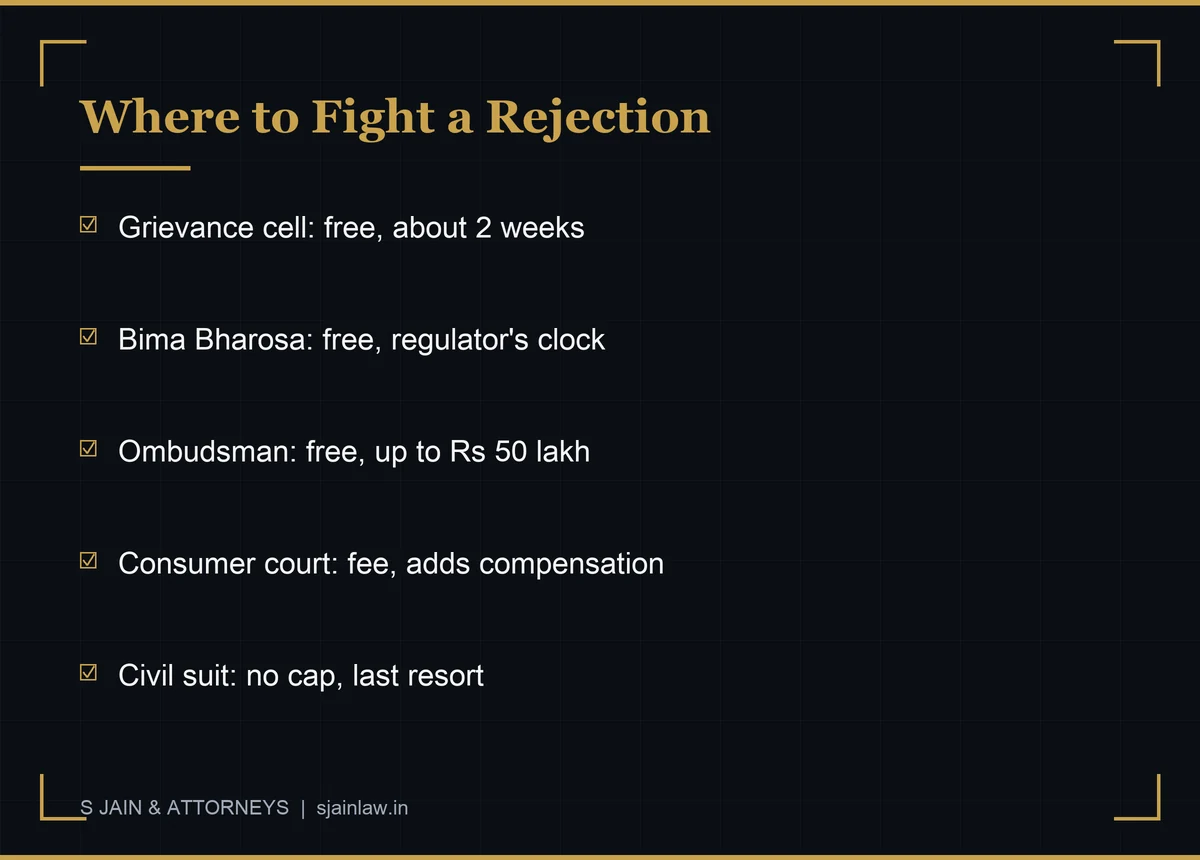
- Written grievance to the insurer. Every insurer has a Grievance Redressal Officer. Send a written complaint (email counts) attacking the rejection ground specifically. The insurer must respond, and under the current IRDAI framework you should have an update or resolution within 14 days.
- Bima Bharosa. If the insurer is silent or unhelpful, register the complaint on Bima Bharosa, IRDAI's online grievance system. This is the official IRDAI complaint route: it is free, it gives you a tracking number, and it puts the insurer's response on a regulator-visible clock of 14 days.
- Insurance Ombudsman complaint. Under the Insurance Ombudsman Rules, 2017, you can file with the ombudsman for your area if your written representation to the insurer was rejected or unanswered for one month, and you file within one year thereafter. The route is completely free, needs no lawyer, and the ombudsman can award up to Rs 50 lakh (raised from Rs 30 lakh by the November 2023 amendment). The award binds the insurer; if you are unhappy with it, your court remedies stay open. Details and forms are on the Council for Insurance Ombudsmen site.
- Consumer commission under the Consumer Protection Act, 2019. Wrongful repudiation is a deficiency in service. Since Indian Medical Association v V.P. Shantha, (1995) 6 SCC 651, services rendered for consideration, including insurance, sit squarely within consumer jurisdiction. The commissions can award the claim amount, interest, compensation for harassment and costs. See our guide to which consumer court to file in.
- Civil suit. The last resort for claims beyond consumer or ombudsman limits or needing elaborate trial. Slower and costlier; take this lane only on advice.
Comparing the forums: cost, time and limits
| Forum | Cost | Typical time | Monetary limit | Best for |
|---|---|---|---|---|
| Insurer grievance cell | Free | About two weeks | Policy limits | Errors, missing documents, quick reversals |
| Bima Bharosa (IRDAI) | Free | Weeks | Not an adjudicator; regulatory pressure | Silent or stonewalling insurers |
| Insurance Ombudsman | Free, no lawyer needed | Months | Up to Rs 50 lakh | Most individual health claims |
| Consumer commission | Modest court fee | 1 to 3 years, often more | Tiered by claim value across District, State and National commissions | Compensation beyond the claim, harassment, larger claims |
| Civil court | Court fees on value | Years | No cap | High-value or legally complex disputes |
How to reply to a claim rejection letter
Your first reply is the most important document you will write, because every later forum reads it. Structure it like this:
- Pin the ground. Quote the rejection letter's exact reason and clause. If the letter is vague, demand the specific clause and the Claims Review Committee approval in your first line.
- Answer the ground with documents. Non-disclosure? Attach the proposal form and point out what was disclosed, or why the fact was not material to this claim, citing the Motegaonkar and Nanda rulings. Waiting period? Set out the dates and any ported credit. Medical necessity? Attach the treating doctor's note advising admission.
- Invoke the rules. The Master Circular of 29 May 2024, the 60-month moratorium if applicable, and the 30-day reimbursement deadline.
- Set a deadline and state the escalation. Give 15 days and state that you will proceed to Bima Bharosa and the Insurance Ombudsman. Send by email plus a trackable mode and preserve proof.
From my own files: the single biggest difference between health claims that get paid on review and those that die is not the medicine, it is the paper. Clients walk in with a one-line rejection SMS and a shoebox of bills; insurers fold when the same claim goes back as a two-page reply pinning the clause, attaching the treating doctor's justification and quoting the one-hour and three-hour timelines the TPA blew through. I have seen "no active line of treatment" rejections reversed at the grievance-cell stage purely because the reply demanded the Claims Review Committee's approval note, which did not exist. Write the reply as if the ombudsman will read it, because if the insurer does not blink, the ombudsman will.
Documents checklist before you escalate
- Policy schedule, policy wording and all renewal receipts (to prove continuous coverage for the moratorium);
- Proposal form as filled at inception, and any medical test reports the insurer took;
- Rejection letter or repudiation email, plus the cashless denial note if any;
- Discharge summary, indoor case papers, treating doctor's advice for admission, and itemised final bills with payment proof;
- Claim form, all correspondence with insurer and TPA, with dates;
- Your written grievance and its proof of delivery.
Time limits you cannot miss
- Ombudsman: within one year of the insurer's rejection of your representation, or of the one-month reply window lapsing;
- Consumer commission: two years from the cause of action under Section 69 of the Consumer Protection Act, 2019, with delay condonable only on sufficient cause shown;
- Policy timelines: intimation and document windows in the policy itself; miss them only with a written explanation, since genuine claims are not meant to die of technical delay.
Health insurance disputes sit inside the wider world of consumer rights: the same statute that protects you against a stonewalling insurer also covers defective online purchases, and the same forum strategy applies. If your dispute is about a life policy repudiated for non-disclosure, read our companion guide on Section 45 and life insurance claim rejection, which covers that ground in depth. And if you want a professional to run the escalation, our consumer protection team handles insurance disputes from the first reply letter to the National Commission.
Related guides and where to get help
- Insurance Claim Rejected? Section 45, the Ombudsman Ladder and How Claims Actually Get Paid
- Insurer Cancelling a Policy After Death: Your Rights
- Insurance Claim Repudiation: When Is It Legally Valid?
Frequently Asked Questions
What are the most common health insurance claim rejection reasons?
Alleged non-disclosure of pre-existing diseases, waiting periods, policy exclusions, "no active line of treatment" objections to hospitalisation, and late intimation or late documents. Each has a specific, well-established counter.
What is the moratorium period in health insurance now?
Sixty months. After five years of continuous coverage, the insurer cannot contest the policy or a claim on grounds of non-disclosure or misrepresentation; only established fraud remains open. The period was reduced from eight years by the IRDAI framework effective 2024.
How fast must the insurer decide a cashless request?
Under the IRDAI Master Circular of 29 May 2024, the cashless authorisation decision must come within one hour of the request, and final discharge authorisation within three hours of the hospital's discharge request, failing which delay charges fall on the insurer.
My cashless claim was denied at the hospital. Is my claim dead?
No. A cashless denial is only a refusal to pre-authorise. Pay, preserve the denial note and records, and file the same claim for reimbursement, which must be decided within 30 days of your last necessary document.
How do I file an IRDAI complaint against my insurer?
First lodge a written grievance with the insurer's grievance cell. If unresolved, register it on the Bima Bharosa portal, IRDAI's grievance system, which is free and tracks the insurer's response against a 14-day clock.
What can the Insurance Ombudsman award, and what does it cost?
The ombudsman can award up to Rs 50 lakh, enhanced from Rs 30 lakh in 2023. Filing is completely free, no lawyer is required, the award binds the insurer, and you must file within one year of the insurer rejecting or ignoring your representation.
Can I go to consumer court instead of the ombudsman?
Yes. Wrongful repudiation is a deficiency in service under the Consumer Protection Act, 2019, within the rule in Indian Medical Association v V.P. Shantha. The commissions can award the claim with interest and compensation, and the limitation is two years from the cause of action.
Does Section 45 of the Insurance Act apply to health insurance?
Section 45's three-year incontestability rule applies in terms to life insurance policies. For health insurance, the parallel protection is the regulatory 60-month moratorium, after which only proven fraud can defeat the policy.
This article is general legal information, not legal advice, and does not create a lawyer-client relationship. Insurance disputes turn on the policy wording and the medical record. For advice on a specific claim, consult a qualified advocate.