A woman went to a clinic in Delhi complaining of prolonged bleeding. She was told to return the next day for a laparoscopy under general anaesthesia, so the doctor could see what was wrong. She agreed to that. While she was unconscious, her uterus, ovaries and fallopian tubes were removed. She was forty four, unmarried, and had consented to a diagnostic look, nothing more. The consent for the surgery had been taken from her mother, who was waiting outside.
Part of the medical negligence practice at S Jain & Attorneys, Bangalore.
It is the kind of case our medical negligence practice sees most often. That is Samira Kohli v Dr Prabha Manchanda, decided by the Supreme Court on 16 January 2008, and it remains the foundation of informed consent medical law in India. Almost every consent dispute since is argued on the propositions that case laid down.
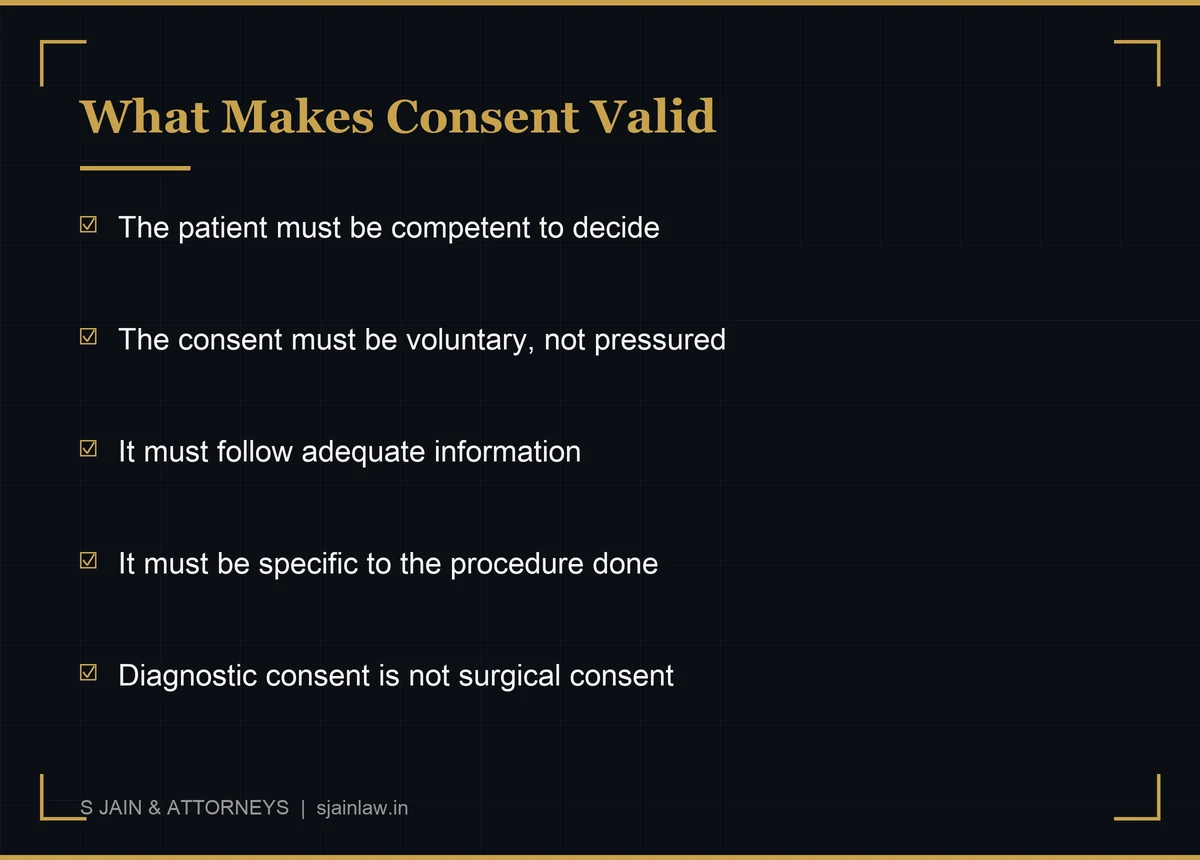
- Valid consent needs three things: the patient must be competent, the consent must be voluntary, and it must follow adequate information about the procedure.
- Consent for a diagnostic procedure is not consent for therapeutic surgery. The two are separate permissions.
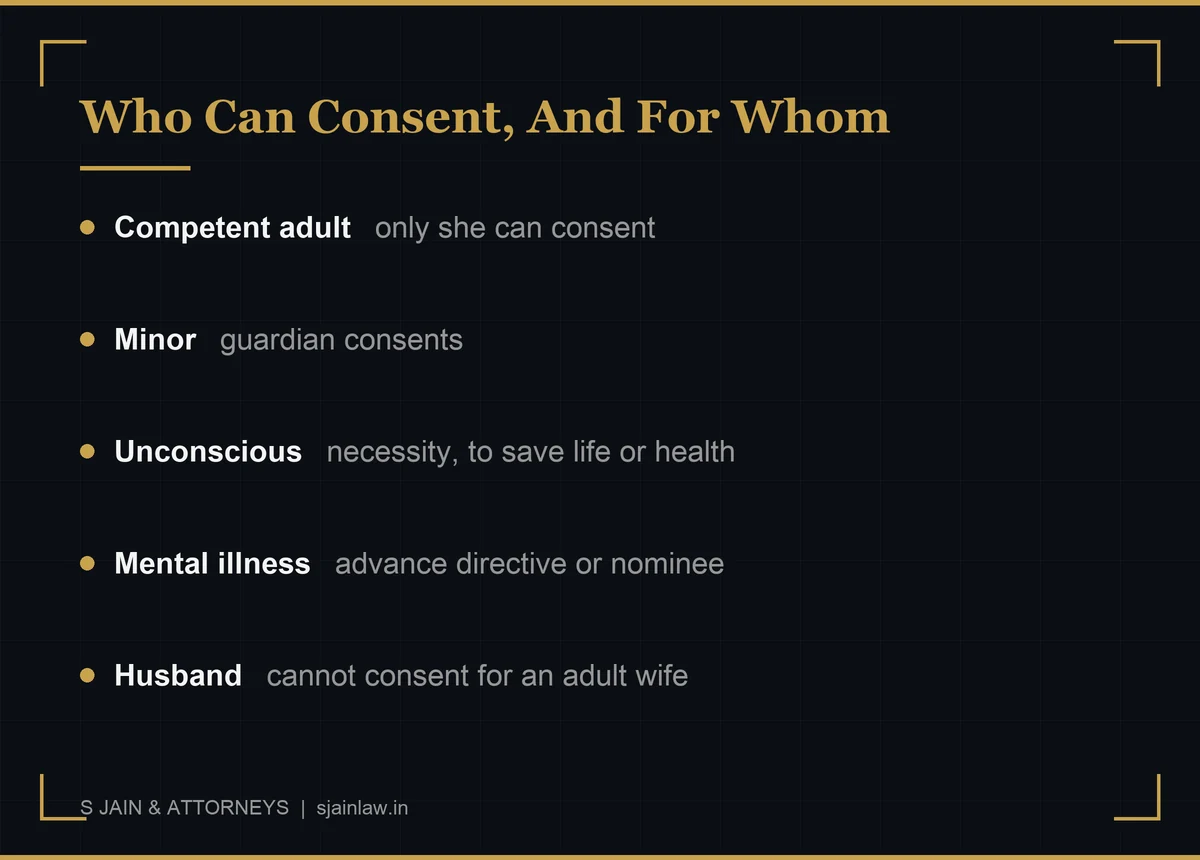
- For a competent adult, nobody else can consent. Not a husband, not a parent, not a son waiting outside.
- India applies the Bolam standard to how much a doctor must disclose, not the wider prudent patient standard used in some other countries.
- Additional surgery without consent is lawful only where it is necessary to save life or preserve health and waiting is unreasonable. Convenience and cost saving do not qualify.
What the Supreme Court actually held in Samira Kohli
The Court set out what makes consent real and valid. In its words, "the patient should have the capacity and competence to consent; his consent should be voluntary; and his consent should be on the basis of adequate information concerning the nature of the treatment procedure."
Three separate requirements sit in that sentence, and a consent fails if any one of them fails. A competent patient who signs under pressure has not consented. A fully informed patient who lacks capacity has not consented. A willing, competent patient who was told nothing useful has not consented either.
On the specific question in that case, the Court was direct: "Consent given only for a diagnostic procedure, cannot be considered as consent for therapeutic treatment." A patient who agrees to let you look has not agreed to let you remove.
Key takeaway: consent attaches to a procedure, not to a doctor or an admission. Every distinct procedure needs its own permission, taken in advance, from the person whose body it is.
On who may give it, the Court disposed of a practice that is still common in Indian hospitals: "When a patient is a competent adult, there is no question of someone else giving consent on her behalf." The mother's signature was worth nothing, because the patient was an adult of sound mind who could have been asked herself.
The disclosure standard: India follows Bolam
How much must a doctor tell a patient? Two competing answers exist internationally. The Bolam standard asks what a responsible body of medical opinion would consider proper to disclose. The prudent patient standard asks what a reasonable patient in that position would want to know. The second is more demanding of doctors.
India chose the first. The Court held that "the extent and nature of information required to be given by doctors should continue to be governed by the Bolam test rather than the 'reasonably prudential patient' test." A doctor is expected to disclose what is "accepted as normal and proper by a body of medical men skilled" in that field.
This is worth stating plainly because a great deal of Indian writing on consent asserts the opposite. It matters in practice: in a dispute, the question is not what this particular patient says she would have wanted to know, but what competent practitioners in that speciality would ordinarily disclose.
That said, the standard is a floor and not a ceiling. Nothing prevents a doctor from telling a patient more, and the practitioners who face the fewest consent disputes are invariably the ones who over disclose rather than under disclose.
What must be disclosed
Adequate information, in practice, means covering the following before the patient decides.
- The nature of the procedure: what will physically be done, in language the patient understands.
- The purpose: what it is meant to achieve, and whether it is diagnostic or therapeutic.
- The expected benefits, stated without overselling.
- The material risks: those that are serious even if uncommon, and those that are common even if minor.
- The alternatives, including more conservative options and their trade offs.
- The consequences of refusing, so the patient understands what declining means.
Two failures recur. The first is the pre printed form that lists a procedure in Latin and asks for a signature at the counter, sometimes at the time of admission and long before the treating doctor has met the patient. The second is disclosure to the family instead of the patient, which is culturally natural in India and legally useless where the patient is a competent adult. Where things go wrong, the compensation awarded in Indian medical negligence cases turns heavily on how the record reads.
| Valid consent | Defective consent | Legal consequence of the defect |
|---|---|---|
| Taken from the competent patient herself | Taken from a spouse, parent or attendant for a competent adult | No consent in law. The procedure is unauthorised |
| Specific to the procedure performed | General or for a different procedure, for example diagnostic consent used for surgery | Consent does not extend to what was done |
| Given before the procedure, with time to consider | Taken on the operating table or under premedication | Voluntariness is open to serious challenge |
| Follows disclosure of nature, risks and alternatives | Signature on a blank or pre printed form with no explanation | Not consent on the basis of adequate information |
| In a language the patient understands, recorded | English form signed by a patient who does not read English | Evidentially very weak; often fatal to the defence |
| Documented in the notes, not only on the form | Form present but no record of the discussion | Defensible in principle, hard to prove in practice |
Who can consent, and for whom
A competent adult consents for herself, always, where she is able to. Capacity is assessed in relation to the decision at hand, not by a global label.
Minors. A guardian ordinarily consents for a minor. The child's own views carry increasing weight as the child matures, and for certain interventions a young person's own participation in the decision matters a great deal.
The unconscious patient. Where a patient cannot consent and the intervention cannot wait, the doctrine of necessity permits treatment in the patient's best interests. This is a narrow exception, not a general authority to proceed.
Persons with mental illness. The Mental Healthcare Act, 2017 changed the architecture here. It recognises an advance directive by which a person may state in advance how they wish to be treated, and a nominated representative who can act where capacity is absent. The Act proceeds from a presumption of capacity rather than an assumption of its absence, which is a significant shift from the older approach.
Consent in specific contexts
| Context | Whose consent | Point most often missed |
|---|---|---|
| Ordinary surgery | The patient, if a competent adult | Each procedure needs its own consent |
| Termination of pregnancy | The pregnant woman. A guardian's consent applies where she is a minor or mentally ill | A husband's consent is not required. Hospitals still ask for it |
| Sterilisation | The person undergoing the procedure | Spousal consent is not a legal precondition |
| Organ donation | The donor, with the statutory authorisation process under the transplantation law | The statutory approvals are separate from clinical consent |
| Clinical trials | The participant, with audio video recording of the consent process in defined situations | Documentation requirements are stricter than in ordinary care |
| Telemedicine | The patient. Consent may be implied where the patient initiates the consultation | Where the practitioner initiates, explicit consent should be recorded |
| Emergency, patient unconscious | Necessity doctrine applies | Limited to what is needed to save life or preserve health now |
Common mistake: asking a husband to sign for his wife's procedure. It is routine in Indian hospitals and it is not law. Where the woman is a competent adult, her consent is the only one that counts, and a husband's signature will not save the hospital in a dispute.
The emergency exception, and how narrow it is
A surgeon who discovers something unexpected mid procedure faces a genuine dilemma. The Court addressed it. An additional unauthorised procedure is permissible where it is "necessary in order to save the life or preserve the health of the patient and it would be unreasonable to delay such unauthorized procedure until patient regains consciousness".
Two words in that formulation do the work: necessary and unreasonable to delay. If the patient can be woken, informed and asked, she must be. If the additional procedure can wait for a second sitting without harm, it should wait.
What does not qualify is telling. Sparing the patient a second anaesthetic, saving a second admission, reducing overall cost, or simply being convinced the surgery is a good idea are not grounds. Convenience and cost savings do not justify operating on someone who has not agreed to it.
What happens when consent fails
A treatment without valid consent is not merely poor practice. It opens several distinct routes, and they are not alternatives to each other in the way patients often assume.
- Obtain the records first. Ask in writing for the complete file: the consent form, the operation notes, the anaesthesia record, the discharge summary and the investigation reports. A patient is entitled to their medical records, and a refusal is itself telling. Our guide on the right to medical records sets out how to ask.
- Have the file reviewed by a doctor. Independent medical opinion is what converts a grievance into a case. Without it, a consent complaint rarely survives contest.
- Consider the consumer route. Treatment for consideration is a service, and deficiency in service includes performing a procedure without valid consent. This is the most commonly used forum. The procedure for filing a medical negligence complaint is set out separately.
- Consider the civil action. A procedure performed without any consent can be framed as a battery, quite apart from negligence, because the interference with the body was unauthorised from the start.
- Understand the criminal position. Criminal liability for a doctor is deliberately hard to establish. Under the Bharatiya Nyaya Sanhita, 2023, causing death by a rash or negligent act is dealt with by Section 106, which carries a distinct and lower maximum for a registered medical practitioner acting in the course of medical treatment. The safeguards laid down in Jacob Mathew v State of Punjab (2005), including an independent medical opinion before prosecution, continue to protect doctors from casual criminal proceedings. The difference between the routes is explained in our note on consumer versus criminal proceedings.
- Complain to the State Medical Council. This is a professional conduct route. It can result in disciplinary action against the practitioner, but it does not compensate the patient.
Practice note: the consumer forum and the medical council serve different purposes. One produces compensation, the other produces professional consequences. Choosing between them, or running both, is a strategic decision and depends on what the patient actually wants.
How consent disputes are actually proved
A consent case is won or lost on documents, because memory is worthless three years later. Both sides know this, which is why the file matters more than the testimony.
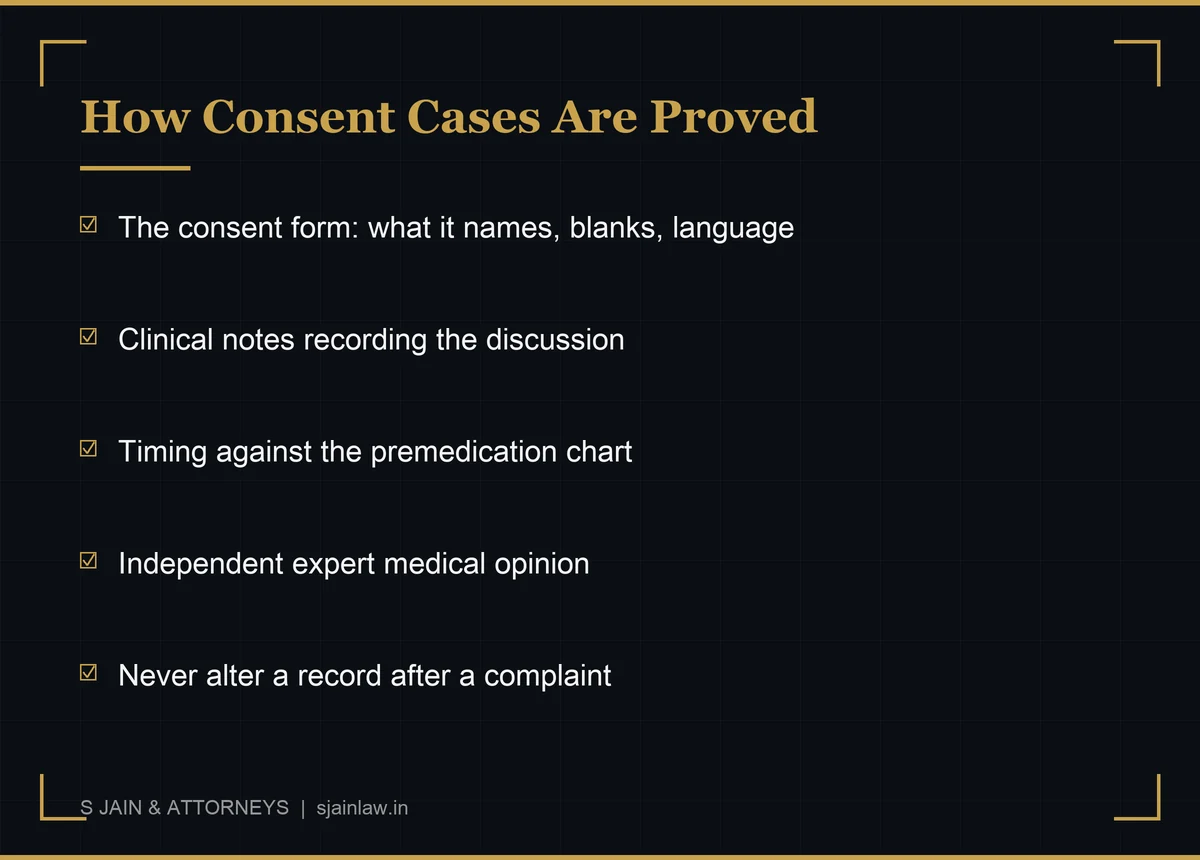
The patient's side is usually built from four things. The consent form itself, examined for what it actually names, whether blanks were filled after signature, and what language it is in. The clinical notes, to see whether any discussion was recorded at all. The timing, established from the admission record, the premedication chart and the operating theatre register, because consent taken after sedation is vulnerable. And independent expert opinion on whether the procedure performed was within what a reasonable practitioner would have disclosed and whether any emergency justification stands up.
The hospital's side depends almost entirely on contemporaneous recording. A signed form with no note of the conversation invites the question of what was explained, and the answer "we always explain" is not evidence. A two line entry recording that risks and alternatives were discussed, in which language, and with whom, is worth more than the form it accompanies.
Warning: altering or reconstructing a record after a complaint is the single worst thing a hospital can do. It converts a defensible clinical case into an indefensible credibility problem, and it is usually detectable.
| Authority | Year and forum | What it established |
|---|---|---|
| Samira Kohli v Dr Prabha Manchanda | 2008, Supreme Court | Consent must be real and valid: capacity, voluntariness and adequate information. Diagnostic consent does not extend to therapeutic surgery. No one consents for a competent adult. India follows the Bolam standard on disclosure. |
| Jacob Mathew v State of Punjab | 2005, Supreme Court | Safeguards against casual criminal prosecution of doctors, including the requirement of independent medical opinion before proceeding. |
| Indian Medical Association v V.P. Shantha | 1995, Supreme Court | Medical services rendered for consideration fall within the consumer protection framework, which is why most consent claims are brought before consumer forums. |
| Mental Healthcare Act, 2017 | Statute | Introduced advance directives and nominated representatives, and a presumption of capacity, changing how consent works for persons with mental illness. |
The regulatory layer
Beyond the case law, professional conduct regulations require practitioners to obtain documented consent and to maintain records. The 2002 regulations governing professional conduct, etiquette and ethics require consent to be documented before operations and set out record keeping duties. The regulatory framework has been in a period of transition, with newer conduct regulations notified and then held in abeyance, so the position on which precise instrument governs at a given moment has not been static. The prudent course for any practitioner is to comply with the stricter of the applicable requirements rather than to rely on the uncertainty.
The other half of consent: the right to refuse
Consent law is usually discussed as the doctor's obligation to obtain permission. Its mirror image is the patient's entitlement to withhold it, and that half is far less understood in Indian hospitals.
A competent adult may decline treatment, and may decline it for reasons that seem irrational to the treating team. The doctor's duty in that situation is not to override the refusal but to make sure it is informed: to explain plainly what is likely to happen without the treatment, to confirm the patient has understood, and to record all of it. A refusal that is documented in those terms protects everyone. An undocumented refusal protects nobody, and it is the hospital that will be asked to explain itself later.
The same applies to discharge against medical advice. The form a patient signs on leaving is not a magic shield. It carries weight only where the record shows the risks of leaving were actually explained, in a language the patient understood, at a time when the patient was capable of taking the decision. Where a patient leaves because they cannot afford to stay, that reality should be recorded too, because it bears directly on whether the decision was truly voluntary.
Refusal by proxy raises a harder question. Where a family declines treatment for a competent adult patient who has not been asked, the hospital is in exactly the territory Samira Kohli addressed, only in reverse. The patient's own view is the one that governs, and a relative's refusal is no more authoritative than a relative's consent.
Practice note: where a competent patient refuses and the family disagrees, the safest course is to record the patient's decision, record the family's position separately, and continue to offer the treatment. Acting on the family's instruction against the patient's expressed wish is the exposure, not the refusal itself.
There is one more scenario worth naming, because it arrives often and is handled badly. A patient consents, then withdraws consent partway through a course of treatment. Consent is not a one time gate; it can be withdrawn by a competent patient at any point, and continuing after a clear withdrawal is not covered by the original permission. Where withdrawal happens mid procedure and stopping would itself be dangerous, the necessity principle applies, but the burden of explaining that judgment sits with the practitioner.
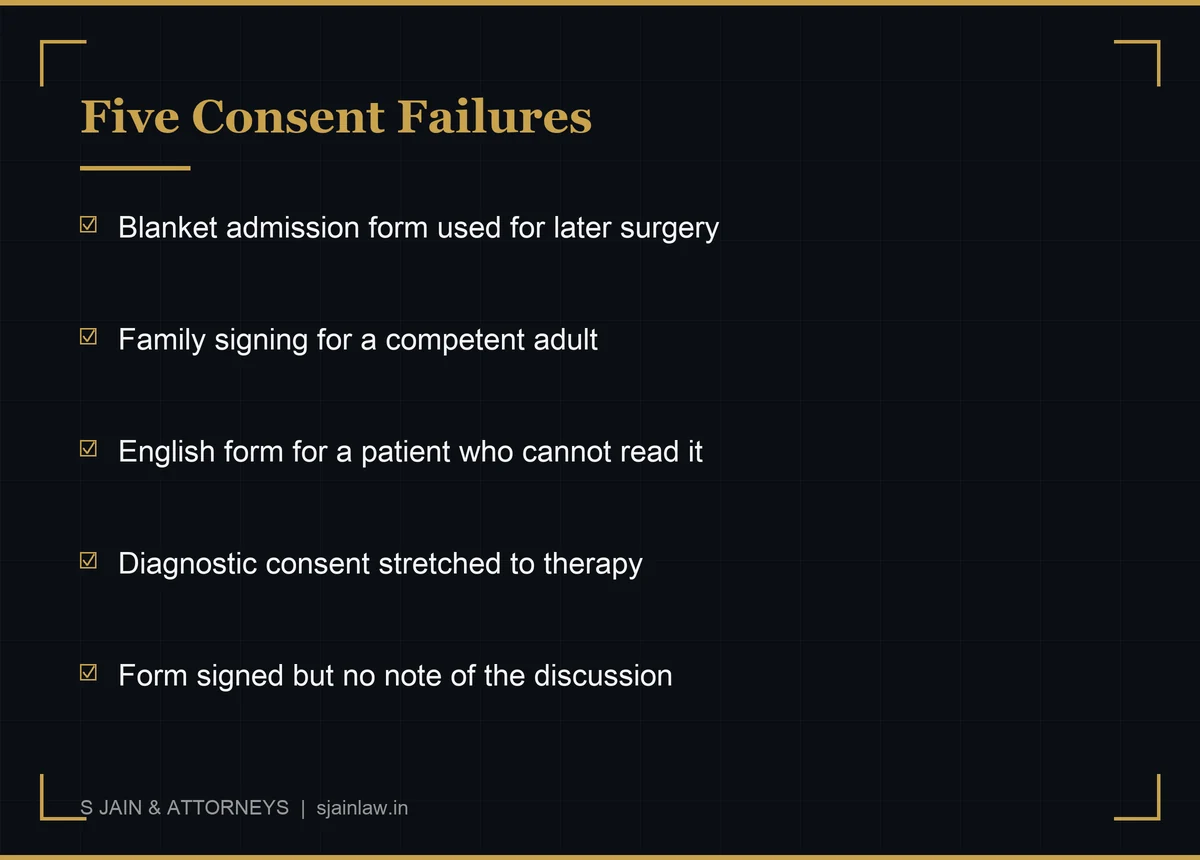
Five mistakes that turn consent into litigation
- Taking consent at admission for whatever follows. A blanket admission form is not consent for a specific operation decided on three days later. Take a fresh, specific consent when the procedure is decided.
- Getting the family to sign for a competent adult. It feels respectful and it is legally worthless. Ask the patient.
- Consenting in a language the patient does not read. An English form signed by a patient who speaks only Kannada or Hindi will not hold up. Use the patient's language and record who explained it.
- Extending a diagnostic consent to therapy. This is precisely what happened in Samira Kohli. If you find something during a diagnostic procedure, the default is to close, wake the patient and ask, unless waiting would genuinely harm her.
- Documenting the form but not the conversation. The signed form proves a signature. A note recording what was explained, what questions were asked and what alternatives were discussed proves consent. Defence lawyers can work with the second; the first alone is thin.
Before you sign: a checklist for patients
- Ask what exactly is being done, and get it in a language you understand
- Ask why this procedure, and what happens if you do nothing for now
- Ask what the alternatives are, including less invasive ones
- Ask what can go wrong, and how often it does
- Ask who will actually perform the procedure
- Do not sign a form with blanks in it, and do not sign under premedication
- Ask for a copy of what you signed, and keep it
- If you are a competent adult, sign for yourself. Do not let a relative sign in your place
What a hospital's consent process should record
- The specific procedure named in plain language, not only in medical shorthand
- The name of the practitioner who explained it, and when
- The risks, benefits and alternatives actually discussed
- The language used and, where applicable, the interpreter's identity
- Confirmation that the patient was competent and unmedicated at the time
- Separate consent for anaesthesia, for blood transfusion and for any distinct additional procedure
- A contemporaneous clinical note of the discussion, not only the signed form
A note from practice
Consent cases are unusual because the medicine is often faultless. I have seen files where the surgery was well indicated, competently performed and produced a good clinical outcome, and the hospital still lost, because the patient was never actually asked. That is difficult for doctors to accept, and I understand why. The instinct in Indian medicine is protective and family centred, and a surgeon who finds a problem while the patient is asleep genuinely believes that fixing it is the kind thing to do. The law takes a different starting point: an adult owns her body and gets to decide what is done to it, even if her decision would be clinically worse. What I tell hospital clients is that the fix is almost free. Take consent for the specific procedure, take it from the patient, take it in her language, take it before the premedication, and write a two line note about what you explained. That note costs nothing and it is the single most useful document in the file when a complaint arrives three years later, by which time nobody remembers the conversation. What I tell patients is the reverse: the form you sign is not a formality, and the moment to ask questions is before you are on the trolley. Where a claim does follow, where you file shapes both the timeline and the outcome, and our consumer protection practice page explains the forum structure.
Glossary
- Informed consent: agreement to a specific procedure given voluntarily by a competent person after adequate information.
- Capacity: the ability to understand, retain and weigh information relevant to a decision and communicate a choice.
- Bolam test: a standard that measures a doctor's conduct, including disclosure, against what a responsible body of skilled practitioners would accept as proper.
- Prudent patient test: the alternative standard, measuring disclosure by what a reasonable patient would want to know. Not the Indian position.
- Battery: an unauthorised interference with the body, actionable even without proof of negligence.
- Doctrine of necessity: the principle permitting treatment of a patient who cannot consent, limited to their best interests where waiting is not reasonable.
- Advance directive: a statement made in advance under the Mental Healthcare Act, 2017 about how a person wishes to be treated if capacity is lost.
- Nominated representative: a person appointed under the same Act to take decisions where the patient cannot.
Related guides and where to get help
- How to File a Medical Negligence Complaint in India: The Step-by-Step Process
- Medical Negligence in India: Where to File, What to Prove and What You Can Claim
- Bank Deducted Insurance Premium Without Consent? Your Rights
Frequently Asked Questions
Is a signed consent form enough to protect the hospital?
Not by itself. The form evidences a signature. What the law requires is that a competent patient voluntarily agreed after being adequately informed, and that is usually proved by the clinical note of the discussion rather than the printed form.
Can my husband sign the consent form for my operation?
Not if you are a competent adult. The Supreme Court held in Samira Kohli that where the patient is a competent adult, there is no question of someone else consenting on her behalf.
Is a husband's consent needed for an abortion?
No. The consent required is that of the pregnant woman. Where she is a minor or mentally ill, a guardian's consent applies. Hospitals frequently ask for a husband's signature, but it is not a legal requirement.
I consented to a diagnostic test and they operated. Is that lawful?
Ordinarily not. Consent for a diagnostic procedure is not consent for therapeutic treatment. The narrow exception is where the additional procedure was necessary to save life or preserve health and it was unreasonable to wait.
What standard decides how much a doctor must tell me?
India applies the Bolam standard, so the question is what a responsible body of skilled practitioners in that field would consider proper to disclose, rather than what a particular patient would have wanted to know.
The form was in English and I do not read English. Does that matter?
Yes, considerably. Consent must rest on adequate information, and information the patient could not read is not adequate. Consent taken in a language the patient does not understand is evidentially very weak.
Can consent be taken after premedication?
It should not be. Consent must be voluntary and given with capacity. A patient who has been sedated is poorly placed to give either, and consent taken at that point is open to serious challenge.
Is treating an unconscious accident victim without consent lawful?
Yes, under the doctrine of necessity, limited to what is required in the patient's best interests where waiting is not reasonable.
Can I refuse treatment my doctor recommends?
A competent adult may refuse, even where the refusal is clinically unwise. The doctor's duty is to ensure the refusal is informed and to record it.
What can I claim if a procedure was done without my consent?
Depending on facts, compensation for deficiency in service before a consumer forum, or damages in a civil action which may be framed in battery as well as negligence. Whether any claim succeeds depends entirely on the record and the expert opinion.
Will the doctor be prosecuted?
Criminal liability is deliberately difficult to establish against a medical practitioner. The Bharatiya Nyaya Sanhita treats death caused by a registered medical practitioner in the course of treatment distinctly, and the Jacob Mathew safeguards, including an independent medical opinion before prosecution, continue to apply.
Does a complaint to the Medical Council get me compensation?
No. That route addresses professional conduct and can lead to disciplinary action. Compensation comes from the consumer forum or a civil court.
This guide is general legal information for public awareness and is not legal or medical advice. Whether any particular consent was valid, and whether any claim would succeed, depends on the complete medical record and on independent expert opinion. Please consult a qualified advocate about your specific matter.