
Two people agree on a divorce settlement of Rs 60 lakh. One of them pays tax on nothing. Change three words in the settlement deed and the same Rs 60 lakh becomes taxable income spread across years. That is the whole of this subject, and it is why the question is alimony taxable in India deserves a proper answer rather than a one line rule.
Part of the maintenance and alimony practice at S Jain & Attorneys, Bangalore.
There is no section of the Income-tax Act, 1961 that says "alimony shall be taxed" or "alimony shall be exempt". The treatment is judge made. It sits alongside the substantive rules on how alimony is decided in India. It turns on an old distinction between a capital receipt and a revenue receipt, applied to matrimonial payments by the Bombay High Court more than forty years ago and followed since.
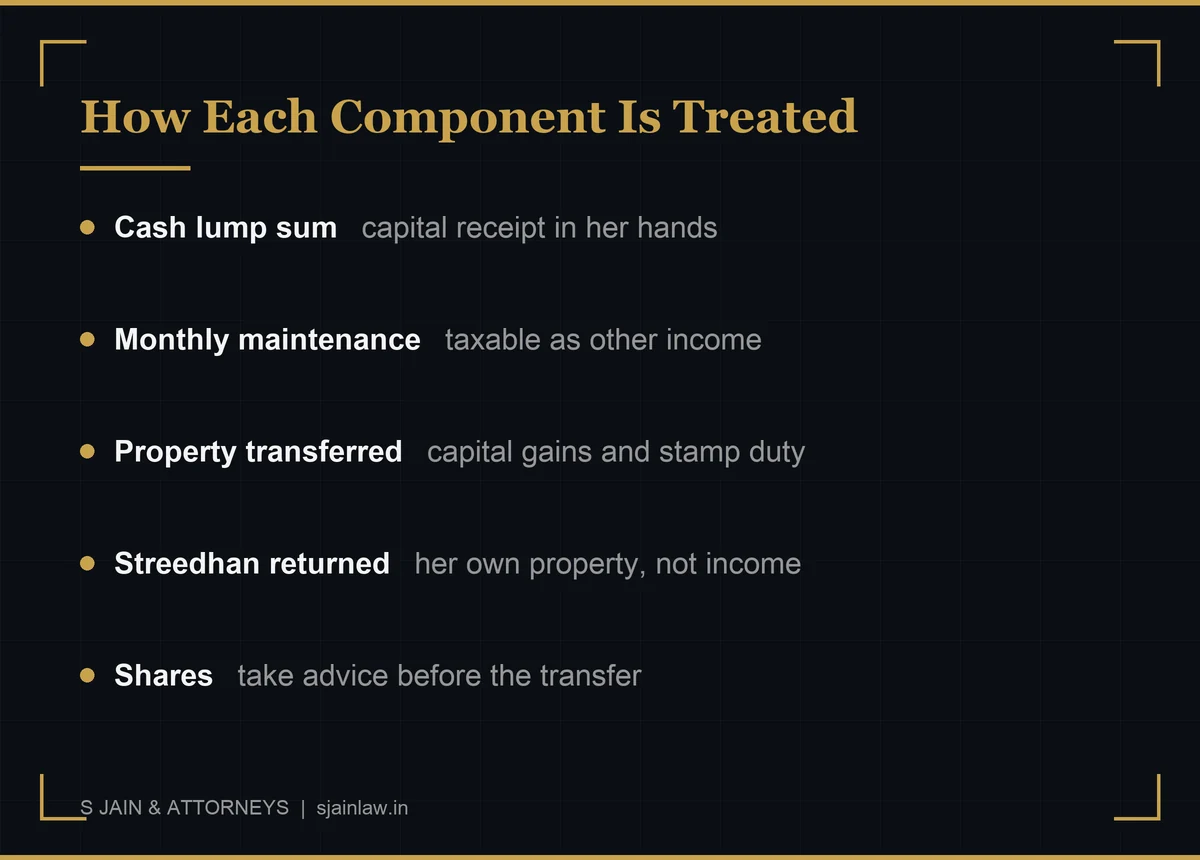
- Lump sum alimony paid as a one time settlement is generally treated as a capital receipt and not taxable in the recipient's hands.
- Monthly or periodic maintenance is generally treated as a revenue receipt and is taxable as income from other sources.
- The payer gets no deduction in India, whether the payment is monthly or lump sum.
- Streedhan returned to a wife is her own property coming back. It is not a transfer and not income at all.
- Property transferred under a settlement raises separate capital gains and stamp duty questions, and the recipient inherits the transferor's cost and holding period on a later sale.
The rule, and the case that created it
The anchor is Princess Maheshwari Devi of Pratapgarh v Commissioner of Income-tax, (1984) 147 ITR 258 (Bombay). The Princess had married the Maharaja of Kotah in 1956. In 1963 she obtained a decree of nullity, under which she was to receive a lump sum of Rs 25,000 as permanent alimony and Rs 750 every month until her remarriage.
The Bombay High Court separated the two payments and taxed them differently.
The monthly payments were income. They were regular, they recurred, and they flowed from a definite source, namely the decree itself. That reasoning traces back to the classic definition of income in CIT v Shaw Wallace and Co, AIR 1932 PC 138, as a periodical monetary return coming in with some sort of regularity from a definite source.
The lump sum was not income. It was a capital receipt, because it represented the extinguishment of her capital right to be maintained. She gave up a right; she received a sum in place of it. That is a transaction on capital account, not a return on anything.
Key takeaway: the tax question is not "how much" but "what is this payment in substance". A stream of money for living expenses is income. A single sum paid to buy out and close a right is capital.
The same logic was applied by the Delhi Bench of the Income Tax Appellate Tribunal in ACIT v Meenakshi Khanna, (2013) 143 ITD 744. The assessee received about USD 99,093, roughly Rs 39.98 lakh, from her former husband as a consolidated settlement of maintenance he had failed to pay. The Revenue argued it was taxable. The Tribunal held it was a capital receipt.
Two features of that decision are worth holding on to, because they are the ones that decide real cases. First, the Tribunal rejected the attempt to tax the sum as a gift without consideration, because there was consideration: she relinquished all her claims. Second, and more surprisingly to most clients, the Tribunal proceeded on the footing that the former husband did not stop being a relative for the purposes of the gift provisions merely because the marriage had ended.
That second point was taken further by the Mumbai Bench in Prema G. Sanghvi v ITO (2017), where the reasoning was that a right to alimony is a pre-existing legal entitlement arising out of the matrimonial relationship, not a windfall dropping in from a stranger. On that view the exemption available for receipts from a relative is engaged.

| Case | Year and forum | What it held |
|---|---|---|
| Princess Maheshwari Devi of Pratapgarh v CIT | 1984, Bombay High Court | Lump sum permanent alimony is a capital receipt and not taxable. Monthly alimony under the same decree is income, being a regular return from a definite source. |
| CIT v Shaw Wallace and Co | 1932, Privy Council | Defined income as a periodical monetary return coming in with some regularity from a definite source. The test still used to classify maintenance. |
| ACIT v Meenakshi Khanna | 2013, ITAT Delhi | A consolidated sum received to settle arrears of maintenance was a capital receipt. The gift provisions did not apply, both because consideration existed and because the former husband was treated as a relative. |
| Prema G. Sanghvi v ITO | 2017, ITAT Mumbai | A right to alimony is a pre-existing legal entitlement arising from the matrimonial relationship, not a windfall, so the relative exemption is engaged. |
| CIT v Manjula J. Shah | Bombay High Court | On a later sale, indexation of cost can run from the previous owner's date of acquisition, which matters for property received in a settlement. |
Where the money comes from: the maintenance provisions themselves
Before the tax question arises, the payment has to have a legal source. Understanding which provision your maintenance flows from helps explain why it is shaped the way it is, and therefore how it will be taxed.
| Provision | What it provides | Typical shape of the payment |
|---|---|---|
| Section 24, Hindu Marriage Act, 1955 | Maintenance pendente lite and expenses of the proceeding | Monthly, while the case runs. Taxable as income in the ordinary case |
| Section 25, Hindu Marriage Act, 1955 | Permanent alimony and maintenance, as a gross sum or as periodical payments | Either. The section expressly allows both, which is exactly where the tax fork appears |
| Section 27, Hindu Marriage Act, 1955 | Disposal of property presented jointly at or about the marriage | Property, not cash. Raises transfer and stamp duty questions |
| Section 144, BNSS, 2023 (formerly Section 125 CrPC) | Order for maintenance of wife, children and parents | Monthly. A recurring revenue receipt |
| Section 18, Hindu Adoptions and Maintenance Act, 1956 | Right of a Hindu wife to be maintained by her husband | Usually monthly, sometimes commuted into a settled sum |
| Sections 20 and 22, Protection of Women from Domestic Violence Act, 2005 | Monetary relief and compensation | Monthly relief or a compensation sum, depending on the order |
Notice what Section 25 of the Hindu Marriage Act does. It permits the court to order a gross sum or monthly or periodical sums. The statute itself offers both roads, and the tax consequence of taking one rather than the other is significant and entirely unaddressed by the statute. That gap is the reason this article exists.
It also explains a practical asymmetry. Interim maintenance ordered while proceedings are pending is, by its nature, periodic. It is meant to keep a dependent spouse afloat during litigation, so it will almost always look like income. A one time settlement negotiated at the end, by contrast, can be shaped deliberately. The room to plan exists at the settlement stage and not before it.
Section 56(2)(x): the provision everyone worries about
Section 56(2)(x) taxes money or property received without consideration, above a threshold, as income from other sources. It carves out receipts from a relative, and receipts on the occasion of marriage, under a will, or by inheritance.
Clients hear "without consideration" and assume a divorce settlement is caught. Two answers usually take it out of the section.
The first is that a settlement is not without consideration at all. The recipient gives up claims, present and future, and often gives up rights to property, residence and further maintenance. That is consideration in substance, and it was the first ground in Meenakshi Khanna.
The second is the relative exemption, on the reasoning in Meenakshi Khanna and Prema Sanghvi. I would put this more cautiously than some commentaries do. The definition of relative refers to a spouse, and whether a former spouse continues to answer that description after the decree is a question on which the Tribunal has taken a purposive view rather than a literal one. It is a sound view, and it is the one currently applied, but it is Tribunal level reasoning rather than a Supreme Court holding.
Practice note: timing can matter. A transfer made pursuant to and recorded in the settlement that leads to the decree is easier to defend than a payment made long afterwards with no documentary link to any matrimonial obligation. Build the link into the paper.
What about property, jewellery and shares?
Most real settlements are not pure cash. A flat changes hands, jewellery is returned, shares are transferred. The wider question of how property is divided after divorce is a separate subject, but the tax consequences travel with it. Each has its own treatment, and lumping them all under the word "alimony" is where avoidable disputes begin.
| What is transferred | Recipient's position | Payer or transferor's position | What to document |
|---|---|---|---|
| Lump sum cash alimony | Generally a capital receipt, not taxable | No deduction available | Recite that it is a one time full and final settlement of all maintenance claims |
| Monthly or periodic maintenance | Generally taxable as income from other sources | No deduction available | Record the amount, the period and any escalation |
| Immovable property transferred under the settlement | Not treated as income received without consideration where it flows from the settlement | Transfer may raise capital gains questions; stamp duty applies on the instrument | Registered instrument reciting the settlement and the consideration of relinquished claims |
| Streedhan returned | Her own property returning. Not a transfer and not income | Nothing to claim; it was never his | An itemised list, ideally with the original invoices or a wedding inventory |
| Shares or securities | As with property, treated by reference to the settlement | Capital gains position needs advice before transfer | Board or depository records tying the transfer to the settlement |
Two further points on property that people discover too late.
First, on a later sale by the recipient, the cost of acquisition and the holding period are generally taken from the transferor, not from the date she received it. The line of reasoning in CIT v Manjula J. Shah supports indexation running from the original owner's date of acquisition. That is usually favourable, because it lengthens the holding period and can convert what looks like a short term gain into a long term one. It also means the recipient needs the transferor's purchase documents, which she will not have unless she asks for them at settlement.
Second, Section 47 of the Income-tax Act lists transfers that are not regarded as transfers for capital gains purposes. It contains no express clause for a transfer made under a divorce settlement. The protection rests on the reasoning that the transfer is for consideration arising out of relinquished matrimonial rights, rather than on a clear statutory exemption. In a high value settlement this is a real point to take advice on rather than assume away.
Two situations that behave differently
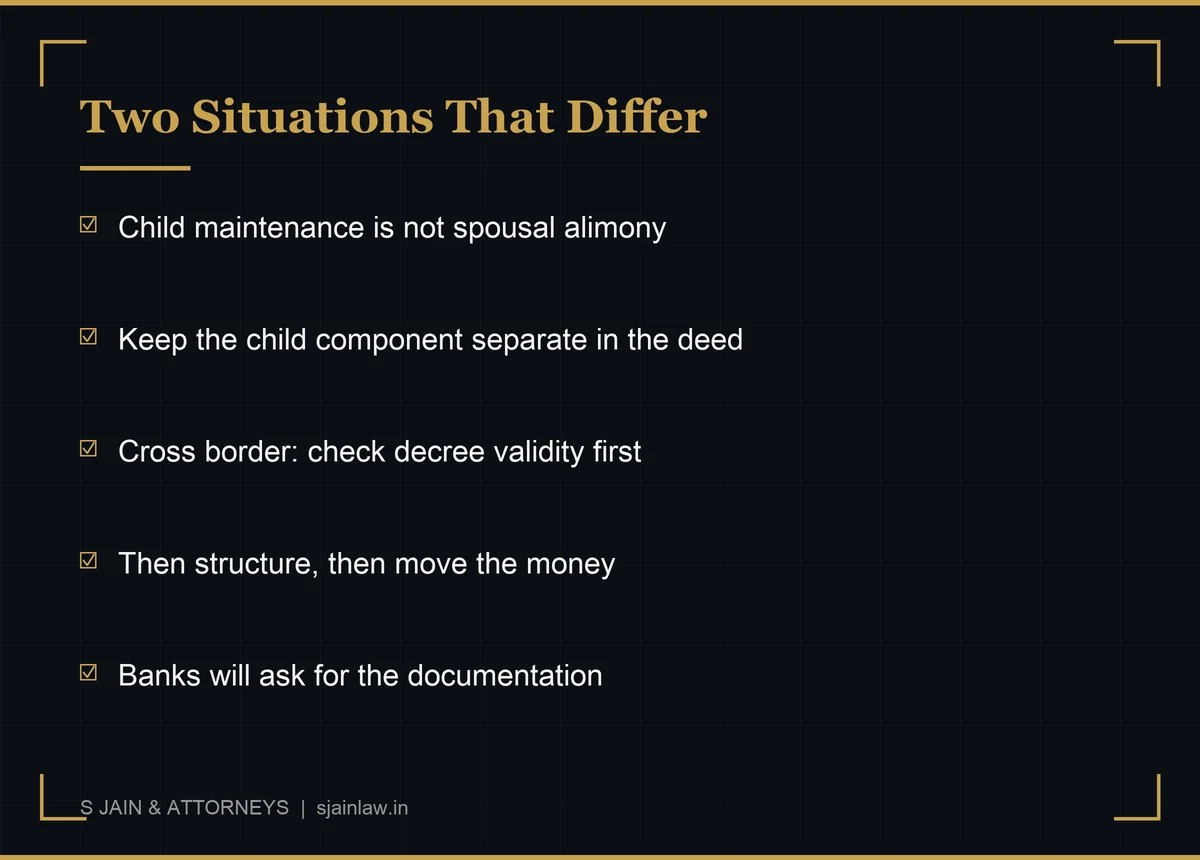
Maintenance for children
Maintenance paid for a child is not the same thing as alimony for a spouse, and it should be separated in the deed. Child maintenance is money applied for the child's benefit rather than a receipt enriching the receiving parent. Where a sum is paid into a fund or account for the child's education or upkeep, the position on whose income it is depends on how the arrangement is set up, and a minor child's income can in defined circumstances be clubbed with a parent's. This is a genuinely technical area and it is worth a specific conversation with a chartered accountant when the child component is large or is being funded through a trust or investment rather than paid monthly.
Common mistake: folding child maintenance into a single "alimony" figure. It obscures who the money is for, complicates enforcement if payments stop, and removes your ability to explain the components later.
Cross border settlements
Where one spouse lives abroad, three questions arrive together: which country may tax the payment, how the money is lawfully remitted, and whether a treaty allocates the right to tax. A payment from an Indian resident to a former spouse abroad, or the reverse, needs the remittance route and the documentation settled before the transfer, because banks will ask. Where the settlement follows a foreign divorce decree, there is a prior question of whether that decree is even recognised in India, which affects the enforceability of everything built on it. Our NRI practice deals with this combination regularly, and the ordering matters: establish the validity of the decree, then structure the settlement, then move the money.
Clubbing, and why divorce ends it
During a marriage, Section 64(1)(iv) can club income arising from assets transferred by one spouse to the other, so that it is taxed in the transferor's hands. Clients often assume this haunts them after divorce as well.
It does not, in the ordinary case. The clubbing provision operates on the relationship of husband and wife. Once the decree dissolves the marriage, income from an asset transferred under the settlement is the recipient's own income. Rent from a flat she now owns is hers, taxable in her hands, and not clubbed back to him.
The point that needs care is a transfer made in contemplation of divorce but before the decree. Where the relationship still subsists at the date of transfer, the clubbing question can be live for the period before dissolution.
Is any TDS required?
Alimony paid by one individual to another is not a payment on which the ordinary business withholding provisions bite. A former husband paying maintenance from his own funds is not deducting tax at source in the way an employer or a company making a contractual payment would.
Two situations do need thought. Where the payer is not resident in India, or the recipient is not, the payment mechanics and the remittance route need advice, and a bank will ask for documentation before remitting. Where a settlement involves the transfer of immovable property above the statutory threshold, the buyer side withholding provisions on property transactions can be engaged depending on how the transaction is structured. Neither is a reason to panic; both are reasons to ask before the money moves.
Warning: do not assume a settlement is tax neutral just because nobody raised it. The Revenue can and does look at large credits. The defence is the paper you created at the time, not an explanation constructed years later.
The payer's side: no deduction, and why that matters to the number
India does not allow the paying spouse a deduction for maintenance or alimony. There is no equivalent of the position that once existed in the United States, where alimony was deductible to the payer and taxable to the recipient until the law changed for agreements after 2018.
The consequence is asymmetry. The payer pays out of income that has already been taxed in his hands, and where the payment is monthly, the recipient is taxed on it again as her income. That is a genuine cost that ought to be priced into the negotiation rather than discovered afterwards. It is also, quietly, one of the strongest practical arguments for structuring a settlement as a clean one time payment where the paying spouse can fund it.
How to structure and document a settlement
- Decide the shape before the number. Agree first whether this is a one time settlement, a monthly arrangement, or a mix. The tax outcome follows the shape, so fixing the number first and the shape later is the wrong order.
- Make full disclosure. Both sides should exchange a statement of income and assets. A settlement signed on concealed figures is vulnerable, and non-disclosure is the most common reason a recorded settlement is later reopened.
- Allocate every component separately. The settlement agreement should say, in terms, how much is one time alimony, how much is monthly maintenance and until when, which assets are transferred, and what is streedhan being returned. A single undifferentiated figure invites the Revenue and the other side to characterise it for you.
- Recite the consideration. State that the recipient relinquishes all present and future claims to maintenance, residence and property. This is the sentence that answers a "without consideration" argument under Section 56(2)(x).
- Collect the transferor's title papers. Where property is transferred, obtain the original purchase deed and cost proof at the time of settlement. The recipient will need them to compute indexed cost on a future sale.
- Get the terms into the decree. Terms recorded by the court are far easier to enforce and to explain later than a private side agreement. In a mutual consent divorce, the settlement should be placed before the court and reflected in the order.
- Take a tax view before signing, not after. On any settlement of size, have the structure looked at by a chartered accountant alongside the advocate. The cost of that advice is trivial against the exposure.

Five mistakes that turn a clean settlement into a dispute
- Calling everything "alimony". A single lump figure that silently includes the return of jewellery, a property transfer and future maintenance leaves every component open to recharacterisation. Break it up.
- Structuring a lump sum as instalments without thought. Paying a one time settlement in a few tranches for the payer's cash flow is common and usually fine, but the deed must make clear it is a single settled sum being paid in instalments, not a periodic maintenance obligation. The drafting decides how it reads.
- Ignoring streedhan. Jewellery and gifts given to the wife at marriage are her absolute property, and streedhan can be recovered separately. Returning them is not a payment and should never be netted off against the alimony figure. Doing so both understates her entitlement and muddies the tax picture.
- Transferring property without the paperwork. No registered instrument, no cost documents from the transferor, no stamp duty planning. The problem surfaces years later when she sells.
- Signing without disclosure. Where a settlement is later shown to rest on concealed income or assets, the aggrieved spouse has a route back to court. Full disclosure protects the person who wants the settlement to hold, which is usually the payer.
Documents to keep
- The settlement deed or memorandum of understanding, in full, with all schedules
- The decree of divorce recording the settlement terms
- Bank statements evidencing each payment, with the settlement referenced in the narration where possible
- For property: the registered transfer instrument, the transferor's original purchase deed, and proof of the original cost and any improvement costs
- For streedhan: the itemised list, wedding inventory or invoices establishing that the items were hers
- Correspondence recording the disclosure of income and assets exchanged before signing
- Any valuation obtained for property or shares at the time of transfer
A note from practice
The pattern I see most often is a settlement negotiated hard on the number and drafted carelessly on everything else. Parties spend six weeks arguing between Rs 50 lakh and Rs 65 lakh, agree at Rs 58 lakh, and then sign a two page document that says he will pay her Rs 58 lakh and she will withdraw her cases. Nothing records that Rs 12 lakh of it is the return of her jewellery, that the flat is being transferred in lieu of a residence claim, or that the payment closes all future maintenance. A year later, the department asks a question, or she wants to sell the flat and has no cost record, or he receives a fresh maintenance application and finds his deed does not clearly say the earlier payment covered it. Every one of those problems is created at the drafting stage and none of them is expensive to prevent. The other thing I say to clients, and it is uncomfortable, is that the tax outcome should not drive the settlement. Structuring a genuine monthly need as a lump sum purely to chase a tax result serves nobody if the receiving spouse cannot manage a large sum or genuinely needs a monthly floor. Get the arrangement right for the two lives involved, then document it so the tax follows the substance instead of fighting it. Our family and divorce practice page sets out how settlements are negotiated and recorded.
Glossary
- Capital receipt: a sum received in exchange for giving up a right or asset, rather than as a return from a source. Not ordinarily taxable as income.
- Revenue receipt: a recurring return from a definite source, taxable as income.
- Permanent alimony: a final provision for maintenance, ordered or agreed at the end of proceedings, whether as a lump sum or periodically.
- Interim maintenance: maintenance ordered while the case is pending, to keep the dependent spouse going until final orders.
- Streedhan: property given to a woman at or around marriage, over which she has absolute ownership.
- Clubbing: the inclusion of one person's income in another's assessment, applied between spouses in defined situations.
- Indexed cost of acquisition: the original purchase cost adjusted for inflation, used to compute long term capital gains.
- Consideration: what a person gives up in return for what they receive. Its presence takes a receipt out of the "without consideration" provisions.
Related guides and where to get help
- One Time Settlement in Divorce: How Lump Sum Alimony Works
- What You Need to Know About Alimony and Maintenance Laws in 2026
- Maintenance and Alimony in India: Common Misconceptions Both Husbands and Wives Get Wrong
Frequently Asked Questions
Is a one time alimony settlement taxable in India?
Generally no. Following Princess Maheshwari Devi of Pratapgarh v CIT, a lump sum paid to settle maintenance claims is treated as a capital receipt rather than income, because it buys out a right instead of producing a return.
Is monthly maintenance taxable?
Generally yes. Periodic payments flowing from a decree are treated as income from a definite source and are taxable in the recipient's hands as income from other sources.
Can the paying spouse claim a deduction?
No. Indian law gives the payer no deduction for alimony or maintenance, whether the payment is monthly or a lump sum.
Does Section 56(2)(x) tax a divorce settlement as a gift?
Ordinarily not, on two grounds: the settlement is supported by consideration, since the recipient relinquishes her claims, and the receipt has been treated as coming from a relative in decisions including ACIT v Meenakshi Khanna and Prema G. Sanghvi v ITO.
Is my ex husband still a "relative" for tax purposes after the decree?
The Tribunal has taken that view, reasoning that the right to alimony arises from the matrimonial relationship and is not a windfall from a stranger. It is a purposive reading rather than a Supreme Court holding, so document the settlement carefully rather than relying on the label alone.
Is returned streedhan taxable?
No. Streedhan is the woman's own property. Its return is not a transfer to her and not income at all. It should be listed separately in the settlement rather than merged into the alimony figure.
What if a lump sum is paid in instalments?
The character of the payment is what matters, not the number of cheques. A single settled sum discharged in tranches should be described in the deed as exactly that, so it is not read as a periodic maintenance obligation.
Is there capital gains tax when a flat is transferred in a settlement?
The transfer is generally defended on the basis that it flows from the settlement and relinquished claims, but Section 47 contains no express exemption for divorce transfers. On a valuable property, take specific advice before executing the transfer.
When I later sell property received in the settlement, what is my cost?
Generally the transferor's cost, with the holding period and indexation running from his acquisition. That usually helps you, but you must obtain his purchase documents at the time of settlement.
Will income from transferred assets be clubbed with my ex husband's income?
Not after the marriage is dissolved. Clubbing between spouses operates on a subsisting marriage. Income from assets you own after the decree is taxable as yours.
Do I have to show non taxable alimony in my income tax return?
A capital receipt is not taxable income, but a large credit in your bank account is visible. Keep the settlement deed and decree available to explain the source if asked.
Should the settlement be recorded in the decree or kept private?
Record it. Terms placed before the court and reflected in the order are far easier to enforce and to explain later than a private side agreement.
This guide is general legal information for public awareness. It is not legal advice and it is not tax advice. The tax treatment of a settlement turns on the facts and on how the decree and deed are worded, and several of the positions above rest on judicial reasoning rather than an express statutory exemption. Please consult a qualified advocate together with a chartered accountant before signing a settlement.