Read enough Section 241 petitions and a pattern emerges. The parties fight for two years about whether the conduct was oppressive, and then the tribunal points them at the exit door and the real dispute starts. Not whether one side buys the other out, but at what price.
Part of the corporate and commercial law practice at S Jain & Attorneys, Bangalore.
Our guide to oppression and mismanagement under Sections 241 and 242 covers who can file, the Section 244 threshold, and what the tribunal can order. This one picks up where that leaves off. You have established the case, or you are close enough that the other side wants to settle. Now somebody has to put a number on your shares.
- The buy-out power comes from Section 242(2)(b) of the Companies Act, 2013. It is discretionary and equitable, not formulaic.
- Fair value is not market value. In a closely held company there is no market, and the whole argument is about which proxy replaces it.
- Valuation is done by a registered valuer under Section 247 and the Companies (Registered Valuers and Valuation) Rules, 2017.
- The valuation date is frequently worth more than the valuation method. Fight for it early.
- Whether a minority discount applies is the single largest swing factor, and it is not rigidly settled in India.
Where the power to fix a price comes from
Section 242(1) lets the Tribunal make such order as it thinks fit once it is satisfied that the company's affairs are being conducted in a manner prejudicial or oppressive, and that winding up would unfairly prejudice the applicant although the facts would otherwise justify a winding-up order.
Section 242(2) then lists what "such order as it thinks fit" can include. Clause (b) is the one that matters here: the purchase of the shares or interests of any members of the company by other members or by the company itself.
Two features of that language decide everything that follows. First, the power is discretionary. There is no statutory formula and no prescribed method. Second, it is equitable. The Tribunal is not conducting an accounting exercise, it is fashioning a remedy, and it can shape the price to undo the unfairness it has found.
Key takeaway: a buy-out price under Section 242 is a remedy, not an arithmetic output. Arguments about what is fair in the circumstances are admissible and they work. Arguments that treat valuation as a purely technical question tend to lose.
Fair value, market value, and why the words matter
In a listed company nobody argues about price, because a market supplies one every second. In the private companies that generate almost all oppression litigation, no market exists. So the tribunal has to pick a proxy, and the vocabulary used to describe that proxy quietly decides the outcome.
| Term | What it actually means | Effect on a minority exit |
|---|---|---|
| Fair market value | The price between a hypothetical willing buyer and willing seller, both at arm's length and under no compulsion | Usually the lowest figure, because a hypothetical buyer of a minority stake in a private company would pay very little for it |
| Fair value | The value of the shares as a proportionate part of the whole undertaking, without regard to the disadvantages of the particular holding | Usually the highest figure, and what an oppressed minority argues for |
| Intrinsic or book value | Net assets divided by shares, drawn from the balance sheet | Depends entirely on whether assets sit at cost or at current value. Often badly out of date |
| Liquidation value | What the assets would fetch on a break-up | A floor, and a useful cross-check when the majority claims the company is worth nothing |
If the other side's valuer has been instructed to find "fair market value of a 12% holding", the discount is already baked into the brief. If yours is instructed to find "the proportionate value of a 12% interest in the undertaking as a whole", it is not. That difference in the letter of instruction is worth more than most of the cross-examination that follows it.
The three approaches every valuer uses
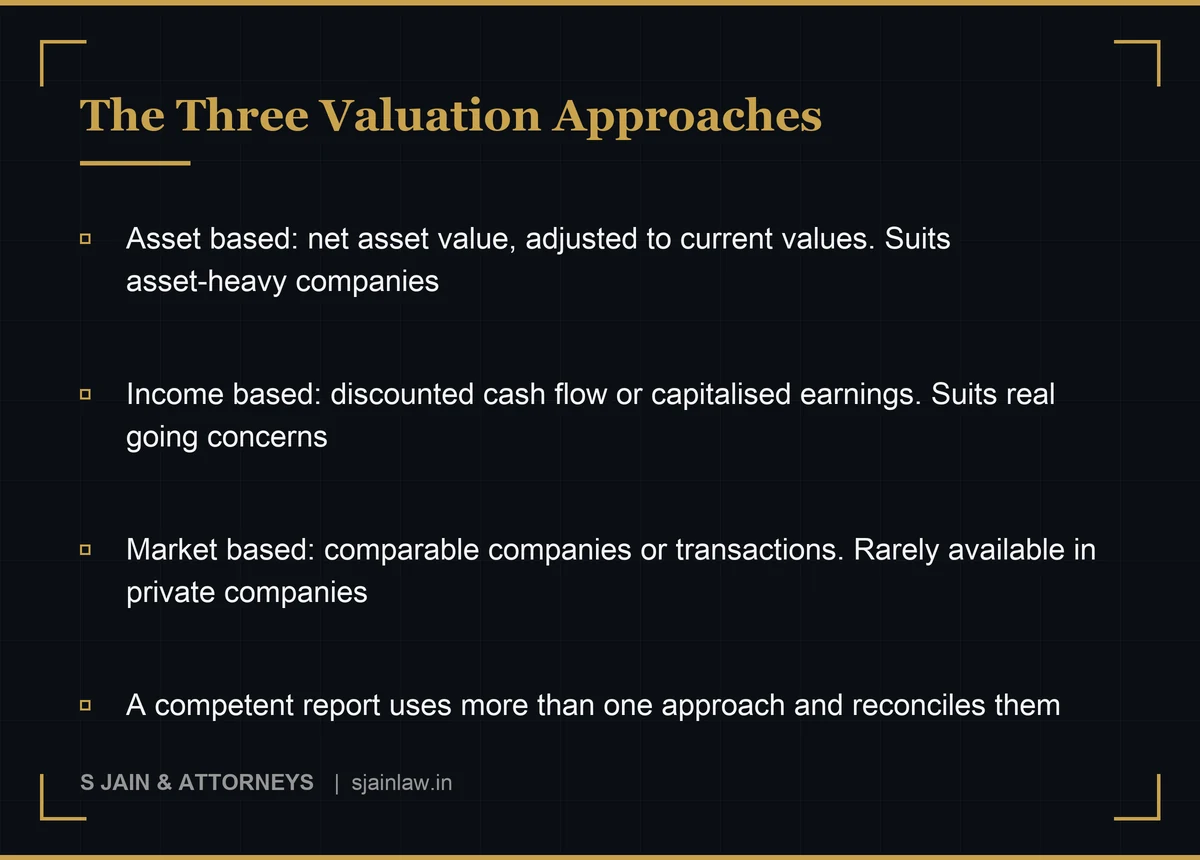
Whatever the label, there are only three families of method. A competent report uses more than one and reconciles them.
1. Asset based
Net asset value, adjusted to current values. Suits asset-heavy companies, real estate holdings and dormant entities.
2. Income based
Discounted cash flow, or capitalisation of maintainable earnings. Suits going concerns with a real trading history.
3. Market based
Comparable companies or comparable transactions. Needs genuinely comparable data, which Indian private companies rarely have.
| Approach | Strongest when | Where it is attacked |
|---|---|---|
| Net asset value | Land, buildings or investments dominate the balance sheet | Book values never revalued; intangibles and goodwill ignored entirely |
| Discounted cash flow | Stable, documented earnings and credible projections | Projections supplied by the party in control; discount rate chosen to suit; terminal value doing all the work |
| Capitalised earnings | Mature business, lumpy but real profits | Choice of the multiple; whether a bad year is treated as representative |
| Comparable transactions | A genuine recent arm's length deal in the same shares exists | The "comparable" is not comparable; related-party pricing dressed up as market evidence |
The minority discount, which is where the money is
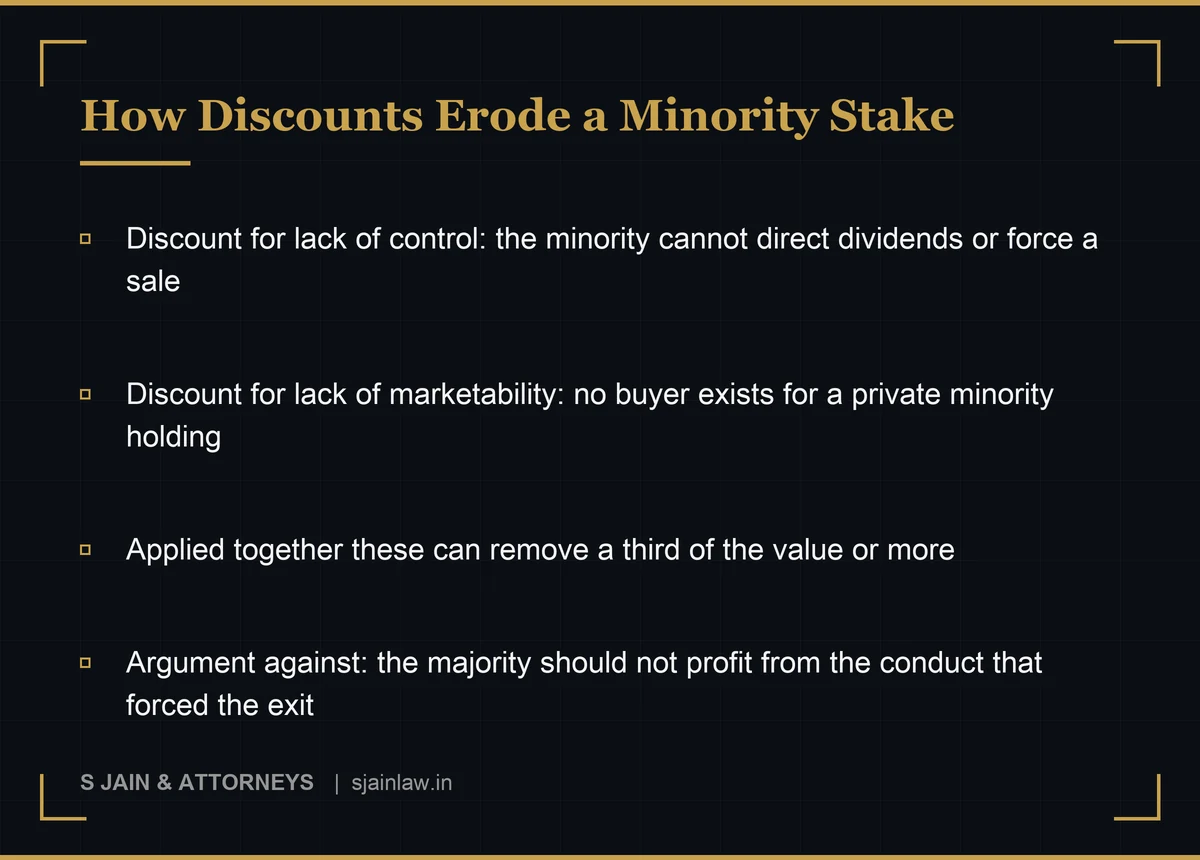
A minority stake in a private company cannot control dividends, cannot force a sale, and cannot be sold to anybody sensible. Conventional valuation therefore applies a discount for lack of control and a further discount for lack of marketability. Applied together these can remove a third of the value or more.
The argument against applying them in an oppression buy-out is straightforward, and it is an argument of principle rather than of finance. The minority is not selling by choice. It is being bought out because the tribunal has found the majority behaved unfairly. To then discount the price precisely because the seller lacks power is to let the majority profit from the very conduct that brought everyone to the tribunal.
That reasoning has considerable force and it is regularly accepted, particularly where the company is in substance a quasi-partnership, the informal-equality-between-participants situation the courts recognise where people went into business together on the understanding that all would participate in management. It is not, however, a rigid rule in India. Section 242 is discretionary, and outcomes are fact-specific. Where the petitioner bought a small stake purely as an investment, never expected management participation, and is exiting on ordinary commercial terms, a discount is much easier to justify.
Key takeaway: treat the discount as an argument to be won on the facts of your company, not as a settled entitlement. Build the quasi-partnership case early, in the pleadings, because it is what carries the no-discount argument later.
What I tell clients at this point is uncomfortable but worth hearing early. The valuation fight is usually decided before a valuer is appointed, and it is decided by the pleadings. I have seen well-founded petitions settle at a poor number because the petition asked for a buy-out at a fair value and said nothing else. No valuation date was pleaded. No add-backs were identified. No quasi-partnership case was set up. By the time the report landed there was nothing on the record to argue from, and the objections read as afterthoughts. The petitions that produce good numbers are the ones where the schedule of related-party leakage was annexed to the petition itself.
Who does the valuing: registered valuers under Section 247
Section 247 of the Companies Act, 2013 requires that where a valuation is required under the Act in respect of any property, stocks, shares, debentures, securities, goodwill or net worth of a company, it shall be done by a person registered as a valuer and possessing the prescribed qualifications. The detail sits in the Companies (Registered Valuers and Valuation) Rules, 2017, which govern registration, asset classes and conduct.
Practical consequences worth knowing before you nominate anybody:
- Confirm the valuer is registered for the correct asset class. A registration for land and building does not cover securities and financial assets.
- Check independence. A valuer who has done recurring work for the company or its promoters is exposed on cross-examination, whichever side proposed them.
- Agree the letter of instruction, not just the identity of the valuer. As set out above, the instruction often decides the answer.
- Fix in advance what the valuer gets access to. A valuation done without the books is a valuation done on the respondent's version of the books.
The valuation date, quietly the biggest lever
Ask any three of the following and you will get three very different numbers: what were the shares worth when the oppression began, what were they worth when the petition was filed, and what are they worth today.
The choice matters enormously, and it usually cuts in a predictable direction. Oppressive conduct commonly depresses value. It strips assets, diverts business to a competing entity controlled by the majority, suppresses dividends, or loads the company with related-party charges. Valuing at the date of the order therefore rewards the wrongdoer, because the wrongdoing has already reduced the number.
The answer is not automatic, but the principle to argue is that the valuation date should be the one that puts the petitioner in the position they would have occupied but for the oppression. Where the company has been damaged by the conduct complained of, that points to a date before the damage, or to a present-day valuation with the effects of the misconduct added back.
Needle Industries: the price can move even without proven oppression
The most useful authority for anyone arguing about price is one where the oppression claim actually failed. In Needle Industries (India) Ltd v Needle Industries Newey (India) Holding Ltd, (1981) 3 SCC 333, the Supreme Court rejected the charge of oppression, restating the standard as conduct that is burdensome, harsh and wrongful, lacking in probity and fair dealing.
Having done so, the Court did not simply dismiss the petition and walk away. It recognised that the Indian shareholders had taken rights shares at par when those shares were worth considerably more, and that this produced an unjust enrichment at the expense of the holding company. It moulded relief accordingly, directing that the difference be paid so that the enrichment was nullified.
That is the point to carry into any valuation dispute. The jurisdiction is equitable. Even where the conduct falls short of oppression, the tribunal retains room to correct a price that would otherwise let one side keep a windfall taken from the other.
What the Tribunal does with the report
A valuation report is evidence. It is not a verdict, and the Tribunal is not obliged to adopt it. In practice one of four things happens.
| Outcome | When it happens |
|---|---|
| Report accepted as it stands | Single tribunal-appointed valuer, sound method, no serious objection filed in time |
| Report accepted with specific adjustments | Method is sound but individual inputs are shown to be wrong, for example an unrevalued property or a diverted contract added back |
| Fresh valuation directed | Independence compromised, wrong asset class, or the valuer worked on materially incomplete records |
| Tribunal fixes its own figure | Two competing reports, both partly credible, and the Tribunal reconciles them in the exercise of its Section 242 discretion |
How to attack a valuation report properly
Objections that say the number is too low achieve nothing. Objections that identify a specific input, show what it should have been, and quantify the difference tend to succeed. Work through this list.
- The instruction. What exactly was the valuer asked to value, and on what basis? A brief that assumes a discount has decided the case before it began.
- The information base. Which records did the valuer see? What was withheld? A report that lists no site visit and no access to the ledgers is a desktop exercise.
- The date. Which date was used, and was the effect of the conduct complained of added back?
- Assets carried at cost. Land bought in 1998 and never revalued is the most common single understatement in Indian private company valuations.
- Related-party leakage. Management fees, rent, royalties or purchases running to entities controlled by the majority. Each is an add-back to maintainable earnings.
- Projections. Who prepared them, and do they match what the company told its bankers or its tax authority in the same period? Divergence is powerful material.
- Discount rate and multiple. Ask the valuer to justify each component. Unexplained risk premiums do not survive questioning.
- Discounts applied. Identify them, quantify them, and argue the principle set out above.
The mirror image: Section 236 squeeze-outs
Section 242 is not the only route to a compulsory transfer. Section 236 of the Companies Act, 2013 deals with the purchase of minority shareholding. Where an acquirer, or persons acting in concert, become registered holders of ninety per cent or more of the issued equity share capital of a company, whether directly or by amalgamation, share exchange, conversion of securities or otherwise, they must notify the company of their intention to buy the remaining shares, and the price is determined by a registered valuer under the prescribed rules. The section also gives the minority a corresponding right to require the majority to buy them out.
The reason it matters here is tactical. A minority holder facing a Section 236 notice is being priced by a valuer engaged in a process the majority initiated. A minority holder who files under Section 241 first is being priced by a valuer in a process where oppression is on the record. Those are very different negotiating positions, and the sequence is a choice.
Before you file: five things that decide the price later
- Secure the historic financials, including the years before the conduct complained of. You will need the pre-oppression baseline.
- Pull every related-party disclosure from the annual accounts and build a schedule of leakage.
- Identify undervalued assets, particularly land, brands and long-held investments, and get indicative current values.
- Preserve evidence of the quasi-partnership understanding, meaning the emails, the shareholders agreement, the pattern of participation in management. This carries the no-discount argument.
- Plead the valuation date and the add-backs expressly in the petition.
Related guides and where to get help
- Oppression and Mismanagement under Sections 241-242: Minority Shareholder Remedies at NCLT
- Shareholder Disputes in Private Limited Companies: Legal Remedies & Prevention
- Moonlighting in India: Is a Second Job Legal, and Can You Be Fired for It?
Frequently Asked Questions
Can the NCLT force the majority to buy me out?
Yes. Section 242(2)(b) of the Companies Act, 2013 lets the Tribunal order the purchase of the shares of any members by other members or by the company. It is discretionary, so the Tribunal decides both whether to order a purchase and on what terms.
Is fair value the same as market value?
No, and the difference is usually the whole dispute. Fair value generally means your proportionate share of the undertaking as a whole. Fair market value means what a hypothetical buyer would pay for your particular minority holding, which in a private company is far less.
Will a minority discount be applied to my shares?
It depends on the facts. Where the company is in substance a quasi-partnership and you are exiting because of the majority's own misconduct, there is a strong argument that no discount should apply. Where you were a passive investor with no expectation of managing, a discount is easier to justify. It is not a settled rule either way in India.
Who appoints the valuer?
Frequently the Tribunal, either from a panel or from names proposed by the parties. The valuer must be a registered valuer under Section 247 and the Companies (Registered Valuers and Valuation) Rules, 2017, and must be registered for the correct asset class.
Which date is used to value the shares?
There is no fixed date. It is argued and decided. Because oppressive conduct often depresses value, an oppressed minority normally argues for a date before the conduct, or for a present valuation with the effects of the conduct added back.
Can I challenge a valuation report I disagree with?
Yes, by filing objections. General complaints that the figure is too low rarely succeed. Objections that identify a specific input, show what it should have been and quantify the difference are what move the number.
What if the company has been stripped of its assets already?
That is what add-backs and the choice of valuation date are for. A valuation that simply photographs a company after the assets have gone rewards the conduct complained of, and the equitable nature of Section 242 is the answer to it.
This article is for general informational purposes only and does not constitute legal advice. Valuation outcomes turn entirely on the facts, the records and the pleadings in the individual case. Please consult a qualified advocate about your own matter.