In 2022 a large Indian IT company terminated a group of employees for holding second jobs, and the word moonlighting entered Indian workplace conversation for good. The debate that followed generated a great deal of opinion and very little law. Employees were told it was illegal. Employers were told they could not stop it. Both statements are wrong.
Part of the employment and labour law practice at S Jain & Attorneys, Bangalore.
There is no provision in Indian law that says an employee may not hold a second job. There is also no provision that protects an employee who does. The answer sits in a handful of different instruments, and which one governs you depends on where you work and what you signed.
- No single Indian statute bans moonlighting across the board.
- Your employment contract is usually the decisive document. An exclusivity clause operating during employment is generally enforceable.
- A restraint that operates after employment ends is void under Section 27 of the Contract Act, 1872, however it is drafted.
- Factory and mine workers face a specific statutory bar on double employment, now under Section 30 of the Occupational Safety, Health and Working Conditions Code, 2020, which replaced Section 60 of the Factories Act, 1948.
- Termination for moonlighting is termination for misconduct, which means the employer must follow a fair process, not simply send a letter.
India's four labour codes came into force on 21 November 2025, with the central rules following on 30 December 2025. Two of the instruments in this article moved. The Factories Act, 1948 was repealed by Section 143 of the Occupational Safety, Health and Working Conditions Code, 2020, and the Industrial Employment (Standing Orders) Act, 1946 by Section 104 of the Industrial Relations Code, 2020. The Contract Act analysis, which is what actually decides most moonlighting disputes, is untouched.
Where the rules actually come from
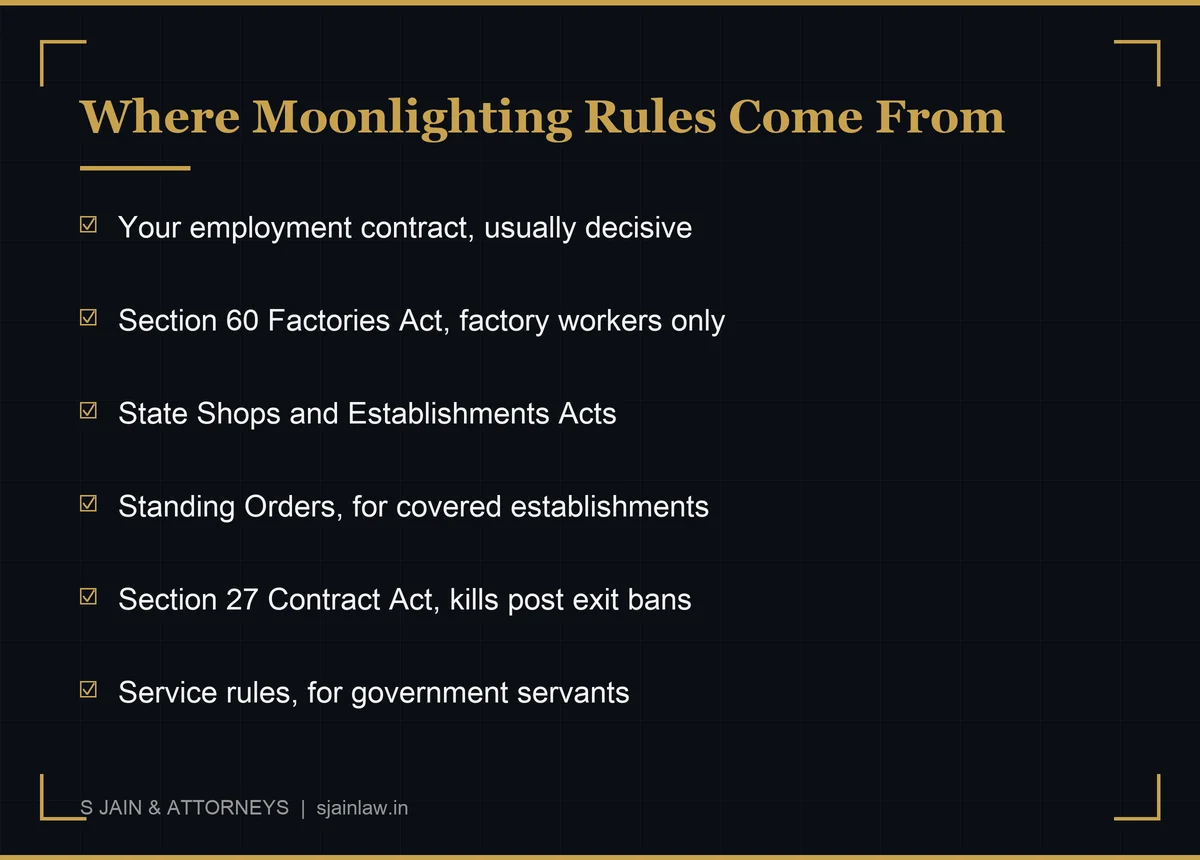
Because there is no single moonlighting law, the position is assembled from several sources. Which of them applies to you determines almost everything.
| Source | What it actually controls | Who it applies to |
|---|---|---|
| The employment contract | Exclusivity, conflict of interest, working hours, confidentiality, disclosure obligations | Everyone with a written contract. The most common battleground |
| Section 30, Occupational Safety, Health and Working Conditions Code, 2020 (formerly Section 60, Factories Act, 1948) | A direct statutory restriction: no worker may be required or allowed to work in a mine or factory if he has already been working in another such establishment within the preceding twelve hours, save in circumstances prescribed by the appropriate Government | Workers in factories and mines, not office employees |
| OSH Code hours provisions, Sections 25 to 27 | Eight hours a day, no more than six days in a week, and double wages for overtime with the worker's consent | Establishments covered by the Code |
| State Shops and Commercial Establishments Acts | Hours of work, rest, overtime and total working limits. Some State laws contain double employment restrictions. These are State statutes and were not repealed by the codes | Shops and commercial establishments, including most offices |
| Standing orders under Chapter IV of the Industrial Relations Code, 2020 (formerly the Industrial Employment (Standing Orders) Act, 1946) | Defines misconduct for covered industrial establishments, and the procedure for punishing it. Model standing orders made by the Central Government apply until certified standing orders come into operation | Workers in industrial establishments with 300 or more workers, the threshold set by Section 28 of the Code |
| Section 27, Contract Act, 1872 | Renders agreements in restraint of a lawful profession or trade void | Everyone. It is what kills post employment restrictions |
| Service conduct rules, for example the CCS (Conduct) Rules, 1964 | Prohibit government servants from engaging in private trade or employment without sanction | Government servants, not private sector employees |
Two things follow immediately. First, a software engineer in a Bengaluru office is not covered by the factory and mine double employment bar, now Section 30 of the OSH Code, whatever a HR circular may imply. Second, a government servant faces a far stricter regime than any private employee, which is why comparisons between the two are unhelpful. A third point is new since the codes came into force: the standing orders threshold is now 300 workers, so a good many mid-sized establishments that once had certified standing orders defining moonlighting as misconduct now fall outside that chapter altogether, and the employer is thrown back on the contract.
The contract: what an employer can and cannot restrict
This is where most moonlighting questions are decided, and Indian law draws a sharp line through the middle of it.
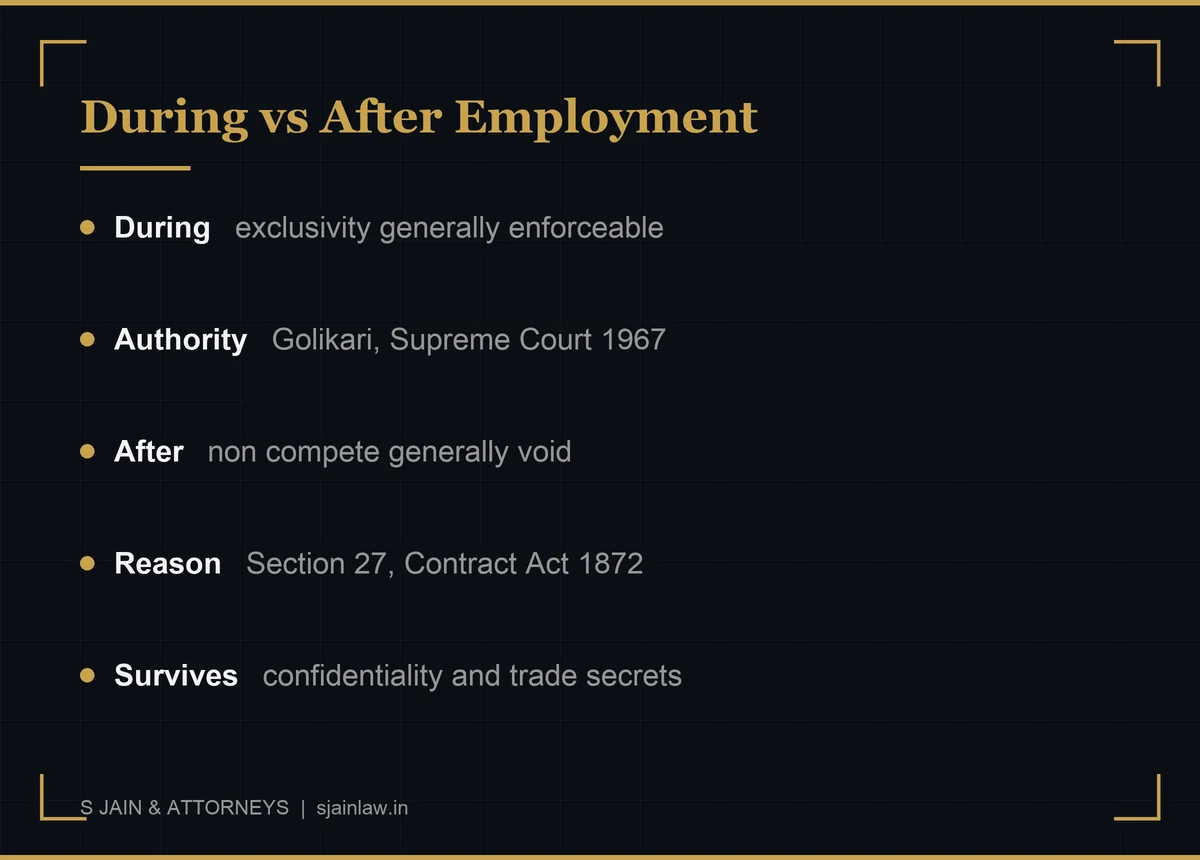
During employment, a clause requiring the employee to devote their whole time to the employer, or not to work for a competitor, is generally valid. The Supreme Court settled this in Niranjan Shankar Golikari v Century Spinning and Manufacturing Co Ltd (1967). Golikari was a shift supervisor in a tyre cord plant, engaged on a five year contract containing a covenant not to work for a competitor during the term. He left shortly after training and joined a competitor. The Court upheld an injunction against him, holding that negative covenants operating during the period of employment, when the employee is bound to serve the employer exclusively, are not regarded as a restraint of trade and do not fall foul of Section 27.
After employment ends, the position reverses completely. Section 27 of the Contract Act makes an agreement restraining anyone from exercising a lawful profession, trade or business void to that extent. Indian courts have applied this strictly, and a clause preventing a former employee from working for a competitor after leaving is generally unenforceable regardless of its duration or geography.
Key takeaway: the enforceability of a restriction turns on when it operates, not on how reasonably it is drafted. During employment, generally enforceable. After employment, generally void.
What survives after employment is a narrower category: obligations protecting confidential information and trade secrets, and obligations arising from the employee's own continuing duties of confidence. An employer cannot stop you working, but it can restrain you from using or disclosing what belongs to it. That distinction is where well drafted agreements do their real work, and it is why a properly prepared non disclosure agreement often protects an employer better than an unenforceable non compete.
When is moonlighting actually misconduct?
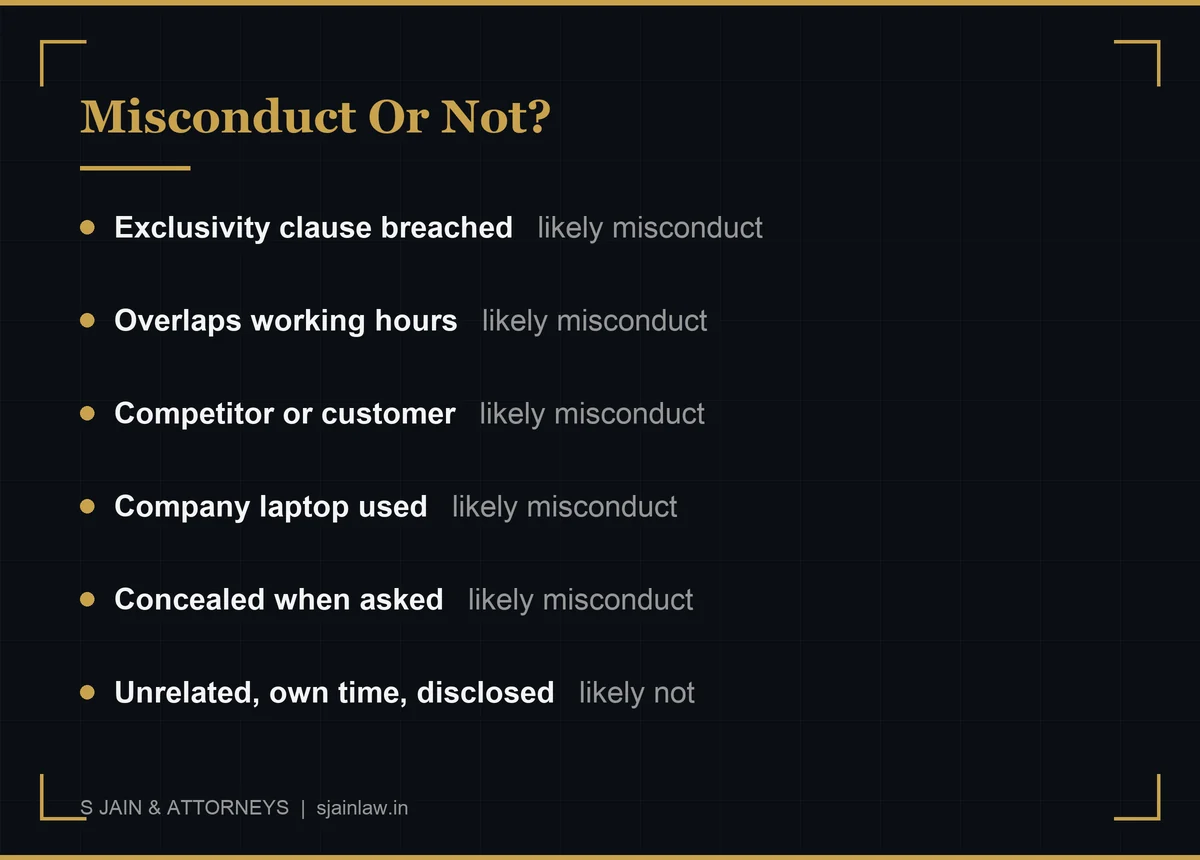
An employer who wants to act on moonlighting must locate the conduct in a recognised category of misconduct. The mere existence of a second income is not enough. The tests that matter are these.
| Test | Likely misconduct | Likely not misconduct |
|---|---|---|
| Contract | Contract contains an exclusivity or whole time clause and the employee ignored it | No exclusivity clause at all, and nothing prohibiting outside work |
| Hours | Second job overlaps working hours, or fatigue demonstrably affects performance | Work done at weekends or after hours with no impact on duties |
| Conflict | Second employer is a competitor, customer or supplier | Unrelated field with no commercial overlap, for example teaching music |
| Resources | Employer's laptop, email, systems, data or premises used for the other work | Own device, own time, own accounts |
| Disclosure | Employee concealed the engagement or lied when asked directly | Employee disclosed it, or was never asked and had no duty to volunteer |
| Confidentiality | Employer's confidential information used in the second engagement | Generic skills applied, with no proprietary information involved |
In practice the two that decide most cases are conflict and dishonesty. An employee doing unrelated freelance work at weekends, on their own machine, with no exclusivity clause, is in a strong position, and the remedies for an unfair termination remain fully available to them. An employee working for a direct competitor while denying it when asked is in a very weak one, and the dishonesty usually hurts more than the second job itself.
The authorities that actually govern
| Authority | Year and forum | What it established |
|---|---|---|
| Niranjan Shankar Golikari v Century Spinning and Mfg Co Ltd | 1967, Supreme Court | A negative covenant operating during employment, where the employee is bound to serve exclusively, is not a restraint of trade and does not offend Section 27. Injunction upheld against an employee who joined a competitor mid term. |
| Superintendence Company of India v Krishan Murgai | 1981, Supreme Court | Reinforced that a restrictive covenant operating after the end of employment attracts Section 27 and is generally void. |
| Percept D'Mark (India) Pvt Ltd v Zaheer Khan | 2006, Supreme Court | A restriction operating after a contract has ended is void under Section 27, and the reasonableness of the restraint does not rescue it. |
| Section 27, Contract Act, 1872 | Statute | Agreements in restraint of a lawful profession, trade or business are void to that extent, subject only to the narrow statutory exception on sale of goodwill. |
Read together, these produce a rule that is simple to state and frequently ignored in drafting: an Indian employer can bind an employee's loyalty while they are employed, and can protect its information forever, but it cannot bind their livelihood afterwards.
What the 2022 episode did and did not decide
The terminations that made moonlighting a national conversation were commercial decisions taken by employers, not judicial rulings. No court laid down that moonlighting is unlawful, and no court held that employees are entitled to it. What the episode actually produced was a wave of contractual amendment, as employers inserted or sharpened exclusivity and disclosure clauses that had often been absent or perfunctory.
That matters for anyone assessing their own position today. An employee whose contract was signed in 2019 may have nothing restricting outside work at all. The same employee, having accepted a revised handbook or a fresh policy acknowledgement in 2023, may now be bound by a clause they never read. Where an employer relies on a policy rather than the contract, the questions become whether the policy was properly communicated, whether the employee acknowledged it, and whether it was applied consistently across the workforce.
Practice note: before assuming you are restricted, find out which document actually binds you. Employees are frequently disciplined under a policy that was never circulated to them, and employers frequently rely on clauses that were superseded.
Joint employment, and the second employer's position
A question that receives almost no attention is what happens to the second employer. It is rarely a passive bystander.
Where the second engagement is with a competitor, and the first employer's confidential information is used, the second employer can face exposure of its own. An employer who knowingly induces an employee to breach a subsisting exclusivity obligation, or who benefits from the transfer of a rival's confidential information, is not insulated merely because the employee was the one who breached the contract. That is a commercial risk which sensible organisations manage at the hiring stage by asking candidates directly about subsisting obligations and requiring a written confirmation.
There is also a practical point for the employee. Where the second employer requires a declaration that the candidate is not otherwise employed, a false declaration creates a fresh problem with the new employer, independent of anything the first employer may do. Employees who conceal a first job to obtain a second one frequently find they have created two vulnerabilities rather than one.
Warning: the moment a false declaration exists in writing with either employer, the dispute stops being about workload and becomes about honesty. That shift is almost always fatal to the employee's position.
What an employer must do before terminating
Termination for moonlighting is termination for misconduct, and that engages process. For employees who qualify as workers in establishments covered by the standing orders chapter of the Industrial Relations Code, the requirements are formal and unforgiving. For others, the contract and general principles of fairness govern, but the practical expectation of a fair hearing has become widespread.
- Establish the facts first. An assumption drawn from a provident fund record or a LinkedIn profile is not proof of a second employment. Verify before acting.
- Identify the breach precisely. Which clause, which duty, which resource. "Moonlighting" is not itself a charge; the charge is breach of an exclusivity obligation, or misuse of confidential information, or dishonesty.
- Issue a show cause notice. Set out the allegation with particulars and give a genuine opportunity to reply. A notice that names no clause and no facts is worthless.
- Hold a fair enquiry. Where an enquiry is required, it must be genuine: notice of the charge, the evidence disclosed, an opportunity to be heard, and an impartial enquiry officer.
- Decide proportionately. A first instance of undisclosed unrelated freelance work and a sustained engagement with a direct competitor are not the same thing. The penalty should reflect the difference.
- Record everything. The file is what will be examined later, not anyone's recollection of the conversation.
Where an employer skips these steps, the termination itself becomes the vulnerability, and the employee's claim shifts from defending the second job to challenging the process. Our guide on wrongful termination and employee remedies sets out what follows from a defective process.
What an employee should do if accused
- Ask for the allegation in writing, with the clause relied on and the facts alleged. Do not respond to a verbal accusation with a verbal explanation.
- Read your own contract before replying. A surprising number of accused employees have no exclusivity clause at all.
- Do not resign under pressure. A resignation obtained by threat of a bad reference removes your remedies and is exactly what a poorly prepared employer wants.
- Be truthful in your reply. Concealment is the aggravating factor most likely to convert a defensible situation into a dismissal.
- Preserve the evidence that the outside work was on your own time and equipment, and did not involve the employer's information.
- Check whether an enquiry was actually held. Where the process was skipped, that is often the strongest point available.
Common mistake: employees deny the second engagement outright, then it is proved. At that point the case is no longer about moonlighting; it is about honesty, and that is a much harder case to defend.
The moonlighter's own exposure
Even where the second job is contractually permissible, it creates obligations of its own that are routinely ignored.
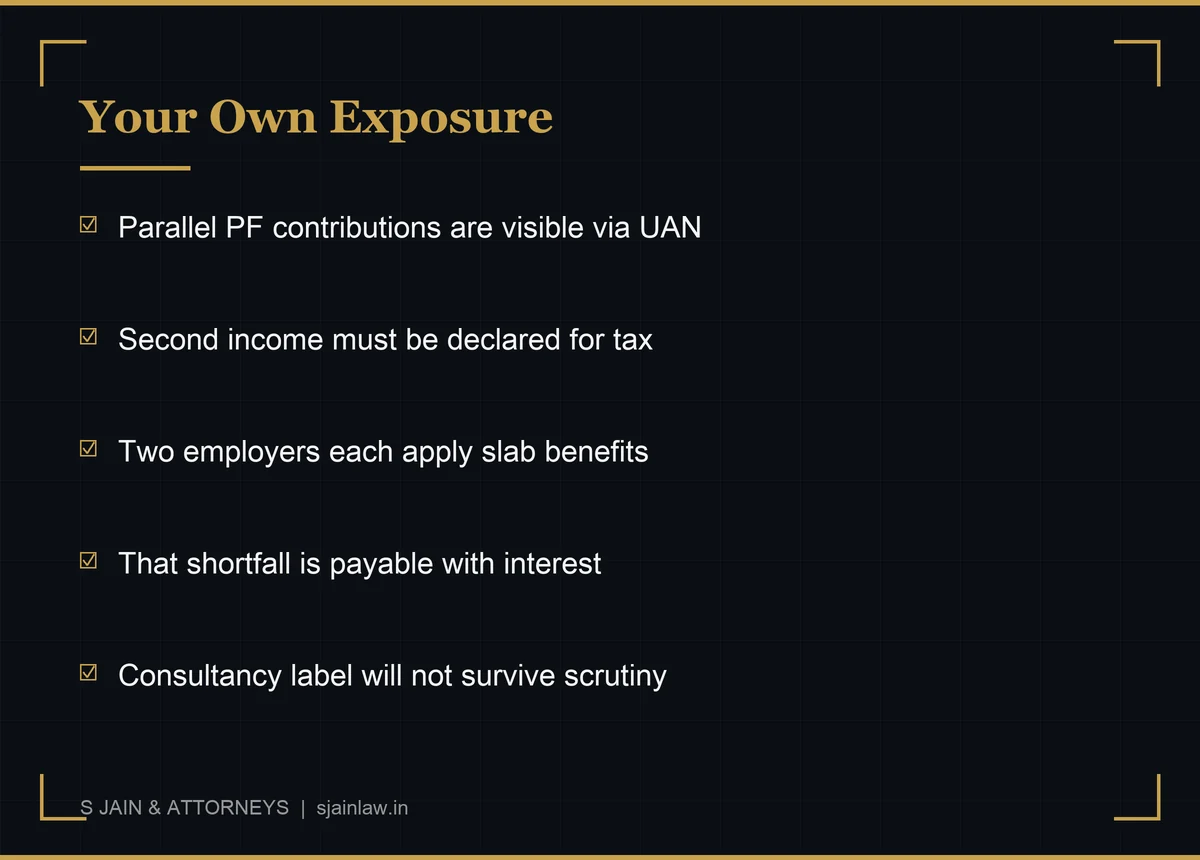
Provident fund and ESI. Simultaneous employment with two covered employers raises questions about contributions and membership. The universal account number system makes parallel contributions visible, and a mismatch is often how an employer discovers the second job in the first place.
Income tax. Income from the second engagement is taxable and must be declared. Where both employers deduct tax at source without knowing about the other, each applies the basic exemption and slab benefits independently, which routinely produces a shortfall the employee must make good with interest at the time of filing. Employees should report the earlier or additional employment income to one employer so that deduction is correct, or plan for the shortfall in advance.
Contract for service versus contract of service. Genuine freelancing under a contract for service is different in character from a second employment. The distinction affects tax treatment, statutory benefits and the strength of any exclusivity argument, and a document titled "consultancy agreement" will not survive scrutiny if the relationship in substance is employment. This is worth getting right when the arrangement is set up rather than when it is challenged, and the drafting points are set out in our note on service agreement drafting.
Gig work and the changing statutory picture
The Code on Social Security, 2020 recognises gig workers and platform workers as categories and provides for social security schemes for them. The Code was brought into force on 21 November 2025 and the central rules followed on 30 December 2025, so this is no longer a proposal to watch. What still needs checking case by case is the State position, because much of the machinery, including registration and the schemes themselves, runs through rules and notifications rather than through the Code alone.
What the direction of travel does suggest is that parallel and platform based work is being treated as a normal feature of the labour market rather than an aberration. Employers who write policies on the assumption that all outside work is suspicious are drafting against that current.
What employers should actually do
The instinct after 2022 was to add a blanket prohibition to every contract. That is the weakest available response, because a total ban on any outside activity is both hard to police and unattractive to the people an employer most wants to keep.
- Write a real outside activity policy that distinguishes between competing work, conflicting work and unrelated work. Prohibit the first two and require disclosure of the third.
- Create a disclosure route that an employee can actually use without fearing dismissal for asking. Policies that make honesty dangerous produce concealment.
- Define conflict of interest with examples rather than as an abstraction. Employees comply with rules they understand.
- Protect information rather than employment. Confidentiality and trade secret protections survive the end of employment. Non competes generally do not.
- Address hours and availability directly, since the legitimate concern is usually performance and fatigue rather than the mere existence of another engagement.
- Apply the policy consistently. Selective enforcement against particular employees is the fact pattern that turns a defensible policy into a discrimination or victimisation argument.
The wider framework of employment documentation this fits into is covered in our guide to the employment agreement in India, and our employment and labour practice page sets out the disputes that follow when these documents are wrong.
Two situations that behave differently
Notice period and garden leave
An employee serving notice is still an employee. The exclusivity obligation continues until the last working day, which is why starting a second job during notice is a common and avoidable mistake. Where an employer places an employee on garden leave, paying them to stay away, the obligation of loyalty ordinarily continues for that period as well, because the employment relationship subsists even though no work is being done. Employees frequently treat garden leave as freedom; contractually it usually is not.
The related question of whether an employer can insist on the full notice period, or recover pay in lieu, turns on the contract and on whether the clause operates as a genuine pre estimate of loss rather than a penalty. That is a separate argument, and it is worth taking advice before simply walking out.
Startup founders and advisory roles
A quieter version of this problem affects senior employees who take advisory positions, board seats or small equity stakes in other ventures. These arrangements rarely look like a second job and are rarely disclosed, but they engage exactly the same tests: is there a conflict, is the employer's time or information being used, and did the contract require disclosure. An advisory role with a company in an adjacent market is more dangerous than a weekend teaching job, precisely because it is closer to the employer's business.
Employees in this position should assume the conflict question will be asked eventually, and should create the disclosure record before it is. An email to a reporting manager, acknowledged, is usually enough to remove the concealment argument entirely, and concealment is what turns these matters into terminations.
Five mistakes on both sides
- Employers relying on a post employment non compete. It is void under Section 27 and gives false comfort. Invest in confidentiality protection instead.
- Employers terminating on suspicion. Provident fund records or a public profile suggest a second engagement; they do not prove one, and acting without verification hands the employee the case.
- Employees assuming silence is safe. Where a contract requires disclosure, not volunteering the information is itself the breach, independent of the outside work.
- Employees using company equipment or accounts. This single fact converts a weak employer case into a strong one, because the evidence is on the employer's own systems.
- Both sides ignoring the tax and provident fund position. The consequences arrive later, quietly, and fall on the employee.
Documents that decide these disputes
- The appointment letter and every subsequent contract or policy acknowledgement
- The specific exclusivity, whole time, conflict of interest and confidentiality clauses
- Any employee handbook or outside activity policy, and evidence that it was circulated
- The show cause notice, the reply, the enquiry record and the termination order
- Evidence of hours: attendance, access logs, and the timing of the outside work
- Device and account records showing whose equipment was used
- Provident fund and tax records showing the parallel engagement
A note from practice
The moonlighting cases that reach me divide neatly into two piles, and the division is almost never about the second job. In the first pile the employee did unrelated work in their own time, disclosed it or was never asked, used nothing belonging to the employer, and the employer reacted to the discovery rather than to any actual harm. Those cases are defensible, and they usually settle once the employer's lawyer reads the contract and finds no exclusivity clause. In the second pile the employee worked for a competitor, used the company laptop, and denied it in writing when confronted. Nothing can be done with the third fact. What I say to employers is that the policy they need is not a ban but a disclosure mechanism, because the harm they actually fear is conflict and leakage, and both are far easier to manage when people are willing to tell you. What I say to employees is narrower: read your contract before you take the second engagement, keep it on your own machine and your own time, and if you are asked a direct question, answer it honestly. Almost every moonlighting dismissal I have seen become unwinnable turned on the denial rather than the work.
Glossary
- Moonlighting: holding a second job or engagement alongside primary employment.
- Exclusivity or whole time clause: a contractual term requiring the employee to devote their working time solely to the employer.
- Restraint of trade: an agreement limiting a person's freedom to carry on a lawful trade or profession, void under Section 27 to that extent.
- Negative covenant: a promise not to do something, such as not to work for a competitor.
- Worker: a defined category of employee attracting specific statutory protections on termination. The Industrial Relations Code, 2020 uses "worker" where the repealed Industrial Disputes Act, 1947 used "workman".
- Standing orders: the certified rules of conduct and discipline in covered industrial establishments, now governed by Chapter IV of the Industrial Relations Code, 2020.
- Contract for service: an engagement as an independent contractor, distinct from a contract of service, which is employment.
- Domestic enquiry: the internal disciplinary process by which an employer establishes misconduct before punishing it.
Related guides and where to get help
- Employment Agreement in India: Key Clauses Guide
- Share Valuation in NCLT Buy-Out Orders: How Fair Value Is Fixed When a Minority Shareholder Exits
- Gratuity in India: Who Qualifies, How It Is Calculated, and When It Can Be Forfeited
- Unfair Labour Practices: The List of Things an Employer Cannot Do
Frequently Asked Questions
Is moonlighting illegal in India?
No statute prohibits it generally. Whether it is permissible for you depends on your contract, the statute governing your establishment, and whether a conflict of interest arises.
Can my employer stop me working a second job?
During employment, yes, where the contract contains an exclusivity or whole time clause. Such clauses have been treated as enforceable since Niranjan Shankar Golikari v Century Spinning (1967) and are not treated as a restraint of trade.
Can my employer stop me joining a competitor after I leave?
Generally no. Section 27 of the Contract Act, 1872 makes agreements in restraint of a lawful profession void, and post employment non compete clauses are usually unenforceable in India.
What if my contract has no exclusivity clause?
Your position is considerably stronger. Without a contractual restriction, the employer must point to something else, such as a conflict of interest, use of its resources or confidential information, or dishonesty in response to a direct question.
Does the double employment bar apply to my office job?
No. Section 60 of the Factories Act, 1948 was repealed with that Act on 21 November 2025 and replaced by Section 30 of the OSH Code, 2020, which restricts a worker from working in a mine or factory if he has already worked in another such establishment within the preceding twelve hours. It does not govern employees in offices, which are regulated by the applicable State Shops and Commercial Establishments legislation.
Can I be dismissed on the spot for moonlighting?
Termination for moonlighting is termination for misconduct, which requires the employer to establish the misconduct through a fair process. Where an enquiry was required and skipped, the termination itself is open to challenge.
Is freelancing on weekends acceptable?
Where there is no exclusivity clause, no conflict with the employer's business, no use of its resources, and no impact on your duties, it is usually defensible. Check whether your contract requires disclosure even of unrelated work.
Should I tell my employer about outside work?
Where the contract requires disclosure, yes, and the failure to disclose is itself the breach. Even where it does not, disclosure removes the dishonesty argument, which is what damages employees most in these disputes.
What are the tax consequences of a second income?
It is taxable and must be declared. Where two employers each deduct tax without knowledge of the other, both apply exemption and slab benefits independently, which commonly produces a shortfall payable with interest at the time of filing.
Will my provident fund reveal a second job?
Parallel contributions under the universal account number system are visible, and this is frequently how a second engagement comes to light.
Do government servants have the same freedom?
No. Service conduct rules such as the Central Civil Services (Conduct) Rules, 1964 restrict government servants from engaging in private trade or employment without sanction. That regime is stricter than anything applying to private sector employees.
Can an employer enforce a blanket ban on all outside activity?
It can write one, but a total prohibition unrelated to conflict, hours or confidentiality is difficult to justify and difficult to enforce consistently. A targeted policy with a disclosure route is both more defensible and more effective.
This guide is general legal information for public awareness and is not legal advice. Whether a particular second engagement is permissible, and whether a particular termination was lawful, depends on the contract, the applicable statute and the process followed. Please consult a qualified advocate about your specific matter.