Gratuity is one of the few payments an Indian employee earns simply by staying. It is not a performance bonus and it is not discretionary. Once the gratuity chapter of the Code on Social Security, 2020 applies to your establishment and you satisfy the qualifying conditions, gratuity becomes a statutory debt owed to you. Employers still treat it as something they may withhold at will, a pattern we see across employment and labour matters, and employees still walk away from it because nobody told them the gratuity rules or the deadline to claim.
Part of the employment and labour law practice at S Jain & Attorneys, Bangalore.
India's four labour codes came into force on 21 November 2025, with the central rules following on 30 December 2025. The Payment of Gratuity Act, 1972 stands repealed by Section 164 of the Code on Social Security, 2020, along with the EPF Act, the ESI Act, the Maternity Benefit Act and five other enactments. Gratuity now sits in Chapter V of the Code. The scheme survived the move almost intact, and this guide keeps the old section numbers alongside the new ones because that is how the case law and most people's paperwork still read. Where the Code changed something, it is flagged.
- Who qualifies: employees of an establishment with 10 or more employees, after 5 years of continuous service. The 5 year condition does not apply where service ends due to death or disablement, or on expiry of a fixed term contract.
- How much: 15 days of last drawn wages for every completed year of service. For monthly rated employees the divisor is 26, not 30.
- Ceiling: now fixed by Central Government notification under Section 53(3) of the Code, rather than written into the statute as the old Rs 20 lakh figure was. Check the notification in force before you rely on a number.
- Forfeiture: only under Section 53(6), the old Section 4(6), and only where the employee was terminated on that ground. After the Supreme Court's 2025 ruling, a criminal conviction is not required, but a fair enquiry is.
- If unpaid: apply to the competent authority, which is what the Code calls the officer the old Act called the Controlling Authority. Interest runs on delayed payment, and the amount is recoverable through a Recovery Officer.
When the gratuity chapter applies to you
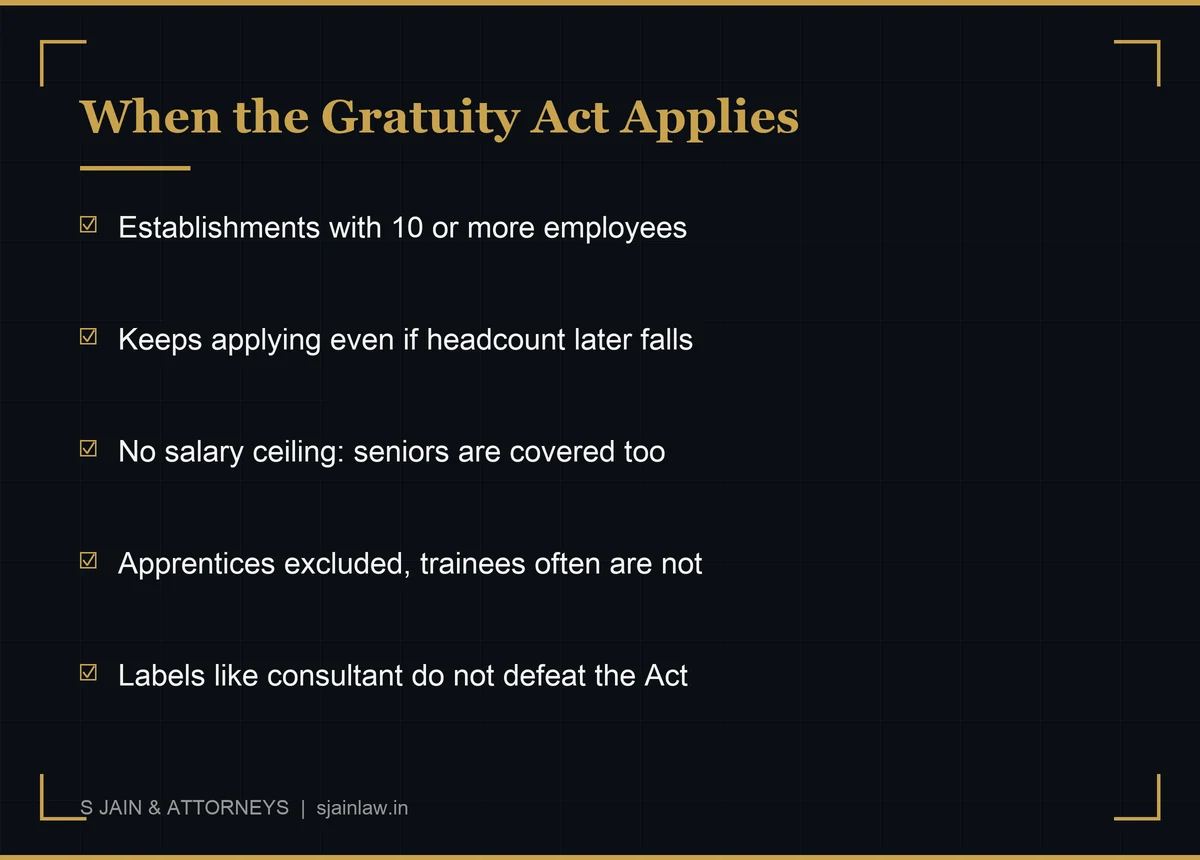
The threshold used to sit in Section 1(3) of the 1972 Act. It now sits in the First Schedule to the Code, read with Section 1(4), and the wording is materially the same. Chapter V applies to every factory, mine, oilfield, plantation, port and railway company, and to every shop or establishment in which ten or more employees are employed, or were employed on any day of the preceding twelve months, together with such other shops or establishments as the appropriate Government notifies.
Two consequences follow that employees routinely miss. First, once the chapter has applied to an establishment it continues to apply even if the headcount later falls below ten. The obligation does not switch off when the workforce shrinks. Second, the ten person count is of employees, not of names on a particular payroll structure, so an employer cannot escape the obligation by describing part of its workforce as consultants while treating them as employees in substance.
The Code defines who is an employee in its definition clause, in terms close to the old Section 2(e): any person employed on wages to do any skilled, semi-skilled, unskilled, manual, operational, supervisory, managerial, administrative, technical or clerical work, whether the terms of employment are express or implied. Apprentices engaged under the Apprentices Act are excluded. Notably, the definition is not limited by salary for gratuity purposes. A senior manager earning a large package is as much an employee as a shop floor worker, whatever the employment agreement calls the role, which is why gratuity disputes reach every level of the organisation chart.
The five year rule, and the 240 day question
Section 53(1) of the Code, the old Section 4(1), is the eligibility provision. Gratuity is payable to an employee on termination of employment after he has rendered continuous service for not less than five years, where the termination is on superannuation, on retirement or resignation, on death or disablement due to accident or disease, on termination of the contract period under fixed term employment, or on any other event the Central Government notifies. For a working journalist the five years reads as three.
The fixed term limb is new, and it matters. It did not exist in the 1972 Act, and it is dealt with separately below.
The proviso is the part people forget. The five year requirement does not apply where employment ends because of death or disablement, or on the expiry of fixed term employment. A family that loses an earning member after two years of service is still entitled, and the gratuity is payable to the nominee or legal heirs. In my experience this is the single most under claimed entitlement in Indian employment law, because grieving families do not know to ask.
What counts as continuous service is defined by Section 54, which replaced Section 2A and carries the same arithmetic. Where an employee is not in continuous service for a full year, he is deemed to be in continuous service if he has actually worked for not less than 240 days in the preceding twelve months, or 190 days in an establishment working fewer than six days a week or in an underground mine. Periods of layoff, authorised leave, strike, lock-out and cessation of work not due to the employee's fault are counted, not deducted, and service rendered before the Code commenced counts just as service rendered after it does.
Key takeaway: the five year clock is about continuous service under Section 54, not about a neat calendar count. Interruptions that were the employer's doing, or that the statute protects, do not break it.
This produces the well known question: does four years and 240 days qualify? The Madras High Court has taken the view that where an employee completes 240 days in the fifth year, that year is treated as a completed year of continuous service, so the employee qualifies. That reasoning is persuasive and often relied on, but it has not been uniformly adopted across all High Courts and it is not a Supreme Court holding. It was decided on Section 2A of the 1972 Act, and Section 54 of the Code reproduces that provision, so the argument transfers, but it is no stronger for the transfer than it was before. The practical position I give clients is this: if you have crossed four years and 240 days, you have a genuine claim worth pressing, but do not treat it as settled entitlement. If you have any control over your exit date and you are close to the line, cross five full years and remove the argument entirely.
How gratuity is calculated
Section 53(2), the old Section 4(2), sets the formula. For every completed year of service, or part of a year in excess of six months, the employer pays gratuity at the rate of fifteen days wages based on the rate of wages last drawn. The Code adds a power for the Central Government to notify a different number of days, so the fifteen is no longer fixed in the statute itself.
For a monthly rated employee, Explanation 3 to Section 53 preserves the old method: the fifteen days wages are calculated by dividing the monthly wages by twenty six and multiplying by fifteen. The divisor of 26 rather than 30 exists because the statute assumes four weekly offs in a month. This single number is where most employer calculations quietly go wrong, always in the employer's favour.
"Wages" is where the Code made a real change, and it is one employees should check. The codes use a single definition of wages: basic pay, dearness allowance and retaining allowance, with house rent allowance, conveyance, overtime, commission and the rest excluded, much as before. But there is now a proviso. Where the excluded payments exceed one-half of total remuneration, or such other percentage as the Central Government notifies, the excess is added back and treated as wages. The old practice of engineering a small basic and a large allowance component to shrink gratuity therefore no longer works cleanly. If your structure is allowance heavy, recompute on the statutory definition rather than on the basic figure on your payslip, because the two may no longer be the same number.
| Category | Formula | Note |
|---|---|---|
| Monthly rated employee covered by the Act | (Last drawn monthly wages / 26) x 15 x completed years | Part year over 6 months counts as a full year |
| Employee in a seasonal establishment | 7 days wages for each season | Second proviso to Section 53(2) |
| Piece rated employee | Based on average of total wages for 3 months preceding termination | Overtime wages excluded from the average |
| Fixed term employee | Pro rata, without the five year requirement | Third proviso to Section 53(2). New under the Code |
| Employee NOT covered by the statute (paid ex gratia or by contract) | Usually (Basic + DA) / 30 x 15 x completed years | Governed by the contract or company policy, not the statute. Divisor is commonly 30 and part years are usually not rounded up |
Three worked examples
Assume in each case that the employee is monthly rated and covered by the statute, and that wages, computed on the Code's definition, means basic plus dearness allowance.
| Scenario | Last drawn wages | Service | Calculation | Gratuity |
|---|---|---|---|---|
| Junior employee, clean exit | Rs 26,000 | 6 years 4 months | (26,000 / 26) x 15 x 6 | Rs 90,000 |
| Mid level, part year over six months | Rs 52,000 | 8 years 7 months, counted as 9 | (52,000 / 26) x 15 x 9 | Rs 2,70,000 |
| Senior employee, ceiling engaged | Rs 2,60,000 | 25 years | (2,60,000 / 26) x 15 x 25 = Rs 37,50,000, capped | The notified ceiling (Rs 20 lakh under the repealed Act) |
Note what the second row does. Eight years and seven months is not eight years. The seven months exceed six, so the year is completed for the purpose of the formula and the multiplier is nine. Employers frequently round down here, and employees frequently accept it.
The ceiling, and the separate tax question
This is one of the places the Code did not merely renumber. Under the 1972 Act, Section 4(3) named the figure, and the Payment of Gratuity (Amendment) Act, 2018 raised it to Rs 20 lakh. Section 53(3) of the Code names no figure at all. It provides that the amount of gratuity payable shall not exceed such amount as may be notified by the Central Government. The ceiling is therefore now a notification question rather than a statutory one, and the honest advice is to check the notification in force on the date of your termination rather than to assume a number. Anything an employer pays above the ceiling is lawful but is a contractual or ex gratia payment, not a statutory one.
The tax treatment is a separate question governed by Section 10(10) of the Income-tax Act, 1961, and the two limits should not be confused. That exemption limit was raised to Rs 20 lakh by notification S.O. 1420(E) dated 29 March 2018, and it sits in the tax statute, not in the labour statute, so it was not disturbed by the repeal of the 1972 Act. Gratuity received by government employees is dealt with separately and more favourably. Two practical points follow: the exemption is a lifetime cumulative limit across all employers, not a fresh limit at each job, and any amount above the exemption is taxable as salary in the year of receipt.
Practice note: if you are negotiating an exit package that includes a gratuity component above Rs 20 lakh, get the tax position modelled before you sign, not after. The excess is taxable and the timing of receipt can matter.
Forfeiture: what changed in 2025
Section 53(6) of the Code, which reproduces the old Section 4(6) word for word, is the only lawful route to reducing or refusing gratuity, and it is narrow. It has two limbs.
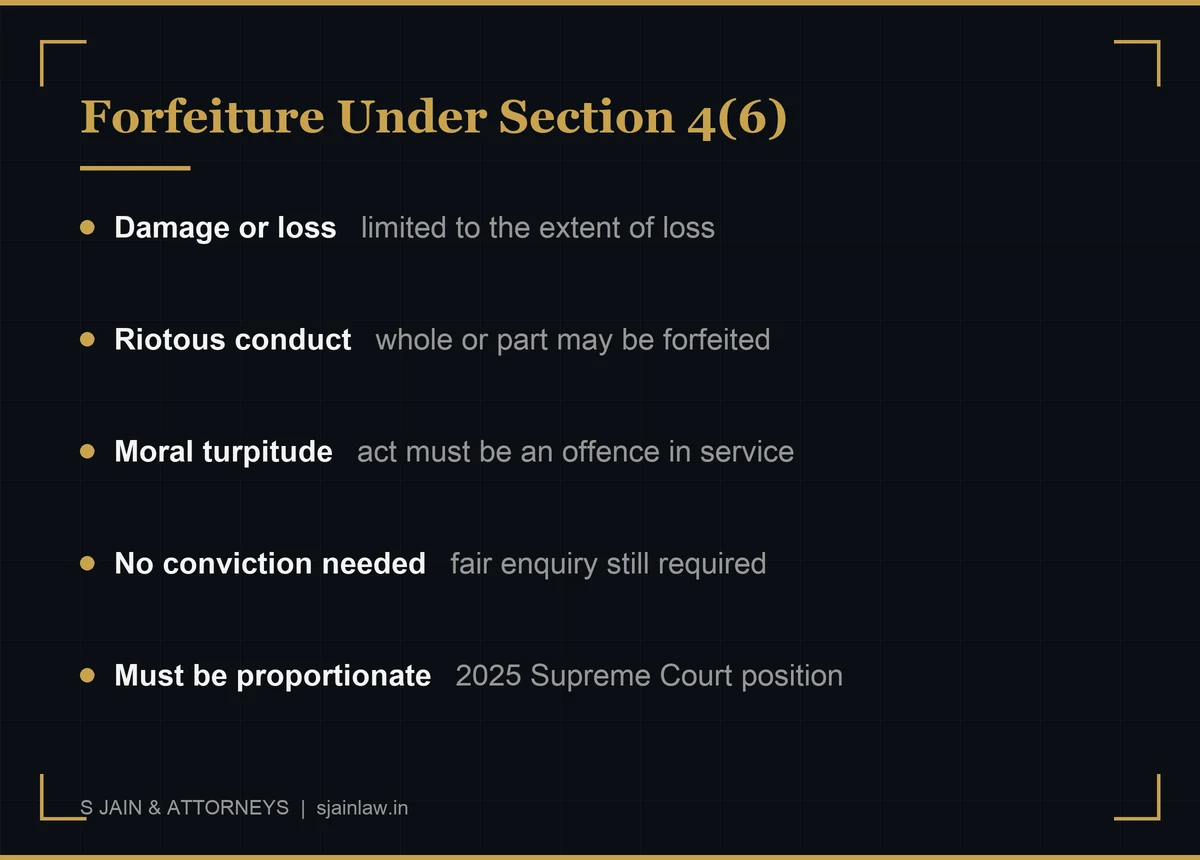
Under Section 53(6)(a), gratuity may be forfeited to the extent of the damage or loss caused, where the employee's services have been terminated for any act, wilful omission or negligence causing damage, loss or destruction of the employer's property. The forfeiture is limited to the extent of that damage. It is not a licence to withhold the whole amount.
Under Section 53(6)(b), gratuity may be wholly or partially forfeited where the employee's services are terminated for riotous or disorderly conduct or any other act of violence, or for any act which constitutes an offence involving moral turpitude, provided that such offence is committed by him in the course of his employment.
For years the operative question was whether that second limb required a criminal conviction. In Union Bank of India v C.G. Ajay Babu (2018) the Supreme Court's approach was read by many as requiring the offence to be established in a criminal court. Employers who forfeited gratuity on the strength of a departmental enquiry alone frequently lost.
That position was revisited in Western Coal Fields Ltd v Manohar Govinda Fulzele, reported at 2025 SCC OnLine SC 345, decided by a Bench of Justices Sudhanshu Dhulia and K. Vinod Chandran. The Court was dealing with two sets of facts: an employee of Western Coal Fields who had secured his employment using a fraudulent birth certificate, and conductors of the Maharashtra State Road Transport Corporation who had misappropriated passenger fares. In both, the forfeiture had been struck down below for want of a criminal conviction.
The Supreme Court held that Section 4(6) does not require a criminal conviction. The statute speaks of an act which constitutes an offence involving moral turpitude, and an offence, in the sense used by the General Clauses Act, 1897, is an act or omission made punishable by law. What matters is the character of the act, not whether a criminal court has pronounced on it. A misconduct established in a properly conducted departmental enquiry can therefore support forfeiture. Because Section 53(6) of the Code carries the same words across without alteration, that reasoning applies to the Code provision as it did to the repealed one.
Two guardrails came with that holding. First, the enquiry must be fair and the employee must have had a real opportunity to defend himself, the same standard that governs any termination for misconduct. Second, forfeiture must be proportionate. On the facts, the Court allowed full forfeiture where the employment itself had been obtained by fraud, but limited the forfeiture in the transport corporation matter to 25 per cent, directing release of the balance.
Common mistake: employers read this ruling as permission to withhold gratuity whenever there is an allegation. It is not. Forfeiture still requires termination on that ground, a fair enquiry, an act that genuinely involves moral turpitude, and proportionality between the misconduct and the amount withheld.
The old section numbers and the new ones
Most gratuity paperwork in circulation, including employer letters and older orders, still cites the 1972 Act. This is the map.
| Old (Payment of Gratuity Act, 1972) | New (Code on Social Security, 2020) | What it says, and why it matters to you |
|---|---|---|
| S.1(3) | S.1(4) with the First Schedule | Applies to establishments with 10 or more employees. Once it applies, it keeps applying even if headcount falls |
| S.2(e) | Definition clause of the Code | Definition of employee. No salary ceiling for gratuity. Seniority is irrelevant to entitlement |
| S.2A | S.54 | Continuous service, 240 days rule. Protected absences do not break your service |
| S.4(1) | S.53(1) | Eligibility on superannuation, retirement, resignation, death, disablement, and now expiry of fixed term employment. The 5 year rule is waived for the last three |
| S.4(2) | S.53(2) | 15 days wages per completed year, divisor 26. The most commonly miscalculated provision |
| S.4(3) | S.53(3) | The ceiling, now set by Central Government notification rather than named in the statute |
| S.4(6) | S.53(6) | Forfeiture grounds. The only lawful basis for withholding |
| S.6 | S.55 | Nomination. Decides who gets paid without a fight |
| S.7 | S.56 | Determination and payment, 30 days to pay, interest on delay, and the dispute application. Your recovery route when payment is refused |
| Controlling Authority | S.58, "competent authority" | Same officer, new label. Appointed by the appropriate Government by notification |
| S.8 (arrears of land revenue) | S.129 | Recovery by a Recovery Officer on a certificate, by attachment and sale, arrest, or appointment of a receiver. Gives the order real teeth |
| S.13 | S.151 | Protection against attachment. Gratuity cannot be attached under a decree for the employee's own debts |
Getting paid: the process when the employer refuses
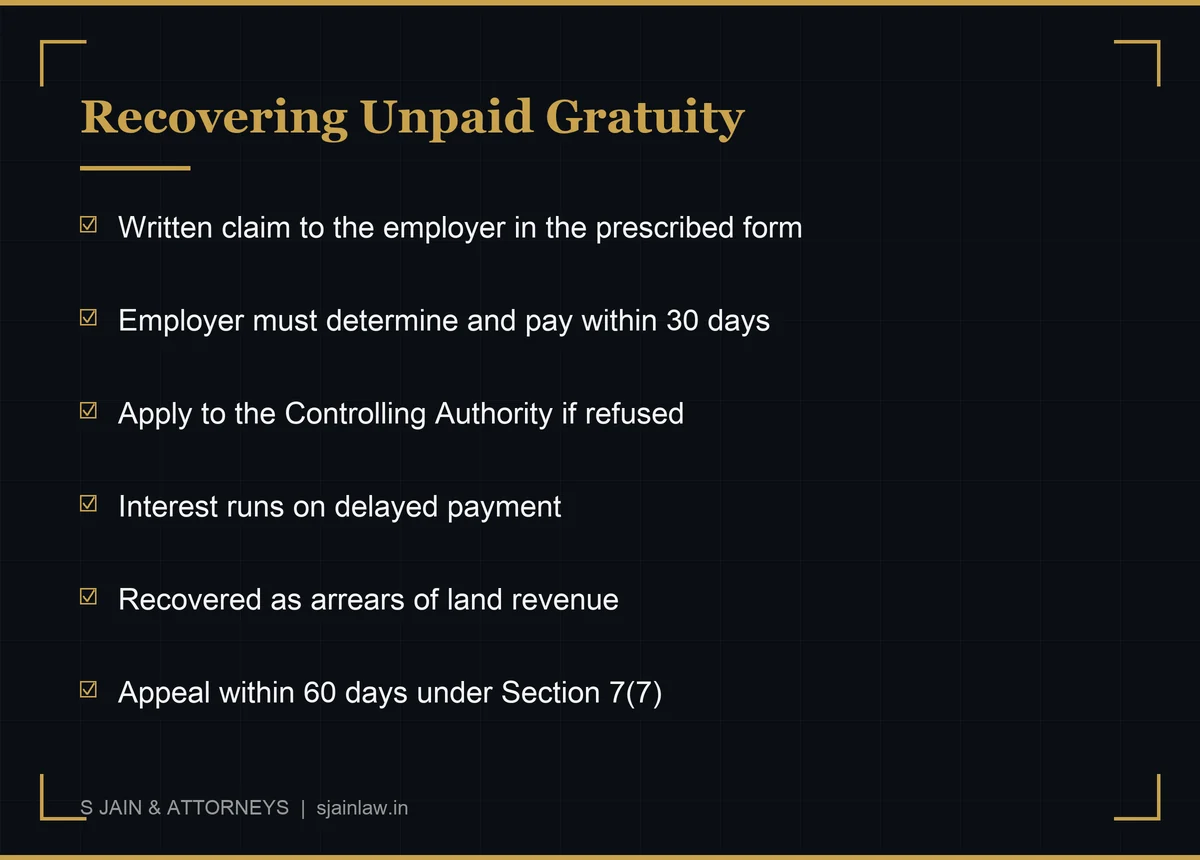
The statute does not leave payment to the employer's goodwill. Under Section 56 of the Code, the old Section 7, the employer must determine the amount of gratuity as soon as it becomes payable and give notice to the person entitled and to the competent authority, whether or not an application has been made. Gratuity must be paid within thirty days from the date it becomes payable. If it is not, the employer is liable to pay simple interest from the due date until payment, at a rate not exceeding the rate the Central Government notifies for repayment of long term deposits.
- Send a written claim. Apply to the employer in the form prescribed by the appropriate Government, ordinarily within thirty days of gratuity becoming payable. Keep proof of dispatch and delivery. Do not abandon a genuine claim merely because a date was missed.
- Wait for the determination. The employer must compute the amount and notify you. Silence is itself a refusal you can act on.
- Apply to the competent authority. Where the employer refuses, disputes the amount, or simply does not pay, apply to the competent authority appointed for the area under Section 58. This is the officer the old Act called the Controlling Authority, in practice the Assistant Labour Commissioner. Where there is a dispute, the employer is required to deposit with the authority the amount it admits to be payable. It is an accessible forum and you are not required to be represented by a lawyer, though it helps once the employer raises a forfeiture defence.
- Contest the forfeiture, if raised. Ask for the enquiry record, applying the same fair procedure principles that govern a workplace enquiry. Forfeiture must rest on termination for a Section 53(6) ground, established in a fair enquiry, and must be proportionate. Each of those is a separate point of attack.
- Obtain the direction and enforce it. The competent authority determines the amount payable, holds an inquiry with the powers of a civil court, and directs the employer to pay. Where the amount stays unpaid it is recovered under Section 129: the authority issues a certificate to a Recovery Officer, who may recover by attachment and sale of the employer's property, by arrest and detention, or by appointing a receiver. That is why these orders are worth pursuing, and the mechanics resemble the execution of any money decree.
- Appeal if required. Section 56(8) allows an appeal to the appropriate Government or the authority it specifies within sixty days of receipt of the order. An employer appealing is ordinarily required to deposit the amount.
Contract staff, fixed term employees and who is actually liable
Gratuity questions get difficult when the worker sits between two entities. A few working principles help.
Contract labour. Where a worker is engaged through a contractor, the contractor is ordinarily the employer for gratuity purposes. Where the contract is a sham and the principal employer in truth controls the work, the principal employer can be fixed with liability. Courts look at who controls, who pays, who disciplines and who can terminate, which is why the wording of the underlying service agreement matters so much.
Fixed term employees. This is the Code's most useful change for employees. Section 53(1)(d) makes gratuity payable on termination of the contract period under fixed term employment, the second proviso removes the five year requirement for that case, and the third proviso to Section 53(2) requires the employer to pay on a pro rata basis. A fixed term employee whose term ends after two or three years is therefore entitled, where under the 1972 Act the same person would ordinarily have got nothing. Repeated short term contracts with the same employer still often add up to continuous service as well, and employers who churn contracts to defeat entitlement are frequently unsuccessful when the pattern is shown.
Apprentices. An apprentice engaged under the Apprentices Act, 1961 is excluded from the definition of employee. A trainee who is in substance doing an employee's work under an employment contract is not, however, converted into an apprentice merely by the label on the letter.
Transfer of undertaking. Where a business is transferred and service is treated as continuous, the past service ordinarily carries over. The documentation at the point of transfer decides most of these disputes, so employees should retain the transfer letter.
Nomination: the paperwork that decides who gets paid
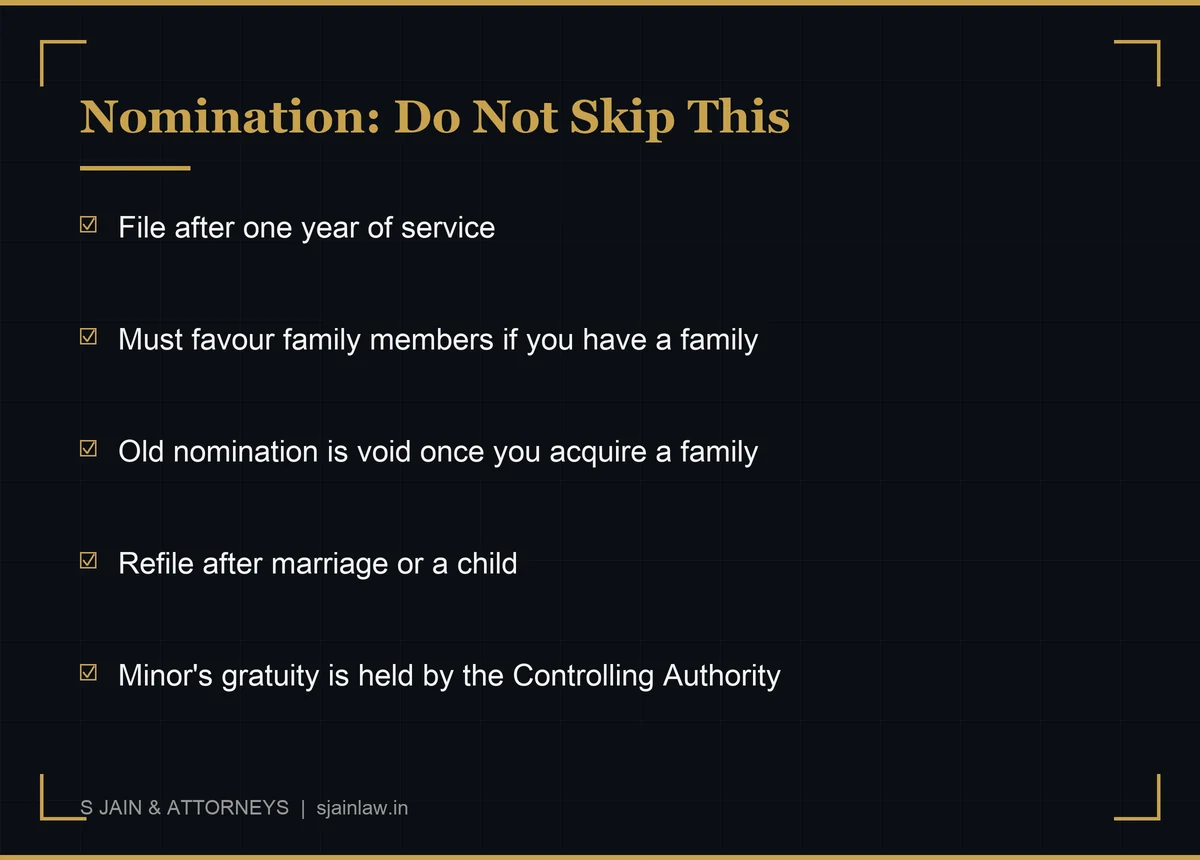
Nomination is the most neglected step in the whole scheme, and it only matters at the worst possible moment. Under Section 55 of the Code, an employee who has completed one year of service is required to file a nomination with the employer in the form prescribed by the appropriate Government, and may distribute the amount among more than one nominee. Where the employee has a family, the nomination must be in favour of one or more members of the family, and a nomination made in favour of an outsider while a family exists is void. Where an employee acquires a family after making a nomination, the earlier nomination becomes void and a fresh one must be filed.
The practical consequence is stark. Where a valid nomination exists, the employer pays the nominee and the matter ends. Where it does not, the gratuity is payable to the legal heirs, and the employer, faced with competing claimants, will usually decline to pay anyone until a succession certificate or an order of the competent authority resolves it. That process can take longer than the family can comfortably wait. If gratuity is payable to a minor, Section 53(1) requires the share to be deposited with the competent authority notified by the appropriate Government, to be invested for the minor's benefit until majority.
Deadline warning: file the nomination, and refile it after marriage or the birth of a child. It takes one form and it is the difference between a payment made in weeks and a claim litigated for a year.
The Code on Social Security, 2020, and what actually changed
An earlier version of this guide said the gratuity chapter of the Code should not be assumed to have displaced the 1972 Act. That is no longer right. The four labour codes were brought into force on 21 November 2025, the central rules followed on 30 December 2025, and the Payment of Gratuity Act, 1972 is repealed by Section 164 of the Code. Gratuity is now governed by Chapter V.
For most employees the entitlement is the same money on the same arithmetic. What genuinely changed is worth listing in one place:
- Fixed term employees now get gratuity on a pro rata basis on expiry of the term, without five years of service. This is the biggest practical gain.
- The ceiling moved out of the statute and into a Central Government notification under Section 53(3).
- The definition of wages is now common to all four codes and includes the rule that excluded allowances above one-half of total remuneration are added back, which can raise the base figure for an allowance heavy salary.
- The fifteen days in the formula can now be varied by Central Government notification, though the formula and the divisor of 26 are otherwise preserved.
- The Controlling Authority is now the competent authority, and recovery runs through a Recovery Officer rather than the Collector recovering arrears of land revenue.
What has not changed is the five year rule, the death and disablement waiver, the 240 day test, the divisor of 26, and the forfeiture grounds. Section 164(2) of the Code also saves things done under the repealed enactments, so a claim, nomination or order made under the 1972 Act does not evaporate because the Act did. If your termination predates 21 November 2025, take advice on which set of provisions governs your particular step rather than assuming either.
Five mistakes that cost employees their gratuity
- Accepting the employer's arithmetic. The single most common error is the divisor. If your employer divided monthly wages by 30 instead of 26, your gratuity is roughly 13 per cent short. Recompute before you sign a full and final settlement.
- Signing a full and final settlement without reserving the claim. A settlement that records receipt of all dues can be used against you. If the gratuity figure is disputed, record the dispute in writing at the time, not later.
- Assuming resignation forfeits gratuity. It does not. Section 53(1) expressly covers resignation, exactly as Section 4(1) did. Employers who suggest otherwise are simply wrong.
- Not claiming on death, disablement or expiry of a fixed term. The five year rule is waived in all three cases. Families routinely fail to claim because the employee was two or three years into the job, and fixed term staff routinely do not know the entitlement now exists at all.
- Letting an allegation substitute for a forfeiture. An employer cannot withhold gratuity because an enquiry is pending or because it suspects misconduct. Forfeiture requires termination on a Section 53(6) ground, and the amount withheld must be proportionate.
Documents to keep, and to collect before you exit
- Appointment letter and every subsequent revision or promotion letter, since these establish the start date and the wage structure
- Salary slips for the last twelve months, and specifically the final month, to prove last drawn basic and dearness allowance
- Resignation letter with acknowledgement, or the termination or retirement letter
- Relieving letter and experience certificate showing the date of joining and the last working day
- The nomination form filed with the employer, and a copy for the family
- Any transfer letter where service moved between group entities
- The full and final settlement statement, with the gratuity computation shown separately
- If forfeiture is alleged: the charge sheet, the enquiry report and the termination order
A note from practice
Gratuity claims are, in my experience, the most winnable and least pursued of all employment claims. The reason is psychological rather than legal. An employee who has resigned wants the relieving letter, wants the reference, and wants to move on. The employer knows this, and a surprising number of gratuity refusals are not legal positions at all but simple bets that the employee will not bother. When the claim does get filed, the employer's defence very often collapses at the first document request, because there was no enquiry, or the termination was on a different ground entirely, or the computation used the wrong divisor and nobody expected it to be checked. I tell clients two things. First, work out your own figure before you accept theirs, because the arithmetic takes ten minutes and the difference is frequently a month's salary or more. Second, do not let the fear of a bad reference decide this for you. The competent authority is not a hostile forum, the amount is a statutory debt rather than a favour, and the employer who withheld it knows that better than you do. The claims that fail are usually the ones brought years later on the strength of memory, without salary slips or a relieving letter. Keep the paper, and the claim keeps itself. Our employment and labour practice page sets out the wider set of workplace claims this sits alongside.
Glossary
- Continuous service: uninterrupted service, including protected absences such as authorised leave, layoff and maternity leave, as defined by Section 54 of the Code on Social Security, 2020 (formerly Section 2A of the 1972 Act).
- Competent authority: the officer appointed by the appropriate Government under Section 58 to decide gratuity disputes. Called the Controlling Authority under the repealed Act, and the same office in practice.
- Dearness allowance: a cost of living component of pay that forms part of "wages" for gratuity computation.
- Forfeiture: the statutory reduction or refusal of gratuity under Section 53(6) (formerly Section 4(6)), available only in defined circumstances.
- Moral turpitude: conduct that is inherently base or dishonest, judged by its character rather than by whether a criminal court has convicted.
- Nominee: the person named by the employee to receive gratuity on death, filed with the employer during service.
- Superannuation: attainment of the age fixed in the contract or rules for retirement.
- Wages: basic pay, dearness allowance and retaining allowance, excluding bonus, commission, HRA and overtime, subject to the Code's rule that excluded allowances above one-half of total remuneration are added back into wages.
Related guides and where to get help
- Compassionate Appointment: Eligibility & Disputes
- GST Arrest Rules: Your Rights When Tax Officers Detain You
- Share Valuation in NCLT Buy-Out Orders: How Fair Value Is Fixed When a Minority Shareholder Exits
- The Employer Owes You Money and Will Not Pay: Section 59
- Notice of Change: The Twenty One Days Before Your Terms Can Be Altered
Frequently Asked Questions
Is the Payment of Gratuity Act, 1972 still in force?
No. It was repealed by Section 164 of the Code on Social Security, 2020 when the four labour codes came into force on 21 November 2025. Gratuity is now governed by Chapter V of the Code, and the scheme is substantially the same.
Is gratuity payable if I resign rather than retire?
Yes. Section 53(1) covers termination on superannuation, retirement or resignation, as well as death, disablement and expiry of a fixed term. Resignation after five years of continuous service carries full entitlement.
I am on a fixed term contract. Do I get gratuity?
Yes, and this is new. Section 53 makes gratuity payable on termination of the contract period under fixed term employment, on a pro rata basis, without the five year requirement. Under the repealed Act the same employee would ordinarily have received nothing.
Do I get gratuity if I worked only four years and eight months?
Four years and 240 days in the fifth year has been held by the Madras High Court to qualify, and that reasoning is frequently relied on. It was decided on Section 2A, which Section 54 of the Code reproduces, so the argument survives. It is not uniformly applied across the country and is not a Supreme Court holding, so treat it as a claim worth pressing rather than a certainty.
My employer divided my salary by 30. Is that correct?
No, not for a monthly rated employee. Explanation 3 to Section 53 requires the monthly wages to be divided by 26. Using 30 understates your gratuity.
Does gratuity include HRA and my performance bonus?
Ordinarily no. Wages means basic pay, dearness allowance and retaining allowance, and house rent allowance, bonus, commission and overtime are excluded. But check the proportions: under the codes, where the excluded allowances exceed one-half of total remuneration, the excess is added back into wages.
What is the gratuity ceiling now?
The Code does not name a figure. Section 53(3) provides that gratuity shall not exceed such amount as the Central Government notifies, so the limit is whatever notification is in force. The Rs 20 lakh figure people remember came from the repealed Act, and the separate income tax exemption under Section 10(10) is a different limit again.
Can my employer withhold gratuity because an enquiry is pending?
Withholding requires termination on a ground listed in Section 53(6). A pending enquiry, or a suspicion, is not by itself a lawful basis to refuse payment.
Can gratuity be forfeited without a criminal conviction?
Yes. In Western Coal Fields Ltd v Manohar Govinda Fulzele (2025), the Supreme Court held that Section 4(6) does not require a conviction, and that misconduct amounting to an offence involving moral turpitude, established in a fair departmental enquiry, can support forfeiture. Section 53(6) of the Code carries the same words, so the reasoning applies. The forfeiture must still be proportionate.
Can the entire gratuity be forfeited?
Only where the statute and proportionality permit. In the 2025 ruling, full forfeiture was upheld where employment itself had been obtained by fraud, while in a fare misappropriation matter the forfeiture was confined to 25 per cent.
What if my employer simply does not respond?
Apply to the competent authority under Section 58. The employer's duty to determine and pay under Section 56 does not depend on your application, and interest runs on delayed payment.
Is there a time limit to claim?
An application is ordinarily to be made within the time prescribed by the appropriate Government, which has been thirty days from gratuity becoming payable. Do not treat a missed date as the end of the matter, and take advice rather than abandoning the claim.
Is gratuity taxable?
For covered private sector employees the exemption under Section 10(10) of the Income-tax Act, 1961 is Rs 20 lakh, raised by notification in 2018. That limit sits in the tax statute and was not affected by the repeal of the 1972 Act. It is a lifetime cumulative limit across employers, and any excess is taxable as salary.
Can a creditor attach my gratuity?
Section 151 of the Code, the successor to Section 13, protects amounts credited in favour of an employee under the gratuity chapter from attachment under any decree or order of any court for the employee's own debts.
If my company was sold, do I lose my earlier service?
Not ordinarily. Where service is treated as continuous on a transfer of undertaking, past service carries over. The transfer documentation usually decides the point, so retain it.
This guide is general legal information for public awareness and is not legal advice. Gratuity disputes turn on the wage structure, the reason for termination and the documents on record. Please consult a qualified advocate about your specific matter.